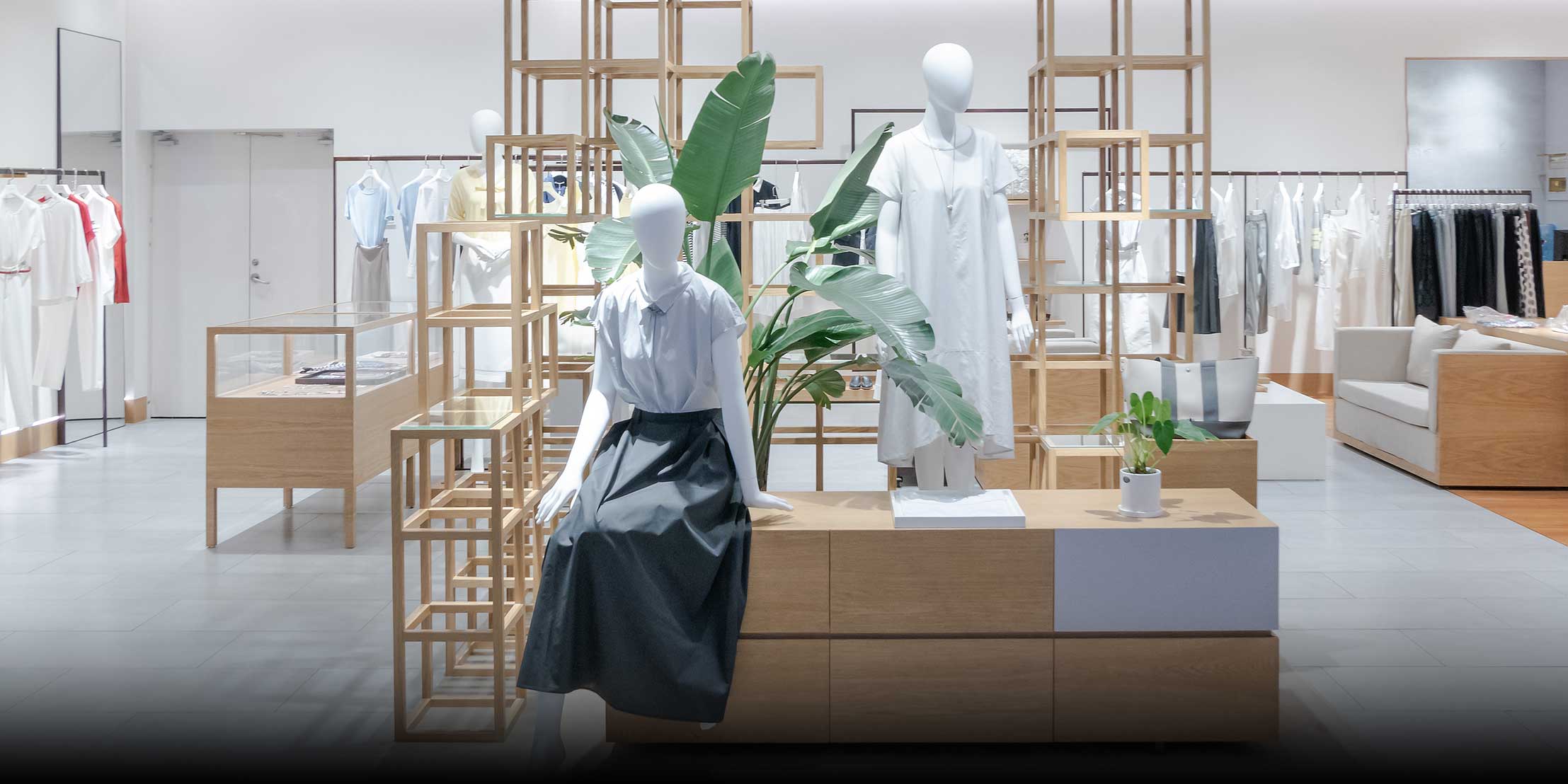
Rack and Ruin: How China’s Trillion-Yuan Womenswear Market Lost Its Color
Editor’s note: According to Syntu Data, e-commerce platforms made a combined 1.6 trillion yuan ($239 billion) in sales last year during “Double Eleven,” China’s annual online shopping event in November. Clothing accounted for 14%, driven largely by womenswear.
Zhou Keke used to get excited when she ordered clothes online. Not anymore. Now she returns about 70% of what she buys, either because of poor quality or because the dimensions don’t match what was listed.
Browsing the Chinese e-commerce platform Taobao recently, she stumbled across a store clearing out unsold stock from a decade ago. She says it was like stepping into another world. Compared with the “simple and vanilla” skirts, scarves, and tops on sale today, she found designs that were bold, irregular, thoughtful, even avant-garde and ingenious.
“So this is what fashion looked like when the economy was booming?” thought Zhou, who lives in China’s eastern Zhejiang province. She bought seven pieces for less than 1,000 yuan ($150) and posted a review on the lifestyle platform Xiaohongshu, or RedNote, receiving nearly 10,000 likes and 1,000 comments.
The womenswear market in the Chinese mainland exceeded 1.23 trillion yuan in 2025, up from 619.7 billion yuan in 2011, according to iiMedia Research. Still, social media is today awash with complaints from female consumers over the blandness of modern clothing. As one netizen put it, “Beauty used to come in 100 forms; now even ugliness is mass-produced.”
However, industry insiders argue that this isn’t a one-sided problem but rather a feedback loop. They say that, as China’s economy slows, most online shoppers are tightening their belts and are less willing to spend on distinctive or niche designs, so brands have no option but to follow what’s selling.
Meanwhile, in the physical space, more consumers can only choose between fast-fashion outlets and luxury brands, as mid-range and boutique stores continue to disappear from malls nationwide.
How’s it looking?
Li Li, a 19-year-old university student from Qingdao, in the eastern Shandong province, recently found a matching top and miniskirt — vivid red with huge black embroidered flower buds — at a vintage clothes market.
“You could tell at a glance it was meant to stand out. A lot of womenswear now comes in muted Morandi colors, or other pale shades,” she says, adding that clothes in the 2000s were “much brighter.”
Li notes that when a piece sells well on Xiaohongshu and Douyin, the Chinese version of TikTok, there’s immediately a rush of near-identical versions.
Zhou says clothes today feel cut-and-paste, with only the logos changing. “If everyone’s designing like that, honestly, what am I supposed to choose? All I can do is compare the price and the fabric. It’s so boring,” she adds.
Gu Hawen, a fashion designer at Unreal World, a clothing company based in the eastern Jiangsu province, recalls that when she entered the industry in 2019, designs in the domestic womenswear market were flourishing. She began noticing a slide in 2023.
“Whether you look at high-end luxury, affordable luxury, or ordinary brands, it’s the same story now,” she says. “Everything is more alike. Some clothing has been stripped back so far that there isn’t a single decorative detail.”
She explains that an unspoken chain of imitation runs through the Chinese womenswear industry: mass-market and fast-fashion brands follow designer and luxury brands in terms of color, silhouette, and other details, and online shops follow mass-market brands.
“The public is more receptive to designs from big-name brands. If companies want to sell, we have to keep up with international tastes and aesthetics,” says Gu, although she stresses that “we only take inspiration; we don’t copy outright. Online sellers copy brands wholesale. It’s a vicious cycle.”
Chen Chen launched her own online clothing brand this year, selling products that stick closely to the design concepts of major labels. The first item she listed, inspired by the British fashion house Vivienne Westwood, sold more than 100 pieces — no easy feat. Within six months, several items promoted on her page had become modest hits on Xiaohongshu, approaching 1,000 sales.
Chen feels modern Chinese consumers tend to follow the crowd, and tastes are becoming increasingly uniform as e-commerce platforms grow.
“Instead of discovering things for yourself, you end up in an algorithm bubble,” she says. “Maybe the first time you see an item of clothing, you don’t even like the style. But the platform keeps pushing it, and then it’s all you see. Eventually, everyone gets conditioned into the same very narrow idea of what looks good.”
She argues that not all consumers recognize or value original design. “You can be selling in exactly the same category, but someone else slaps ‘same style as Chanel’ on their listing and wipes the floor with you.”
In Chen’s view, online womenswear brands that invest in developing unique designs are being squeezed out. Spending six months refining a collection no longer works, as everyone is chasing the next viral hit, and keeping up is the only way to make money.
“Trends change way too fast now,” she adds. “A brand might plan its collection for months, but by the time it hits the rails, everything looks dated. Then a new bestseller suddenly appears, and they have no choice but to follow. … Copying a bestseller means lower costs, less risk, and higher profit margins.”
Imitation game
Zhou feels China’s womenswear market is not only becoming more conservative and homogeneous but also that brands are cutting corners on materials compared with a decade ago, creating a false economy. “Brands are becoming less responsible, so more shoppers are sending items back more often. But returns cost the sellers money. It’s a vicious cycle.”
Industry insiders argue the root of the issue lies in an underlying shift in consumer psychology, as younger consumers place greater emphasis on value for money.
“It’s become harder for people to earn money these past few years,” says Chen. “They’re expecting more from every penny.”
With consumers more price-sensitive, brands have grown cautious about what they charge, applying pressure further down the supply chain.
“Sewing workers are putting in more effort, but their pay hasn’t gone up, so the quality keeps getting worse,” Chen explains. “The pressure on workers at the bottom of the industry is intense. They have to get orders out by a fixed deadline. Companies keep squeezing them and demanding more pieces per day.”
Gu also sees the domestic market’s homogenization as a symptom of the broader economic chill. “Staying alive matters far more than being original,” she says. “After all, beyond the designer, there’s a sales team, logistics, and 50 or 60 other mouths to feed. No business owner is going to bankrupt themselves simply to underwrite a designer’s personal aesthetic.”
For clothing companies, a design’s main job is to keep the business alive, so giving the market what’s familiar is the safest survival strategy, Gu explains.
“Designers have the least say in whether a garment gets made,” with the final decision usually in the hands of marketing and store managers, she adds. This group’s preference is for more “universal garments” that match a wide range of body shapes and personal tastes. “Designed pieces are selective — they can depend on a person’s height, figure, looks, their whole bearing.”
Even when an inventive design survives internal vetting, an unusual cut or trim can increase the retail price, potentially sending consumers elsewhere. Gu recently incorporated neo-Chinese style elements including knot buttons, mandarin collars, and wide cuffs into her garments, but they sold poorly. The feedback was that shoppers deemed the items too expensive.
Copycats are also astonishingly fast. Gu says imitations of her designs have appeared for sale online within as little as 24 hours, at a fraction of the price. “It gets to the point where it feels original designs are a bit of a joke,” she says with a resigned sigh.
Market gap
According to the domestic retail industry tracker Linkshop, at least 40 well-known Chinese online womenswear stores announced they were closing or halting new product releases in 2024, while e-commerce news outlet Ebrun reports that more than a dozen more shuttered in the first half of this year.
Meanwhile, many mid-range sellers have withdrawn from city malls across China, widening the gap between high-end and cut-price clothing stores.
“Expensive clothes are just getting more expensive. In malls, items can cost 5,000 or 6,000 yuan, or even more than 10,000. At the other end, there are fast-fashion brands like Uniqlo and Zara,” says Chen. “Some of the really good mid-range brands, ones pricing items at 1,000 or 2,000 yuan, seem to have gone from the malls. Even where you find them, their designs and quality are far less appealing than they used to be.”
Like Zhou, many shoppers are now turning to secondhand and vintage clothing stores. Others are even learning to sew and making their own clothes, to ensure they get the design, fabric, and cut they want.
“I miss a time when imagination could go anywhere, when people dared to design and weren’t in such a hurry to see results,” laments Li.
Some designers have tried to resist uniformity, like Gu, who makes small adjustments while sticking to her company’s established style. Last year, she took one of its hit jackets and added seams at the collar or cuffs, and extra trim, to achieve something “slightly different.”
She hopes the market turmoil will ease within the next couple of years. “When people are doing a little better financially, and companies have some breathing room — when one bad season no longer means bankrupting the business — things should get much better.”
(For privacy reasons, Zhou Keke, Li Li, and Gu Hawen are pseudonyms.)
Reported by Yang Xiaotong.
A version of this article originally appeared in Oh Youth! (36Kr). It has been translated and edited for brevity and clarity, and is republished here with permission.
Translator: Chen Yue; editors: Wang Juyi and Hao Qibao.
(Header image: 500px Essential/VCG)