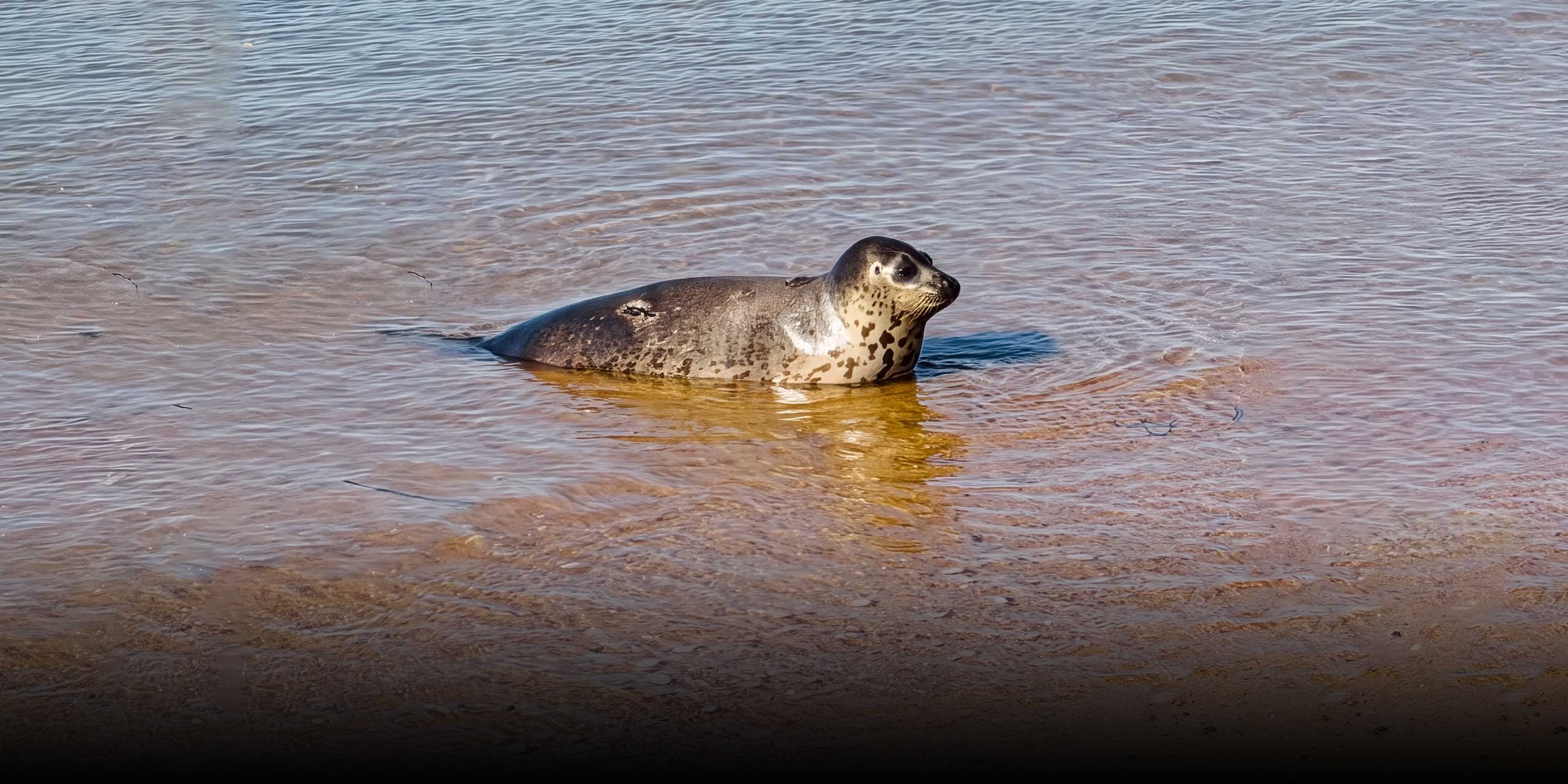
Rehab, Release, Repeat: Nana, the Seal Who Refuses to Return to the Wild
In wildlife conservation, there are three steps to helping an injured or orphaned animal: rescue, rehabilitate, and release. “Returning” isn’t part of the plan, but try telling that to China’s celebrity seal Nana.
This 2-year-old wild spotted seal, a Class I protected species in China, was a must-see attraction this summer for visitors to Dachangshan Island, part of Dalian’s Changshan Archipelago in the northeastern Liaoning province.
Nana has been released twice far out into the Yellow Sea, with the hope he’d join a migrating colony. Both times he’s made his way back alone, once covering more than 200 kilometers in just six days.
When he first showed up on the island in June, he was wary of humans and swam away when approached. But over time, he grew braver. Tourists tempted him near with tasty fish, though this sometimes resulted in him receiving a prod or a kick, and often a startling camera flash.
Concerned for Nana’s welfare, the local government put up warning signs telling people not to feed him and to keep a safe distance, and vowed “not to use him to promote tourism.” Yet within months, a “Nana Line” shuttle service had opened, running directly from the island’s Yuanyang Port to its “best seal-watching spot,” while the local tourism bureau began working with a private business to make and sell seal-related merchandise.
For many locals, Nana’s presence has been bittersweet: he’s a cute addition to the neighborhood, but the risks to his safety outweigh the benefits, they say.
Despite the falling temperature, authorities have ruled out moving him again, much to the delight of those who feel the seal has “made his choice.” But as the tourist season ends and his steady, fan-fueled food supply dries up, others worry that Nana could face a harsh winter alone.
Hello, new neighbor
Nana was just a pup in the summer of 2024, when fishermen first spotted him resting on a buoy in waters off Beihai, in the southern Guangxi Zhuang Autonomous Region. Noticing he was thin and had wounds on his body, likely caused by boat propellers, they alerted the authorities, who transported him to the Beihai Aquatic Rescue and Rehabilitation Center.
The spot where Nana was discovered lies just off a migration route for spotted seals between the western Pacific Ocean and Dalian’s Liaodong Bay. Experts suspect he drifted from his colony and was stranded alone.
In November 2025, after being nursed back to health, Nana was transferred to a wild species rehabilitation center in Dalian operated by the Liaoning Ocean and Fisheries Science and Research Institute. There, he quickly went from 50 to 70 kilograms and grew a new coat of glossy fur. “You could see him looking better every day,” says Chai Yuqiao, a researcher at the base.
By this spring, Nana was deemed well enough to return to the wild. On April 16, the institute released him and two other rescued seals roughly 10 kilometers from shore in the Yellow Sea, thinking they would naturally head for the migration route and find a new colony.
Nana’s two companions did exactly that, but data from his satellite tag shows he never left the Yellow Sea. Two months later, he popped up at Dachangshan Island.
Locals first spotted the seal relaxing in a rocky tide pool on June 19.
“Back then he was wary and rarely came close,” recalls Feng Zhi, who runs a guesthouse on the island. “He’d just hang around, and if someone walked over, he’d swim away.”
But that changed the more he interacted with tourists. “Wherever the crowd was thickest, that’s where he’d be,” says Li Ai, who also works in the hospitality industry. “But he can be picky about people,” she adds, explaining that Nana appeared especially fond of a wetsuit-wearing livestreamer known as “Man in Black,” who has 24,000 followers on Douyin, the Chinese version of TikTok. Nana often chased him and snuggled up to him.
Zhou Long, another guesthouse manager, says Nana once squeezed in between him and several friends as they stood in the shallows. The seal was warm, slippery, and plump, “like a balloon that’s about to pop,” he says.
People soon began feeding Nana fish and petting him when he got close. A local boat captain says he often tried stopping tourists from doing this, but few listened. He worried Nana might accidentally be fed a fish containing a fishhook, “the consequences of which don’t bear thinking about.”
Some people were even captured on surveillance cameras throwing Nana barbecued meat, bread, and potato chips, foods that could seriously upset his digestive system, while others kicked him, and thoughtless children threw stones at him.
“I couldn’t bear to watch and couldn’t do anything about it. I could only turn around and walk away,” says Li.
Many locals breathed a sigh of relief on Sept. 7 when the authorities finally arrived to take Nana away.
Gone, but not forgotten
To protect and “re-wild” Nana, the Changhai County government, which administers Dachangshan Island, decided to again transport the seal out to the Yellow Sea, this time to a spot about 140 kilometers away by boat.
Nana was back on the island just six days later. His tracking tag had fallen off a month earlier, but Tian Jiashen, director of marine rare animal conservation research at the Liaoning institute, estimates the seal’s return journey must have covered at least 200 kilometers.
Zhou had an inkling he’d not seen the last of Nana. Social media users had been eagerly sharing news of sightings, and the seal was getting closer all the time. On the evening of Sept. 13, Zhou went to the shore, opened a livestream, and lay in wait, with nearly 200 followers logging on to watch.
As night fell, Zhou heard a splash, like “a huge creature leaping into the water.” When he ran over, Nana was beside the blue pontoon bridge that he’d frequented all summer.
Within hours, Lin Gao, an employee at a beachside water sports center, had reinstalled the giant inflatable yellow duck Nana had liked to sleep on. “We couldn’t let him come back and find it gone,” he says, adding that work had felt “hollow” without Nana around.
Tian admits he never expected the seal to return but now believes Nana’s interactions with tourists might have reawakened his memories of being rescued and fed by humans.
Staff at the Liaoning institute recall that Nana was initially more curious than cautious. Marine researcher Chen Yanyu says he was once scrubbing the rearing pool when Nana surprisingly pushed a long-handled brush toward his hand. He badly wanted to pat the seal’s head, but that would be against the rules of “rehab and release.”
In wildlife conservation, keeping a safe distance is paramount. Rescued seals are fed by pouring live fish into the pool, while researchers deliberately approach the animals with nets to condition them to avoid people. By the time of his release, Nana had begun watching the staff from afar.
On that first release day, Chen watched Nana slide down the boat’s ramp into the sea with tears in his eyes.
However, when the seal became a celebrity, the institute came under attack from netizens who felt it had failed in its responsibilities to rehabilitate Nana.
Tian, who has worked there since 2010, believes the criticism was unfair. He explained that the institute is manned year-round by researchers who volunteer their time for free, and that in the past two decades it has helped rescue 244 spotted seals, releasing 223.
“The sea is his home, and he should go home,” he adds, talking about Nana. “Keeping him here, in a human environment — that would be cruelty.”
The risks human behaviors pose to wildlife are obvious. Ah Nong, a spotted seal rescued late last year after spending 15 months in waters off Wenchang, in the southern island province of Hainan, was found to have diarrhea, elevated liver function, and ultraviolet skin burns from being fed, touched, and photographed by tourists.
When Nana returned a second time, Chai and some colleagues wanted to go see him, “to find out whether he still remembered us.” Others, like researcher Shi Hongyue, held another wish: that one day they would come across Nana naturally during a survey of a wild colony.
Sealing his fate?
Nana became even more famous after returning to Dachangshan Island last month. By 7 a.m., at least 10 livestreamers would already be set up on shore, waiting for the seal to wake up. These channels quickly became a key marketing tool for guesthouses and other local businesses.
In August, Chinese media quoted an unnamed local official as saying that authorities “would not use (Nana) for cultural tourism promotions.” However, that attitude appeared to shift after the seal’s return in September.
The Changhai Culture and Tourism Bureau opened the “Nana Line” on Sept. 25, and beachside stalls hawking Nana-themed merch began popping up this month.
More warning signs and loudspeakers have been placed along the beach, reminding tourists that feeding protected species is forbidden, while enforcement officers and volunteers now regularly patrol the area. The local government has announced it will not attempt to move Nana again and is planning to build him a shelter on the pontoon bridge, away from the crowds.
Residents say the feeding and touching has declined, but it still happens.
This will naturally trail off as the tourist and fishing seasons wind down ahead of the coldest months, leading some to worry that Nana could starve. Despite the rules, in October, Sun Zongjun, the owner of the water sports center, pledged on a livestream that “we’ll definitely keep feeding him when it gets cold.” The county government has yet to confirm whether live fish stocks will be provided for the seal over winter.
Tian says it’s hard to predict whether Nana will ever leave and fully return to nature; it depends on diverse factors like water temperature, his physiological state, and whether he meets any companions and joins a new colony.
Scientific studies using tracking data show that spotted seals tend to rest or breed in the same place, year after year. Tian believes this behavior, and his memories of human interaction, could be what led Nana back to Dachangshan Island.
While most locals were happy to welcome Nana “home,” his presence has also brought pressure. “Our island lives off tourism. If anything happens to him, the criticism of millions of people could crash down on us in an instant,” says Lin, who regularly volunteers to patrol the pontoon bridge in the early hours.
On most nights, Nana can be found sleeping soundly on his giant yellow duck as it rocks gently in the waves. Soon, he will be joined in these waters by other spotted seals. No one knows what will come next.
“It’s fine if Nana stays,” says Liu Yi, a guesthouse owner on the island. “But I still hope he leaves.”
(Due to privacy concerns, Lin Gao, Feng Zhi, Li Ai, Zhou Long, and Liu Yi are pseudonyms.)
Reported by Qin Bing and Feng Haoni.
A version of this article originally appeared in The Beijing News. It has been translated and edited for brevity and clarity, and is republished here with permission.
Translator: PaperBuddy; editors: Wang Juyi and Hao Qibao.
(Header image: Nana comes ashore at Dachangshan Island, Liaoning, Sept. 27, 2026. From Xiaohongshu)