Cold Comfort: What Europe’s Heat Wave Means for Chinese Factories
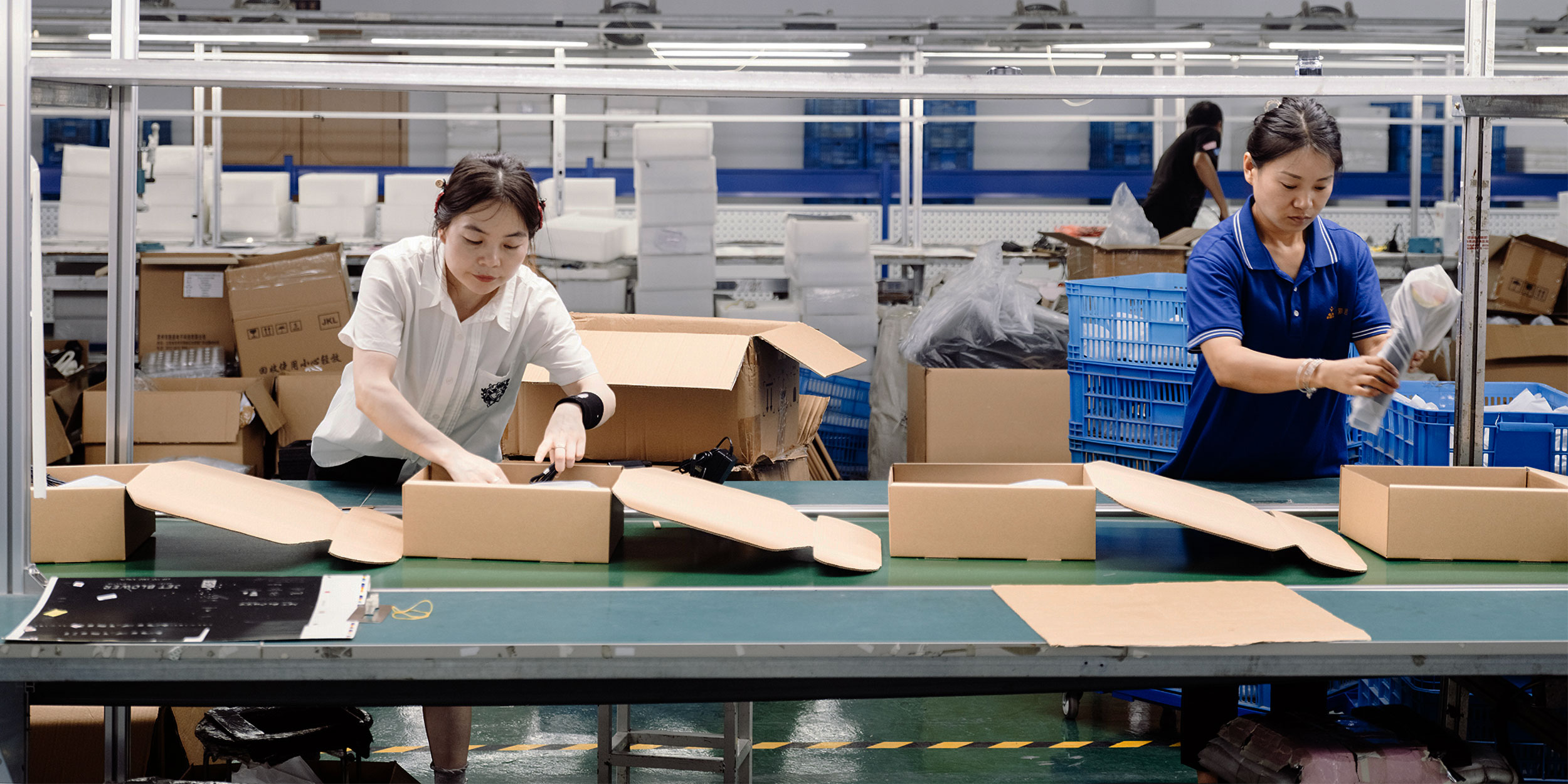
Two gray-green production lines glow beneath harsh white lights, their conveyor belts moving ceaselessly like mechanical rivers. Clanging metal, the rip of packing tape, and the dull thud of cardboard boxes mingle with the hurried footsteps of workers shuttling goods back and forth.
It’s July 10, and the Pinotec electric fan factory in Suzhou, in the eastern Jiangsu province, is running at full capacity to meet several rush orders that have come from Europe in the wake of a record-breaking heat wave.
As temperatures soared in June, exports of Chinese air conditioners to the European Union jumped nearly 73% year on year, according to China’s General Administration of Customs. Sales of fans and evaporative air coolers also surged on global e-commerce platforms.
For the managers and employees at Pinotec, which manufactures fans under the Booster brand, the extreme weather represented a lifeline. After taking a major hit from the China-U.S. trade war and the ongoing Middle East conflict, the sudden spike in orders gave the company an opportunity to expand into European markets and turn its finances around.
But as demand has risen, so have the costs of metals and electrical components, while the market competition has rapidly intensified. Add a weakening euro against the yuan — which erodes the value of European revenue when converted back home — and the factory’s profits remain razor-thin.
Despite the hot market, Pinotec and other small- and medium-sized businesses in China are facing the cold, hard reality that this summer boom could leave them weaker, not stronger.
Final countdown
Every hour, factory manager Zhu Guangshuai anxiously paces through the workshop to gauge his workers’ progress. For the past two weeks, Pinotec has been rushing to complete an order for 500 large fans from a customer in Germany — and shipment is scheduled for 8 p.m. tonight.
Zhu had been confident that just two hours would be enough time for final assembly, but the first hour is already gone and only 223 units are finished. To speed things up, he opens a second, smaller production line, initially assigning two additional workers to help with wiring and soldering, before eventually asking the floor supervisor and materials handler to also step in.
In the end, 15 workers drop what they are doing to help their colleagues reach the finish line — attaching screens, installing handle grips, snapping on base plates, tightening screws. Then, they all proceed to packaging.
Multi-skilled workers who can easily switch between roles have become essential for the factory’s survival in recent times. When the Chinese fan market contracted last year, the company merged two assembly lines and laid off any inexperienced or temporary workers, halving its workforce to just 60.
Away from the factory floor, Pinotec also shut down its 40-person domestic e-commerce operation, dispensed with its content creation team for Douyin, the Chinese version of TikTok, and dismantled its livestreaming studio.
The company initially made massage guns but switched to manufacturing electric fans in late 2023, focusing on high-powered turbo blowers before introducing a range that includes a palm-sized, handheld model. Profits rose early on, but sales dropped sharply once domestic competitors started to flood the market with cheaper alternatives.
Pinotec’s main markets are North America and Europe, where many people commonly use turbo blowers to clean debris from their cars or backyards. Domestic demand is extremely limited. When trade tensions between China and the United States escalated last year, disrupting global markets, 90% of the factory’s orders came from overseas.
Shortly after the U.S. introduced increased tariffs on Chinese exports in February 2025, an American supermarket chain canceled an order for tens of thousands of units. Then, European customers began asking to delay shipments until the economic outlook became clearer.
The company began losing more than 100,000 yuan ($14,835) a month — and that’s before the outbreak of the conflict in the Middle East in February this year. Pinotec lost contact with its customers in Iran for almost six months; finished goods piled up in its warehouse, unable to be shipped or paid for.
Things only began to pick up in late May when Europe was hit by an extreme heat wave, with temperatures soaring as high as 45 degrees Celsius in some parts of Spain.
Inquiries flooded in through Pinotec’s international e-commerce platform: A customer in the United Kingdom ordered 2,500 turbo blowers, along with several handheld models; a Belgian distributor placed five orders over two months, totaling more than 2,000 fans, most bound for France; and other units were also shipped to Switzerland and the Netherlands.
To handle the additional workload, the factory reconfigured its production line. Normally, the assembled fans would undergo two days of charge-and-discharge testing, yet Zhu arranged for assembly and testing to be carried out simultaneously, allowing packaging to begin much earlier.
At 8 p.m. on July 10, the fans bound for Germany are shipped on time.
But Zhu barely has time to catch his breath before a new crisis arises. The electric control boards needed for tomorrow’s production order still haven’t arrived after three weeks of waiting. Pinotec has no option but to absorb the pressure. “We’re already right up against the delivery deadline,” Zhu says. “There’s no room to push it back.”
He decides to adjust the production schedule and bring forward another order. The company can’t afford to leave the assembly line idle for even a day.
And the problems keep coming. Whether it’s the time crunch or reduced staffing, defective products keep appearing on the line and need replacing, while a consignment of plastic casings from an upstream supplier is discovered to have color discrepancies between the upper and lower halves.
All Zhu can do is think on his feet to find solutions.
Changing market
According to Pinotec’s founder, Shen Guangping, the combined effects of rising material costs — prices for copper, iron, zinc, tin, lithium batteries, chips, resistors, and capacitors have all increased in 2026 — and fluctuations in the euro-yuan exchange rate have slashed profits by up to 20%.
Deliveries from component suppliers have also become unpredictable. Suppliers used to stockpile some materials, he says, but now no one is willing to hold inventory; materials are procured only after a customer places an order, affecting lead time.
Sometimes, electronic components suddenly increase in price on the same day an order is placed — but once a quote has been given, the factory often has no choice but to absorb the difference.
Pinotec has taken on nearly 200,000 yuan worth of business without passing on the additional material costs, Shen says. “Our sales volume has grown by more than 50% compared with last year, but there’s almost no profit. We’re mainly producing these orders to win new customers and maintain production volume.”
To drum up new business, Shen has been attending as many overseas trade shows as possible. Last year, he attended nearly 20 across the U.S., Germany, Brazil, and Japan. This year his target is 26, at least two a month.
At recent events, he noticed more customers asking about handheld fans. Sensing an opportunity, he began taking small Booster fans to trade shows and had his technical team develop a mini fan and other new products.
However, the market competition is now fierce. Fan manufacturers in Foshan and Zhongshan, two major manufacturing bases in the southern Guangdong province, have orders through September. Domestic factories are also adapting to international requirements, releasing new product colors and developing low-power, variable-frequency models tailored to European voltage standards and electricity costs.
The EU has imposed strict compliance controls on imported cooling products, and incomplete product certification can expose companies to multiple penalties.
Production cycle
It’s been exactly a week since the Pinotec workers rushed to complete the German order, and now they are halfway through assembling a batch of small handheld fans bound for Japan, which has also experienced extreme heat this year.
Suddenly, the production line is halted. An ultrasonic welding mold that fuses the plastic casing is malfunctioning, leaving scorch marks and gaps in the seams.
Zhu assigns a worker to adjust the mold while coordinating others to assemble the remaining components. Fortunately, the problem has come toward the end of the process — any earlier and the day’s production plan would need to be canceled. Just 24 hours earlier, the factory manager was forced to send workers home early due to a battery shortage.
However, when two representatives from the Japanese client later arrive to inspect the goods, they find the mold still hasn’t been repaired, and delivery is postponed.
As an on-site inspector, Du Kai’s task is to report and handle challenges like these. Before joining Pinotec in early 2024, the 28-year-old worked in sales in Beijing and the neighboring city of Tianjin, and as a property agent in the central Henan province. Rather than relying on commission, he had hoped factory work would provide him and his wife more stability.
After proving his versatility, Du was among those who kept his job when the company swung the axe in 2025. Another group that the company was reluctant to let go was its three qualified solderers, as the role requires delicate skill.
Feng Juan is the factory’s most recent hire. Once a temporary worker employed to apply glue, she was recruited as a solderer after someone else quit. In addition to the salary, the job comes with a 1,000 yuan monthly supplement, yet Feng was hesitant at first — she’d heard that the fumes from soldering were toxic and could affect fertility.
She thought it over, and as she already had two sons and wasn’t planning on having more children, she accepted. Her husband runs a lifting equipment installation business, earning 30,000 yuan a month, but Feng says the family still feels financial pressure. In the past year, the couple has renovated a condominium in their native Henan for their eldest son, and is now planning to buy one for their youngest.
Feng’s eldest son, in his late teens, also works at a factory in Suzhou — a temporary arrangement after he began acting out in school — yet she hopes he won’t end up toiling in a high-stress manual job like her.
Packaging line supervisor Wang Chao is also working to save money for his child. A 38-year-old single father, his parents care for his son back in Henan. He no longer has lofty career aspirations, nor is he interested in job-hopping in search of a better position. His only wish is to put away 5,000 yuan a month and have social insurance coverage.
Even as orders have surged, Wang’s packaging team has dwindled to only 12 workers. He hopes to hire five more, but finding them is proving hard. His two recent hires lasted just six days before quitting because the job was “too tiring.”
Zhu and the factory workers are trying to make the most of this summer boom and, in turn, bring more stability to their lives. They hope that, by evening, their finished fans are loaded onto the trucks and shipped overseas on time. Then, the next day, they can do it all again.
(Due to privacy concerns, Du Kai is a pseudonym.)
Reported by Wei Ronghuan.
A version of this article originally appeared in White Night Workshop. It has been translated and edited for brevity and clarity, and is republished here with permission.
Translator: Carrie Davies; editors: Wang Juyi and Hao Qibao.
(Header image: Workers pack items at the factory in Suzhou, Jiangsu province, July 2026. Lü Meng/White Night Workshop )