Lu Xun’s Overlooked Translations That Shaped Modern Chinese Literature
In 1903, 22-year-old Lu Xun, then a student in Japan, wandered into a bookstore in Jimbocho, Tokyo’s famed book district, where his attention was caught by a science fiction novel titled “A Journey to the Moon in Ninety-Seven Hours and Twenty Minutes.” Translated into Japanese by Inoue Tsutomu and believed to have been written by an American author, the novel appealed to Lu Xun’s own ambition to popularize scientific knowledge in China, where modern science education was still in its infancy. Enthusiastic about the genre’s potential, he quickly set about translating it into Chinese.
His version, “Yuejie Lüxing” (“A Journey to the Moon”), published the same year and among the earliest Chinese translations of science fiction, marked the beginning of his prolific career as a translator, long before he became celebrated as the “founding father of modern Chinese literature” for his novels and essays.
Today, we know that Inoue had misidentified the original author. The novel was, in fact, Jules Verne’s “De la Terre à la Lune: trajet direct en 97 heures 20 minutes,” published in 1865 and widely translated into English in the 1870s. Misled by its setting — in post-Civil War America, where members of the Baltimore Gun Club plan to fire a projectile at the moon — Inoue assumed the author was American. Lu Xun, following this assumption, opened his translation with original passages describing America in extravagant detail to provide context for his Chinese readers.
The curious story of this translation and mistranslation of Verne’s novel illuminates how literary forms and ideas traveled across borders at the turn of the 20th century, particularly in East Asia following the First Sino-Japanese War (1894–1895), when waves of Chinese students — including Lu Xun — went to study in Japan.
It was in Tokyo, amid the intellectual riches of Jimbocho, where he spent much of his leisure time, that Lu Xun was drawn to translation. Japan’s Meiji Restoration, which restored imperial rule in 1868, had already spurred a flood of translations from European languages into Japanese. Eager to take advantage of this wealth of material, Lu Xun, by then proficient in Japanese, with a working knowledge of German and some Russian, immersed himself in these texts. On one hand, he translated texts from cultures he perceived as more scientifically and technologically advanced, with the aim of promoting science education among his own people; on the other hand, he gradually developed an interest in writers from marginalized communities and nations, believing their experiences would resonate with China, which had endured decades of foreign invasion and exploitation. Later, recounting his decision to translate the exiled Russian writer and activist Vasily Eroshenko, he made clear that he saw translation not simply as an aesthetic pursuit, but as a means of giving voice to the oppressed.
It is worth remembering that Lu Xun, then an unknown young student named Zhou Shuren, had yet to adopt his most famous pen name that would be enshrined in modern Chinese literature. In 1918, he published “A Madman’s Diary,” a pioneering work of modern Chinese fiction inspired by a short story of the same name by Russian writer Nikolai Gogol. He later wrote the celebrated novella “The True Story of Ah Q,” published in 1921, helping establish vernacular Chinese as a language of modern literature. He is remembered as a pioneer of the New Culture Movement, which championed “Mr. Democracy” and “Mr. Science” just as China transitioned from monarchy to republic.
But in 1903, a literary career was not yet his ambition. Funded by a Qing government scholarship to study in Japan, he began by taking language courses, translating scientific essays, science fiction, and literary works along the way, before enrolling in medical school in Sendai City, 370 kilometers north of Tokyo, in 1904.
He would soon abandon medicine to pursue his own literary and intellectual revolution, with translation as his chosen medium. Back in Tokyo in 1906, Lu Xun remained enrolled at a German-language school, but rather than attend classes, he devoted his time to translating, writing, and publishing. He shared a small room with his younger brother, Zhou Zuoren (1885–1967), who had joined him in Japan.
The brothers sent their translations to publishers in China. Translation was poorly paid a century ago, just as it often is today. Zhou Zuoren later recalled with resignation: “… manuscript fees were truly meager. Typically, the translation of Western-language texts only earned two yuan per 1,000 characters — and this was a net amount, with all punctuation and black spaces excluded from the calculation.”
Nevertheless, the brothers pursued their work with passion, publishing “Collection of Stories from Abroad” in . Reflecting their intellectual ambitions, the collection featured revolutionary literature from “peripheral” nations whose experiences echoed China’s own. They hoped such works could change minds and contribute to social progress. Funded by Jiang Yizhi, a banker from China’s eastern Zhejiang province, the collection sold poorly, with just 21 copies of the first volume and 20 of the second sold in six months, according to Lu Xun’s preface to a later edition.
Like translators today, those of the past could find their intellectual lives both poor and rich: financial hardship drove them to scrimp and work harder, while literature’s riches tempted them to procrastinate. We might imagine these “revolutio.nary figures” readily sacrificing leisure for national salvation, but their personal accounts tell a more relatable, even comforting, story.
After Lu Xun returned to Tokyo from Sendai, the brothers moved to the wider Kanda-Jimbocho area. After moving a few times, they rented the former residence of renowned Japanese novelist Natsume Sōseki with three friends and named their share-house Wushe, “the house of five.” As admirers of Natsume, they even shopped at the same grocery stores he had frequented and followed his recommended reading list. Personal accounts suggest that Lu Xun spent much of his stipend on books, economizing on food and other daily necessities as a result, which also helps explain why he shared a room with Zhou Zuoren.
Tightening their belts for books while working on their envisioned projects, Zhou Zuoren described a conflict with Lu Xun when they shared a room: “He kept urging me to translate, but I brushed him off. One day, he suddenly flew into a rage, raised his fist, and beat me on the head several times.” As a translator who habitually procrastinates, I can’t bear to imagine what life would be like if I shared a room with my editor.
Translation was more than just work for the Zhou brothers. They lived a “translated” way of life. Kanda-Jimbocho, where they lived, served as a “universal library” and remains Tokyo’s most celebrated book district. Much like Chinese students abroad today who frequent bookstores such as Strand Bookstore, Daunt Books, Shakespeare and Company, or Kinokuniya, the brothers visited Jimbocho’s bookshops almost daily.
The brothers devoured texts across languages and genres. They kept detailed records of their favorite bookstores, even rating the quality of their books and service. Their daily lives involved constant movement between languages as they learned new ones and absorbed political, social, and literary theories, whether in their original languages or in translation.
This broad and intensive engagement transformed their intellectual horizons, offering access to ideas from around the world. As Zhou Zuoren later recalled, Lu Xun would read and write until dawn, sleep until late morning, get up to smoke, and then repeat the cycle.
Later, figures such as Zhou Enlai, the first premier of the People’s Republic of China; Guo Moruo, a writer, poet, and communist leader; Tian Han, the playwright who wrote the lyrics to China’s national anthem; and Feng Zikai, a pioneer of modern Chinese comics, would undergo similar intellectual journeys shaped by translation while studying in Tokyo. They, too, explored different paths toward China’s modernization through their engagement with translated texts, ideas, and ways of life.
In a 1931 letter to fellow writer and revolutionary Qu Qiubai, Lu Xun argued that “translations not only introduce new things but also new ways of expression.” By incorporating unfamiliar syntax into modern Chinese through translation, whether “ancient, dialectal or foreign,” he believed “we can later make it our own.”
His goal was to shape modern Chinese into a truly global language through translation, one flexible enough to absorb diverse forms of expression and capable of conveying ideas from around the world. Arguably, in his imagination, modern Chinese was a language born of translation, one that proudly celebrates its linguistic inheritances. Tian Han and Feng Zikai shared similar convictions, believing that drama and comics — beyond translation in the narrow linguistic sense — embodied cosmopolitan ideals and egalitarian possibilities more vividly than other forms.
To fully appreciate Lu Xun’s significance in modern Chinese literature and language, we cannot examine his fiction alone. In many ways, his identity as a translator — both in the literal sense and in the broader, metaphorical sense of absorbing influences from other cultures and passing them on — was fundamental to his intellectual and literary work.
At a time when cultural exchange has become increasingly complex and contentious, Lu Xun’s story as a translator offers a fresh perspective on what it means to be truly global.
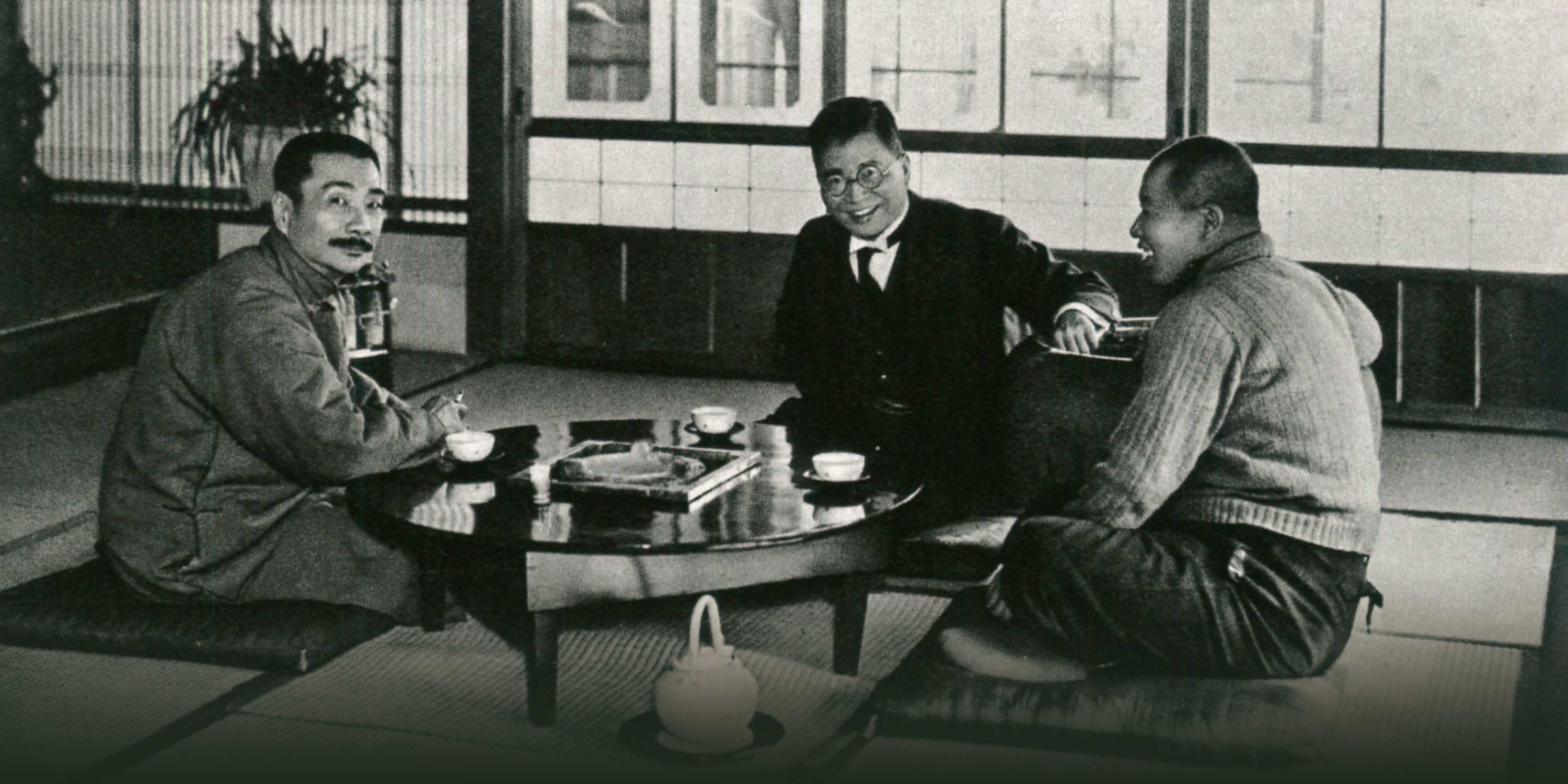
(Header image: Lu Xun (left) with Kaizōsha publishing house president Sanehiko Yamamoto (center) and Japanese bookseller Kanzo Uchiyama (right) at Shingetsutei in Shanghai, Feb. 11, 1936. From the collection of the Lu Xun Museum.)