Reel to Real: The ‘Voy Boys’ and the Movie That Never Was
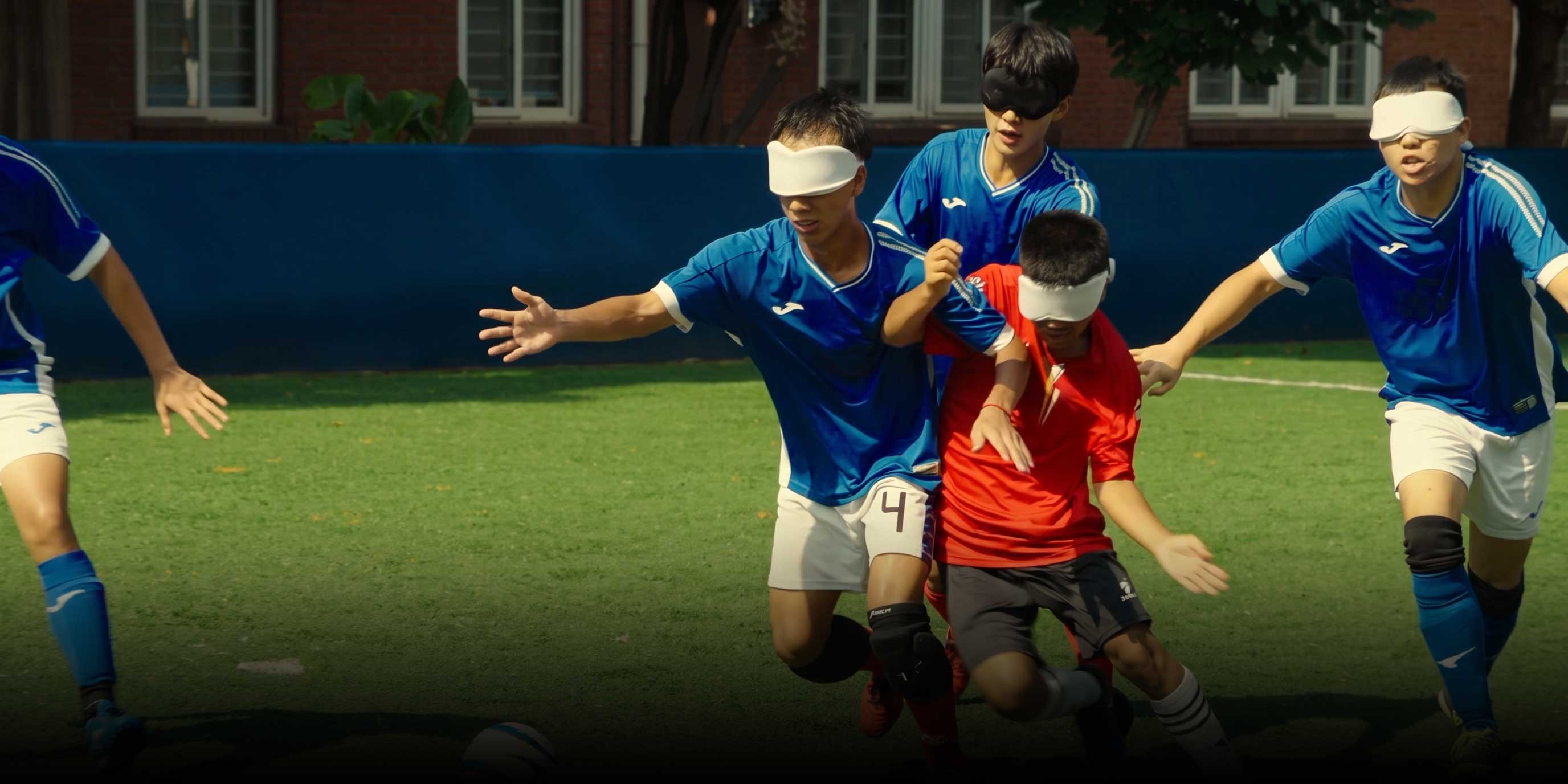
It’s late 2024, and Bilali Yasen barrels toward goal, the football skipping at his feet as he narrowly passes his opposition. In the pitch darkness, he hears only the sound of his heartbeat and the faint calls of his teammates.
He shoots and hits the back of the net, capping a 5-1 rout.
Having lost their first four games at China’s 2024 National Blind Football Championship, the win marks a major milestone for the 16-year-old striker and the rest of the “Voy Boys,” a newly formed team of visually impaired players from China’s northwestern Xinjiang Uyghur Autonomous Region.
Born with glaucoma and cataracts, Bilali had never expected to play football again after his sight began fading at age 7. But at the final whistle, he is brimming with confidence and even envisioning a call-up to the national squad.
China has had a national men’s blind football team since 2006, winning eight Asian titles as well as silver at the 2008 Beijing Paralympic Games.
Yet the sport remains largely unknown in the country. For this young Xinjiang team, the struggle to secure sufficient long-term funding, along with professional coaching and management, is just beginning.
Even more improbably, the Voy Boys wouldn’t exist if not for a movie that was never made.
Cameras, action!
Su Yiyan, a dancer turned movie producer in Beijing, had been toying with a story about blind football for a while before starting production in 2021. The idea centered on a disillusioned big-city football coach who takes over a small-town team of visually impaired children, with both sides finding healing in each other.
Initially, she planned to base the movie in the southwestern Yunnan province, which already had a relatively strong tradition in the sport, but was encouraged instead to head north by Shanghai’s Xinjiang aid office, part of a national paired-assistance program in which wealthier cities coordinate economic, educational, and infrastructure projects in underdeveloped areas.
In the spring of 2021, Su and her crew arrived in Xinjiang to find local boys who could appear in the movie. The only real criteria were that they needed to be visually impaired and in good physical condition.
After visiting schools in several towns and cities, they traveled to Shache County, on the southern rim of the Taklimakan Desert in Xinjiang’s Kashgar prefecture, where they invited 13 students aged 13 to 14 from its Special Education School to take part in a basic running test.
“I was stunned. Every one of them had the bravery to run,” recalled Su, highlighting the fact that it takes immense courage to do that when you can’t see clearly.
The following summer, two physical education teachers from Kashgar were drafted in to begin training the children in skills and tactics at the school.
Blind football uses a modified ball with bells inside, allowing players to locate it by sound, and is played on an enclosed 40-by-20-meter pitch. Each team fields four visually impaired outfield players, all in blackout eye masks, and one sighted or partially sighted goalkeeper. Teams can also use a sighted off-field guide to call and direct players toward the goal.
Much of the initial training focuses on building the players’ courage to run and prepare for the inevitable collisions.
Abudumijiti Memet, a 19-year-old defender with congenital cataracts, said he was frightened at first, and would always lean backward when moving at pace. “The coach told me that the more afraid you are, the more likely you are to get hurt when someone runs into you,” he said. “Players who keep moving forward are less likely to be injured.”
Zhang Jian, head coach for the Shanghai Blind Football Team, provided remote support in 2021 and briefly led on-site training in 2023. He was surprised by how quickly the team took shape and impressed by their boldness, coordination, stamina, and general enthusiasm. Zhang took special note of Bilali, whose performances were “beyond everyone’s expectations.”
“It’s rare for someone of his height to perform as well as he does,” he said, referring to Bilali, who stands at a relatively short 1.65 meters. “He wasn’t good at dribbling at first, and his coordination could be poor … but he was certainly the bravest and the most determined in matches.”
For Bilali, it was a joy to be playing the “beautiful game” again. “Once I started running, I felt I’d rediscovered a familiar feeling,” he said, explaining that football was his favorite pastime before his eyesight faded. “The wind was blowing past my ears — it made me happy. Only on the pitch can we run without fear.”
Missing the target
Although things looked good on the field, by 2022 the movie project was stalling. The pandemic had caused scheduling issues, and some promised production financing never materialized. The money the crew did have — mainly from Su’s friends and connections — was vanishing fast.
Attempts to drum up further investment had all failed.
“To film my original idea required tens of millions of yuan, but we had no backers,” said Su, explaining that she had initially hoped to cast a big-name actor in the coach role. “One director suggested I change the focus of the movie to the children, which would only cost about 5 million yuan ($740,000). But we still couldn’t raise the money.”
With the project still in its early stages, she decided to shut it down. That summer, she flew to Xinjiang to break the news to the cast and their coaches.
Without a movie, there was no one to organize coaching or matches. “We’d just discovered blind football, and with it found hope,” said Bilali. “We all feared that the opportunity would disappear and we’d feel lost again.”
After returning to Beijing, Su couldn’t stop thinking about the children. “You can’t give people something and then take it away, especially a group of visually impaired kids so eager to play football,” she recalled thinking.
A year later, Su quit her job and teamed up with filmmaker Li Zhiwei to continue the project as a documentary about Xinjiang’s first blind football team. They used their own money, a bank loan, and about 260,000 yuan borrowed from friends to rent recording equipment and buy supplies including balls, goals, eye masks, and pitchside barriers.
“To save money, we sometimes took three connecting flights in a single day, getting up at 3 a.m. to reach the airport and arriving in Shache at nearly 11 p.m.,” Su once told domestic media. “Our crew spent no more than 100 yuan a night on accommodation. When we ran out of money, we went back out to raise more funds.”
In the summer of 2023, Zhang invited four boys from the Xinjiang team, including Bilali, to his annual training camp at the Shanghai School for the Blind, where they could learn from veteran players.
In addition to football practice, the trip included visits to the Shanghai Zoo, Shanghai Tower, and a café staffed by visually impaired workers. For Bilali, it was a glimpse into another world.
His elder sister, Maierwanimu Yasen, said her brother was different upon his return. After losing his sight, he’d become withdrawn and less talkative, and physically weaker, “but now he told us much more. He’d realized that visually impaired people could do all kinds of things — not just massage, but run cafés and pursue other careers,” referring to the default vocation for blind people in China.
He also now felt that if the team trained hard enough, it could play in more major cities, taking on China’s 10 or so provincial teams.
Taking another shot
In October 2023, Su’s crew arranged an exhibition match between the Xinjiang youth squad and the Shanghai Blind Football Team. The game was played on the pitch at Shache’s special education school, with relatives and local officials watching on.
“That’s when I first saw them play,” said Maierwanimu. “I felt then that they could really do it. I realized this wasn’t just a game they were playing for fun.”
The Xinjiang team won 2-0.
Almost a year later, the Xinjiang Disabled Persons’ Federation announced the official establishment of the region’s first men’s blind football team, comprising 11 members, and the opening of a dedicated arena and training facility in Korla, almost 1,ooo kilometers by road from Shache.
The team — nicknamed the Voy Boys for the players’ shout of “voy” (Spanish for “I go”) to warn others they are moving — immediately began preparing for the 2024 National Blind Football Championship in Fuzhou, capital of the eastern Fujian province.
Bilali’s five-goal display in the team’s final match of the tournament provided the climax to Su’s documentary, “Voy Boys,” which went on limited release nationwide in July 2026. So far, it has grossed just over 340,000 yuan, far less than the 3 million yuan it cost to make.
Final whistle?
When the cameras stopped rolling in 2024, life carried on for the team.
Xinjiang finished in ninth place in Fuzhou. However, to encourage them and other newly formed squads to keep competing, all participating teams received automatic qualification for the combined National Games for Persons with Disabilities and the National Special Olympic Games, co-hosted in December 2025 by the southern Guangdong province along with the Hong Kong and Macao special administrative regions.
The team went on to finish seventh in that competition and then fourth at the 2026 national championship, held in Korla.
Luo Chengmian, a 28-year-old former blind football player from the eastern Zhejiang province, took over as head coach in 2024. He was assisted by Mahemuti Rozi, vice principal of the Shache’s special education school, who’d followed the team’s progress from the beginning.
“At first, I thought playing football was unnecessary, so I didn’t pay much attention,” said Mahemuti. “But in every match I saw how they gave everything they had. They fought with everything, always pushing to play out the entire match. It really moved me.”
However, the team has struggled to recruit for certain positions, including goalkeepers and off-field guides. Often, candidates are found just a day or two before a match and lack experience.
The players being separated by large distances is another challenge. Because the Shache school launched its high school program only in 2025, Bilali, Abudumijiti, and five other players had earlier transferred to a special education school in the Changji Hui Autonomous Prefecture, about 1,700 kilometers away, to continue their studies.
After Luo quit in late 2025 over disputes related to his salary and the players’ subsidies, it was up to Mahemuti to keep the team going. He juggled the job alongside his responsibilities overseeing the school’s logistics and cafeteria, and connected with coaches in Yunnan for remote guidance and training plans. This December, he aims to help the players in Changji arrange internships in Shache so they can restart training with the rest of the team.
Without a regular coach, those in Changji had to organize their own training sessions before morning reading and in the hour between classes and evening study.
“If we get the chance, we just want time to train, a better pitch, medicine, and a coach,” Abudumijiti said. “At least we chose this path ourselves. We want to keep walking it until we can’t go any farther.”
By contrast, Luo now coaches the Sichuan Blind Football Team’s women’s squad, based in Chengdu, capital of the southwestern Sichuan province, where players train six hours a day, receive daily allowances, and enjoy full medical insurance and access to traditional Chinese medicine massage services.
Su told Sixth Tone that the Xinjiang players receive a few hundred yuan a month in food subsidies, and hope for further support, including for medical supplies. The Xinjiang Disabled Persons’ Federation did not respond to Sixth Tone’s request for comment.
At least four of the Voy Boys are expected to graduate high school next June, creating a dilemma over what to do next.
For visually impaired people in China, massage therapy remains one of the most accessible careers. Bilali and Abudumijiti both chose massage courses after transferring to Changji, yet the school didn’t even have textbooks for visually impaired students. They had to take photographs of the materials with their phones and use text-to-speech apps to understand the content.
“And I feel this kind of work often means staying indoors. You can’t feel the sunshine,” Abudumijiti said. “That made me reluctant to pursue it, even though many people told me it was the most suitable profession for someone like me.”
Without that option, though, he’s unsure about the future. The son of a police officer and gas station worker, he’s now thinking about working with his older brother, who plans to open an auto repair shop.
“If we have to rely on our families’ money to continue training outside school, honestly, that’d be too much of a burden,” Abudumijiti added. “A dream is a dream, but we also need to plan. What happens when we get too old to play and haven’t earned enough money? We can’t live on dreams.”
Su, now 51, has quit show business and is paying off her debts working as a bungee fitness instructor in Beijing. She argued that, like anyone, disabled people need opportunities: “It’s us, as able-bodied people, who imagine that they can’t do this or that. We assume they don’t need to create social value, and that as long as they are safe, that’s enough. But they don’t want to live that way. They still want to find their own worth.”
After an accident during training earlier this year involving a Xinjiang player, Su proposed the China Blind Football Players’ Sports Injury Protection Fund, aiming to provide medical insurance coverage to registered players. The idea is still awaiting approval from authorities.
In March 2025, Bilali was selected for the national team’s reserve squad, based in Fuzhou. For the first time, he encountered professional gym equipment, a dedicated medical team, and an individualized training plan. “The intensity was high. I’d never experienced such demanding training in Xinjiang,” he said.
Later, he joined a national team training camp ahead of the recent 2026 Asian Para Games in Aichi-Nagoya, Japan, but wasn’t selected. China took gold on Oct. 23 after defeating the hosts 1-0 in the final.
“I’m looking forward to eventually going back to Xinjiang to see my family and teammates, but I’m also afraid that I won’t be able to train anymore,” he said. “I worry that my skills will fall behind.”
Editor: Hao Qibao.
(Header image: A poster for “Voy Boys.” Courtesy of Su)