How Contemporary Art Finds a Home in Small-Town China
The drive southwest from Hangzhou, the capital of eastern China’s Zhejiang province, takes about six hours. The highway passes through tunnel after tunnel, opening onto solar farms terraced into hillsides, villages with white walls and gray-tiled roofs, and transmission towers climbing the ridges. The last tunnel leads into a narrow valley, with clouds hanging low over the mountains.
This is Qingyuan County, which remains relatively remote despite its location in one of China’s richest provinces and improvements in transport infrastructure. Little known beyond its shiitake mushrooms and pencil manufacturing, the county moves to its own rhythm. I arrive at dusk, just as electric moped riders stream in from factories and workshops a few minutes outside town. Here, electric mopeds have a lane of their own. At traffic lights, riders cluster together, their helmets like a patch of colorful mushrooms, then move off as one when the light turns green.
Media portrayals of China often focus on modern metropolises or traditional villages, overlooking places like Qingyuan. Its urban center is a xiancheng, or county town, where schools, hospitals, shops, and cultural and government facilities serve both townspeople and residents of surrounding villages. Qingyuan County as a whole had 141,000 permanent residents in 2023. Across China, some 160 million people lived in similar county towns at the end of 2021. A 2022 national policy recognized their role in connecting cities and the countryside, calling for improved public services, including museums.
County towns have also been largely overlooked in China’s contemporary art scene. For more than a decade, Chinese artists and curators have been working beyond major cities like Beijing and Shanghai. Festivals such as Art Field Nanhai have brought installations to the countryside in the southern Guangdong province. The Bishan Project incorporated art into a “rural revitalization” initiative in a village in Zhejiang’s neighboring Anhui province. Anren, a historic town in the southwestern Sichuan province, hosted three editions of a contemporary art biennale.
These projects have expanded the reach of contemporary art in China. Yet artistic practices in county towns, where urban and rural life intersect, remain underreported. Another problem is the condescending language sometimes used in media coverage. For example, the term xiachen, literally “sinking,” is often used to describe cultural resources flowing from major cities to smaller communities, downplaying the role of local people in shaping art scenes.
The Art Museum of Pond Loach (AMPL) in Qingyuan offers a different perspective, showing how contemporary art institutions and smaller communities can shape one another.
Established in 2023, AMPL takes its name from a small, mud-burrowing freshwater fish. The museum draws on this image to describe its mission: immersing itself in the space between urban and rural life and engaging with the everyday experiences of county-town residents. It seeks to support what its director, Hu Dingyu, describes as “modest yet significant contemporary art.”
A Qingyuan native who left the county as a child and later studied and worked as a curator in the Netherlands, Hu has a complicated relationship with her hometown and resists portraying her return as a nostalgic homecoming or a search for her roots. Instead, she sought to establish a lasting institution where relationships among artists, museum staff, and local residents could develop over time.
That starts with the architecture. AMPL occupies two floors of a ceramics museum founded by a member of Hu’s family. Dedicated to celadon, a type of green-glazed ceramic with strong ties to Zhejiang, the museum shares a building with the local marriage registry and a library reading room.
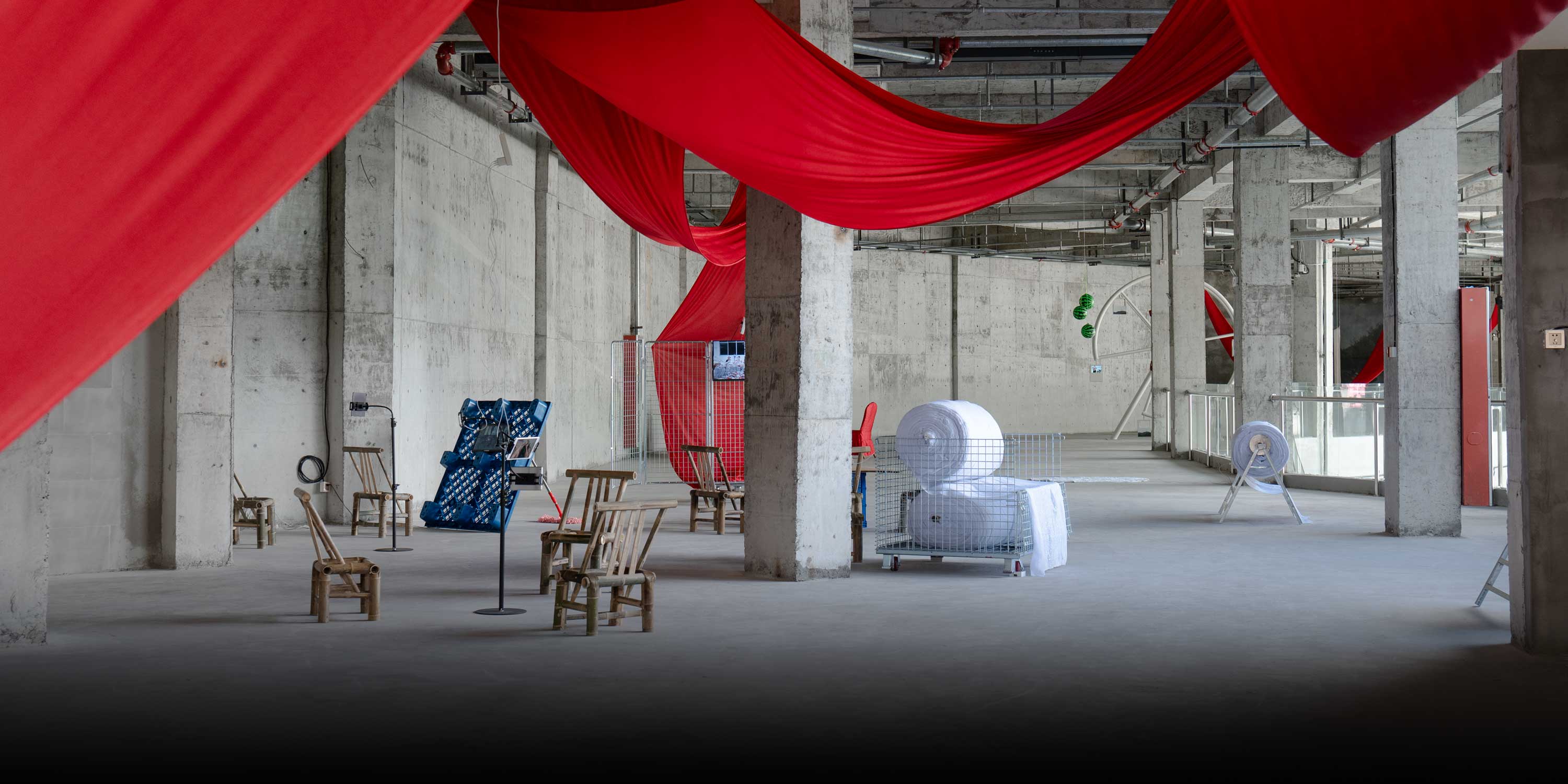
Hu and her team carved out a space for contemporary art within this setting, and the contrast remains visible. Gray concrete walls, exposed rebar and pipes, and alarm fixtures sit alongside the polished glass cases displaying celadon downstairs. To me, these unfinished surfaces made the gallery feel like a work in progress, reflecting the artistic practices taking shape within and beyond its walls.
AMPL’s development resembles a process of grafting: artistic practices and networks formed elsewhere take root through encounters with local institutions, skills, and ways of life. These local conditions are not simply a backdrop. They are constantly evolving and actively shape what artists and the museum can do.
Indeed, AMPL’s curation, research, and public education programs are all centered around county-town life. It invites artists to spend time in Qingyuan and develop projects in collaboration with local people. Rather than focusing solely on the finished artworks, artists are encouraged to gain inspiration from everyday encounters, including those with local workers.
In one project, a modified “chariot” joined the evening moped traffic. In another, local shops and a long-vanished dance hall became subjects of an exhibition. The museum’s collaborations have also extended into classrooms. Working with artists, AMPL made recordings of contemporary art classes at Hangzhou’s China Academy of Art available to local high school teachers for use in their lessons. Together, these projects have brought artistic practice into familiar settings, from roads and shops to schools.
Local networks are equally important to AMPL’s day-to-day operations. Without a dedicated exhibition installation team, the museum relies on local welders, electricians, and other tradespeople recruited through personal contacts. Since the museum opened, workers who were initially unfamiliar with installing contemporary art have become regular collaborators. These relationships have become part of the museum’s infrastructure.
AMPL’s 2026 exhibition, “Factory Girl,” is perhaps the most convincing evidence of how contemporary art can take root — rather than “sink” — in county-towns. Featuring artist Zheng Que and curated by Nie Xiaoyi, the exhibition explores manufacturing in China’s counties through Zheng’s own experience. Beginning in 2023, she worked at a factory producing Christmas goods in Pan’an, another county in Zhejiang, and filmed herself on the job. Like Qingyuan’s pencils, the factory’s products connected local workers to consumers far beyond the county. Zheng herself was the “factory girl.”
According to Zheng, most workers were women from nearby villages, ranging in age from their 30s to their 70s and 80s. Many were retired and wanted something to keep them occupied. Coworkers were often also neighbors or relatives, connected through overlapping networks of family and acquaintances.
At the opening of “Factory Girl,” I met artists, curators, and other art professionals who had traveled from Shanghai and Hangzhou. Over dinner, we shared loach hotpot, a local specialty featuring the fish that gave AMPL its name, and shiitake mushrooms, all prepared by local residents.
Together, these activities suggest a more reciprocal relationship than the language of xiachen implies. At AMPL, the graft is both architectural and cultural. What matters is how the different elements come together: how space is shared, how local skills are put to use, and how relationships are sustained through repeated collaboration and practical adjustments.
Whether these connections can sustain AMPL in the long term remains uncertain. Resources and networks from major cities will continue to matter, but so will the museum’s ability to give artists time to develop work with local residents and maintain those relationships beyond individual exhibitions. For the graft to take hold, collaboration must become an ongoing practice, giving people in Qingyuan a role in shaping the museum’s future. More broadly, AMPL raises questions about how contemporary art can develop beyond China’s major cities, and the role smaller communities can play in shaping it.
(Header image: The installation “Zheng Que: Factory Girl,” Art Museum of Pond Loach, Qingyuan County, Zhejiang province, 2026. Photo by Luo Shunqi, Han Qian and Cao Danyang. All images courtesy of Jin Yu)