A Decade On, Can China’s ‘Yoga Village’ Still Hold Its Pose?
HEBEI, North China — It began with a “crazy” idea: use yoga to lift the village out of poverty. And it worked.
In 2016, yoga put Yugouliang on the map. Tucked away in the northern Hebei province, about 300 kilometers from Beijing, the village began attracting experts, journalists, and advertisers to watch its mostly elderly population perform stretches, headstands, and the splits beside crop fields, chicken coops, and sheep pens.
New revenue streams followed: livestream sales, online classes, yoga festivals, TV appearances, and even a movie. By 2020, the annual per capita net income for households under the national poverty alleviation program had reached 12,335 yuan ($1,840), up from 2,800 yuan in 2015, taking the village above the poverty line.
Today, a large stone marker proclaiming Yugouliang a “National Fitness Yoga Demonstration Village” still stands at the village entrance, but the national attention has long faded.
As the officials who drove the trend departed and the locals aged, the streets fell quiet, and the young people who had returned to help with social media marketing and sales left once again for better opportunities in major cities.
Yet 10 years on from that viral fame, yoga remains a force in many households here, either as a source of income or simply as a memory of how it opened a door to another world.
Stretching the imagination
When Jin Xiuying, then Yugouliang’s director of women’s affairs, was first tasked with going door to door to promote yoga in March 2016, she didn’t even know how to write the word in Chinese.
Naturally, she had a hard time convincing villagers. She recalls typical responses like, “Are you crazy? Farm work is exhausting enough. Who has time to exercise?” Others were confused and thought she was offering free fish, as the phrase sounds similar to “yoga” in Mandarin.
“Do me a favor, have a try,” she urged them. “The new official wants us to do it.”
She was referring to Lu Wenzhen, then 50, who had recently been appointed the village’s resident first secretary as part of a national program that dispatched officials from major cities to help develop impoverished rural areas. He’d previously been the Party secretary of a vocational college in Shijiazhuang, the Hebei capital.
Lu arrived that February, taking a seven-hour car ride to a village so remote that he couldn’t locate it on his map app.
Its 100 or so residents — mostly the middle-aged wives and elderly parents of migrant workers — survived by farming crops, raising cattle and sheep, or renting out their land. More than half survived on incomes of less than 2,952 yuan a year, below the official poverty line, while chronic illnesses like bronchitis, arthritis, and rheumatism were common due to years of physical labor and the cold climate.
In early 2016, the village still had no internet access, and playing mahjong or card games were among the few forms of entertainment. While visiting people’s homes, Lu observed that many elderly women would sit cross-legged for long periods on their kang, a traditional heated brick platform.
It reminded Lu of the lotus position in yoga — and that’s when he struck on the idea that this 5,000-year-old Eastern exercise could be the village’s ticket out of poverty. The locals could learn through movements they already knew: sitting on a kang, pulling weeds from the fields, and pushing a stone mill to make tofu.
The only issue was that Lu had never practiced yoga. So he watched instructional videos online, then taught others what he’d learned on an open field outside the village committee office.
He started with breathing exercises, getting villagers to stand with their legs bent, extend their arms in a circle in front of their chests, and make long “woo woo” sounds. Then they would crawl on all fours to strengthen their shoulders and backs and improve their balance. Yoga poses came later.
Lu bought 50 pairs of white gloves to protect his students’ hands during floor exercises, as well as 100 red foam yoga mats. Soon, nearly 70 villagers were showing up to his twice-daily training sessions, mostly women aged over 65.
At first, Jin received complaints from villagers about soreness, and she was still convinced that “Lu was just trying something out and wouldn’t stay long.” But after three months, the symptoms from her herniated disc began to ease, potentially saving her tens of thousands of yuan in medical costs, and others were reporting that they also felt healthier. So she persisted.
In March 2017, a producer from Hebei TV called to invite the village’s “yoga grannies” to perform in its studio. A month later, the state broadcaster CCTV broadcast a clip of Yugouliang residents in various poses.
The unprecedented attention inspired the locals to train harder to master tougher positions, such as the one-legged tree pose, the Sirsasana handstand, and lateral splits. More men began joining Lu’s sessions, and even the village’s superstitious hawks stopped suggesting that female yoga practitioners would bring about poor harvests by “pointing their backsides at heaven.”
Rising fortunes
In the summer of 2017, Jin’s daughter returned from university for the holiday and helped register an account on the Kuaishou short-video platform to promote “China’s yoga village.” In just over a year, it gained more than 300,000 followers.
Then came livestreaming. Most evenings, villagers would gather beside a concrete road to film themselves practicing yoga under the streetlights. They sold local products — potato noodles, red beans, soybeans, oat flour, and quinoa — and prerecorded yoga courses, which brought in thousands of yuan on a good day.
The income was divided according to how often each villager took part. Frequent participants were making more than 1,000 yuan a month, five times the rural pension at the time.
The group practiced year-round. In winter, they filmed in an abandoned single-story house after blocking holes in the walls and windows with old clothes and installing two coal-fired stoves to stay warm.
Wu Qilian, 83, who then practiced yoga with her husband, said that her grandson quit as a gig worker in Beijing to return home and run a social media account for the family. Livestreaming helped them earn several thousand yuan a year in additional income.
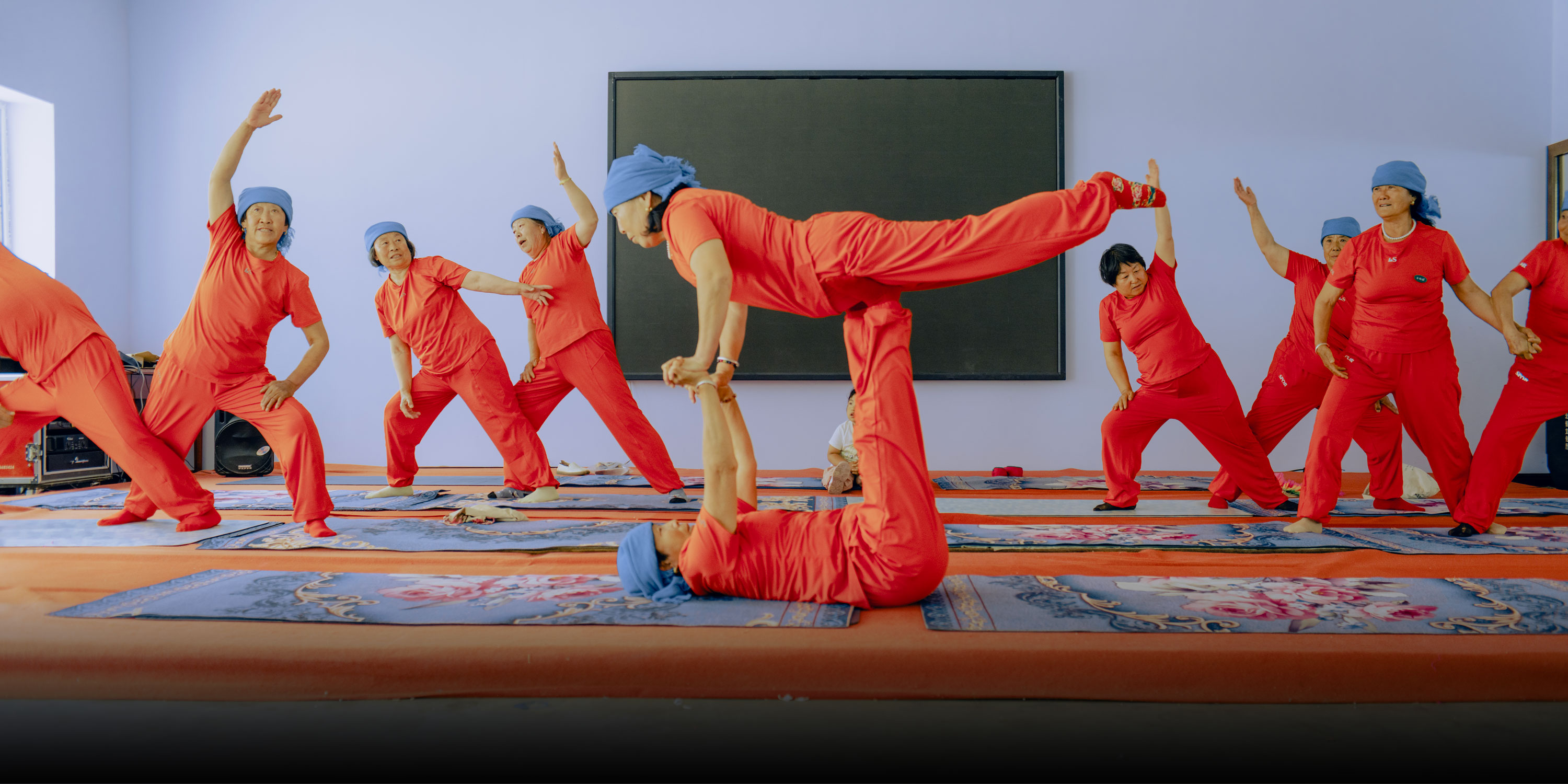
Yoga competitions and festivals were organized to attract visitors, while the village women continued to perform on TV shows across the country, wearing their signature blue headscarves and red athletic outfits.
“If you couldn’t do a headstand, if you weren’t good enough, they wouldn’t take you out to perform,” Li Xiufang told Sixth Tone. The 69-year-old returned to the village from Beijing after retiring at 55 and found “everyone was doing yoga, so I just joined in.”
Netizens dubbed Yugouliang “China’s No. 1 Yoga Village,” while the national sports authority designated it as a “National Fitness Yoga Demonstration Village.”
In 2022, the Chinese media giant Tencent released the movie “Welcome to Yoga Village” via its streaming service. A dramatized account of Lu’s poverty-alleviation efforts, it features several locals in minor speaking roles.
“Look at this. I’m a movie star,” said Zhang Xiying, 72, who had a few lines of dialogue. Pointing to a wall of photos in her home dedicated to her on-screen appearances, she added, “If I didn’t do yoga, who would invite an old woman like me anywhere?”
The village also secured more than 2.69 million yuan in government funding to build a small quinoa processing plant, creating 16 jobs. Many locals had switched to growing the grain because of its popularity among fitness enthusiasts.
On Feb. 29, 2020, Yugouliang was officially declared out of poverty.
Twist of fate
The boom times didn’t last long. Compared with other crops, quinoa requires deeper and more intensive tilling, so the aging villagers soon stopped growing it. Lu’s attempts to introduce a new variety of potato also failed when negotiations to secure a wholesale buyer broke down.
Livestream sales, which led to competition as well as resentment from families not sharing in the revenue, saw a sharp drop-off. After only a year back home, Wu’s grandson returned to Beijing to look for work.
Meanwhile, several members of the yoga group died, including Wu’s husband, or moved away to live with their children. Many of those remaining in the village are either too old to achieve difficult positions or have debilitating health issues.
Jin stepped down as the village’s director of women’s affairs in 2021. Residents say her successor promised to pay for yoga participation, but the money never materialized, so they stopped attending.
Liu Runtao, 58, took the role this year and has been struggling to put the team back together. She’d never practiced yoga before returning to the village in recent years. Now, when she posts notices about training sessions, usually only her relatives show up.
In villages like Yugouliang, organizing events and upgrading infrastructure often depend on approval and funding from town or county authorities. However, as officials change, so do their offices’ priorities.
Lu told Sixth Tone that he would sometimes win a higher official’s backing for a project only to see them transferred out before anything was finalized, taking things back to square one. Even when the village was at its most popular, funding to update its tourism facilities was slow to come.
Lu stepped down as resident first secretary in 2023 and returned to the vocational college in Shijiazhuang. Now 60, he still returns for major events and helps promote Yugouliang, but he feels it’s now someone else’s responsibility to keep the “yoga village” narrative alive.
Winding down
On one sunny July afternoon, a group of villagers sat chatting at a bus stop. Services pass through here just twice a day. Apart from the occasional truck carrying agricultural supplies, the main road is largely silent.
Liu had arranged a yoga training session, but just nine elderly women showed up. Most residents can no longer achieve the poses that made them famous. Only the septuagenarian Zhang can still balance with both feet off the ground.
The new resident first secretary, Li Jidong, who worked for the same Shijiazhuang college as Lu, watched from the sidelines. He has little interest in yoga, apparently seeing it more as a liability. “What if someone has a brain hemorrhage while doing it?” he said, after interrupting the session to suggest the elderly women attempt a safer activity.
Li believes that Yugouliang’s remote location and climate make Lu’s vision of building a tourism industry here difficult to realize.
“I don’t have that kind of ability. No single institution or person can solve a problem this big on their own,” he said. Li has only been in the job for two years but admits that he already wants to leave.
During a recent yoga event, Li asked people to help with livestream sales of local farm products, but the results were disappointing.
The village Party secretary, Zhang Pengcheng, who took over from his father in 2021, said he has also tried encouraging residents to make short videos and livestream, but many struggle even to use smartphones, let alone speak standard Mandarin with viewers online.
Yet he sees the remaining yoga team as the “embers” to spark a tourism boom. In 2025, he organized a gala in which the team performed on ice beside a bonfire. A livestream of the event drew about 100,000 viewers.
But for now, the priority is improving infrastructure. In July last year, the township government and local businesses funded the opening of a guesthouse with room for up to 86 guests. It has yet to turn a profit. When Sixth Tone visited, its doors and windows were shuttered.
The village has also built a canteen for pensioners, with dishes starting at just 2 yuan. It was also temporarily closed in July because of a staff shortage.
Before stepping down, Jin earned a yoga instructor qualification in Nanjing, capital of the eastern Jiangsu province, and has since relocated to Zhangbei Town, about 60 kilometers from Yugouliang. She offers free classes to locals and teaches online six days a week.
Of the few residents still practicing yoga in Yugouliang, Zhang Xiying, despite her age, remains the most able and enthusiastic — though not for the village’s benefit, but for her own family’s.
“Exercise keeps me healthy,” she said, after wrapping up a practice session. “And I need to take good care of my old man.”
Additional reporting: Wu Huiyuan; editor: Hao Qibao.
(Header image: Villagers practice yoga together on a summer afternoon in Yugouliang, Hebei province, July 2026. All photos by Wu Huiyuan/Sixth Tone)