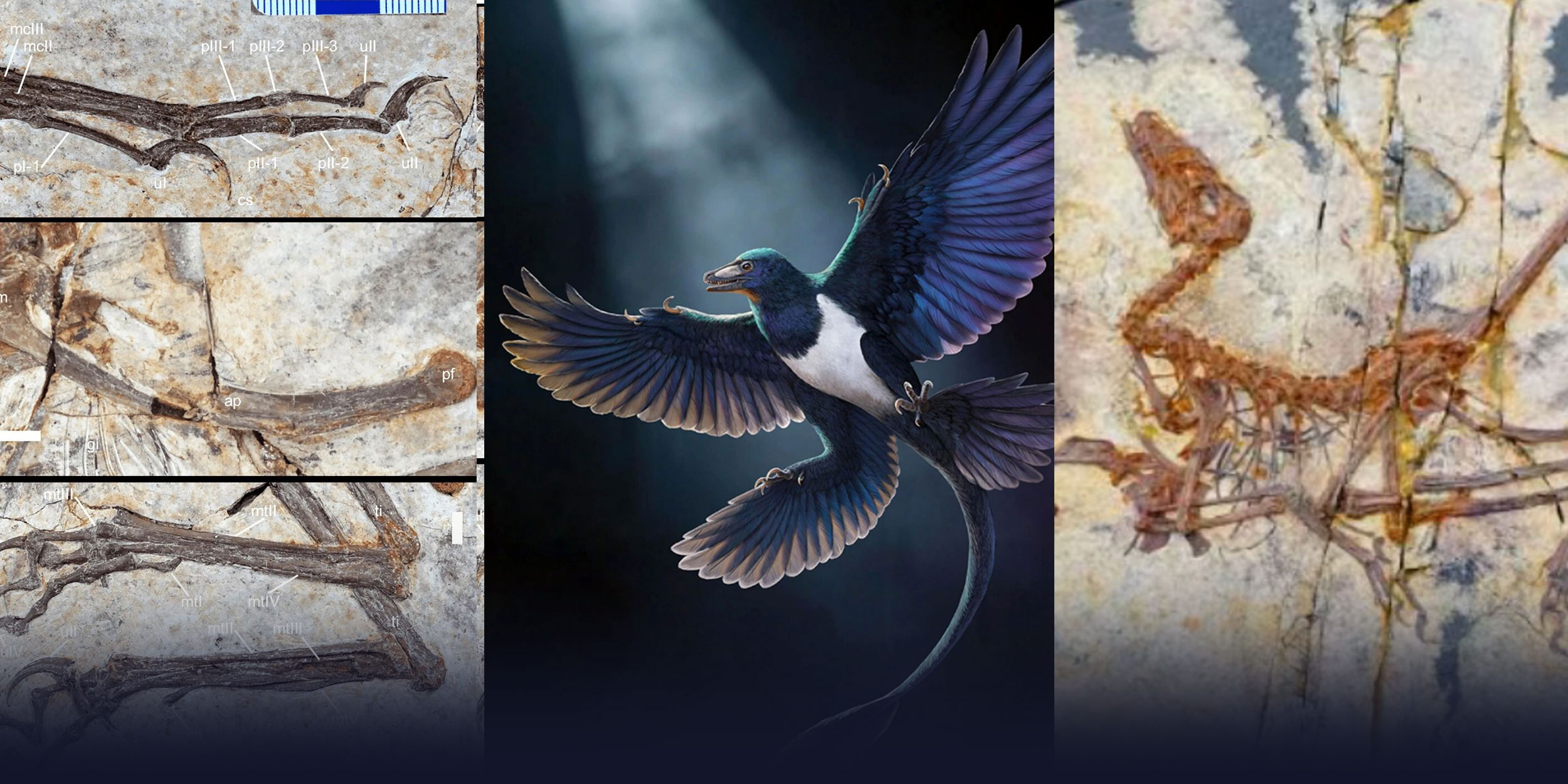
Feathered Dinosaur From China Points to Another Path to Flight
Researchers have identified a new species of feathered dinosaur from northeastern China whose anatomy suggests that birds and their close dinosaur relatives developed flight-related features along separate evolutionary paths.
The fossil — a nearly complete 57-centimeter skeleton with some feathers preserved — dates to the Early Cretaceous, more than 100 million years ago. Discovered by a local farmer in Liaoning province’s Jianchang County, it was donated to Hebei Geo University’s museum in 2023.
Researchers from the Chinese Academy of Geological Sciences and Hebei Geo University, working with colleagues from around the world, named the species Norellraptor barsboldi in a study published Sept. 29 in the journal Nature Communications.
The fossil adds evidence to a long-running debate over whether birds and their close dinosaur relatives inherited flight-related anatomy from a common ancestor or developed it separately.
Norellraptor belongs to the microraptorines, a group of small, feathered predators closely related to birds. Fossils of some members show long feathers on both their forelimbs and hindlimbs, suggesting they were adapted to move through the air.
The researchers compared Norellraptor with other fossils and found that roughly 30% of the anatomical changes they traced through microraptorine evolution also appeared in the bird lineage. In microraptorines, finger bones shortened before wrist and hand bones fused and the breastbone lengthened. In the bird lineage, those changes appeared in the opposite order.
Growth marks in Norellraptor’s forearm bone suggest it was at least 3 years old and still growing when it died, an age estimate the researchers factored into their comparisons with other fossils.
The different sequences challenge the idea that microraptorines and birds inherited the same flight apparatus or followed a shared pattern of development, the researchers said. They argue that the similar features arose independently in the two lineages.
(Header image: Left and right: Fossilized limb bones of Norellraptor barsboldi. Center: An artist’s reconstruction of the species by Zhang Chuang. From Nature)