When China’s Family Heirlooms Need More Than Tape, Glue, or Luck
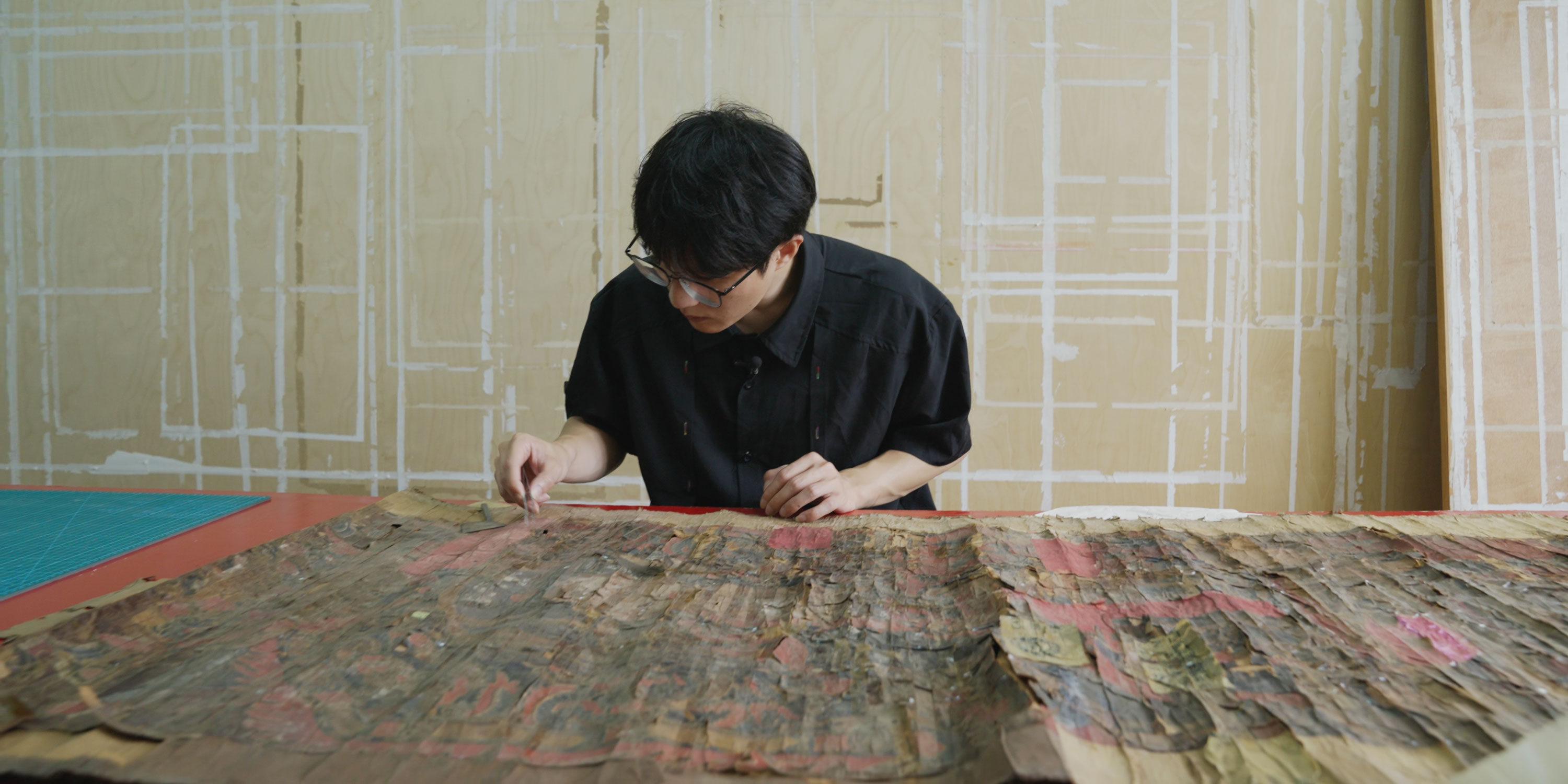
SHANGHAI — “Great-grandma, your head seems to be a little loose,” Yu Mingrui jokes as he examines an ancestral portrait depicting nine members of a family across three generations.
The 28-year-old Shanghai restorer was commissioned to repair the Qing dynasty (1644–1911) portrait by a descendant of the family in Ningbo, in eastern China’s Zhejiang province, which had been passed down through generations. Yu filmed the process and posted it on Douyin, China’s version of TikTok.
Amid the portrait’s cracks and damage, Yu found clean, deliberate cuts around one woman’s painted head, suggesting the section was once removed and replaced.
Yu commented that the painter might have added the faces after painting the bodies. But viewers offered their own explanations. Some hypothesized the painter had covered up a mistake and repainted the face. Others suggested that descendants of a male ancestor’s concubine had altered the portrait to replace his wife’s image.
The answer may never be known. But the mystery drew widespread attention online, with videos about the painting receiving more than 100 million views and likes across Chinese social media platforms.
On Chinese social media, independent restorers like Yu are demonstrating how damaged paintings, old books, and family records are taken apart, repaired, and preserved.
“A lot of people told me that they simply didn’t know that something damaged could actually be restored before watching my videos,” Yu told Sixth Tone.
The objects brought to independent restorers include ancestral portraits, genealogies, old books, and calligraphy passed down through families and kept in homes rather than institutions.
Often made from paper or silk, these objects are vulnerable to moisture, insects, light, and age. Even when damaged, they can retain names, images, and other details about the families that preserved them.
For restorers like Yu, the videos can also connect that work with owners who might otherwise have left such objects damaged at home. Those commissions provide restorers with work and, in some cases, allow families to recover information from records that had become too fragile or damaged to read.
Face value
When the Qing-era ancestral portrait arrived at Yu’s studio, its ink had faded, its paper had become brittle, and its edges were torn. A patchwork of old advertising flyers held it together, promoting everything from cakes to real estate.
At 3.4 meters long and 1.2 meters wide, the portrait barely fits into the worktable at the center of Yu’s roughly 40-square-meter studio in Shanghai’s rural Songjiang District.
Yu turned the makeshift repairs into another joke for his viewers. Families in China traditionally honor deceased relatives with food and other offerings. The flyers, Yu joked, had given the painted ancestors a modern assortment of their own.
“Whatever the ancestors are missing, they can just take it from behind the painting,” he said.
Repairing the portrait, however, was a more exacting process. Yu said the restoration is divided into four broad stages: washing away dust and stains, removing the backing paper and remnants of earlier repairs, patching tears and holes with paper matching the original, and retouching missing colors and lines.
Each stage depends on the painting’s condition. Even washing it requires the restorer to decide whether to use hot or cold water, whether mold and stains require chemical treatment, and how much the paper can withstand. Chemicals can remove stains quickly, but excessive treatment can damage the paper or alter the painting itself.
“The real difficulty lies in the uncertainty,” Yu said. “A restorer’s experience gives you certainty at the beginning, serving as a safety net to deal with the uncertainty that appears in the process.”
The portrait took around three months to restore. Before treatment, Yu said, face-detection software picked up only three of the nine painted faces. Afterward, when he photographed the restored portrait, the software marked all nine faces on screen. Yu charges around 10,000 yuan ($1,493) for a painting of this size and complexity.
Yu began posting restoration videos while studying Chinese antique restoration in college. After graduating in 2021, he opened his own studio. His videos often begin with an unusual detail, a question about an object’s history, or a joke designed to catch attention.
“History isn’t only made up of famous paintings or nationally protected cultural relics,” he said. “It is also made up of these seemingly insignificant objects. As I restore them, I’m also helping to pass that culture on.”
Genealogies, ancestral portraits, and other family documents offer a view of the past that differs from official histories and local gazetteers, Zhang Yi, a historian at Shanghai Jiao Tong University, told Sixth Tone. Genealogies, for example, can record more than 1,000 people, while larger volumes can include tens of thousands, sometimes with birth and death dates.
“These materials greatly enrich our understanding of the lives and personal histories of ordinary people in Chinese history,” Zhang said.
The videos have also helped Yu turn restoration into a livelihood. His online following attracts commercial sponsorships, which now account for roughly half his income, he said. Many clients bring him just one family object in need of repair, but together, those individual commissions have allowed him to build his own customer base.
Paper trail
Beijing restorer Lian Chengchun also works mainly for private owners, from collectors to families preserving books passed down through generations.
Her videos offer them a first lesson in how to handle and preserve those objects at home, and can prompt people to take a second look at old records before the stories they carry disappear.
“I see little distinction between collections held by organizations and individuals,” Lian said. “Whether a book is restored by a public institution, an independent restorer or a private collector, the goal is the same: to preserve it for future generations.”
Books kept in private hands can arrive in almost any condition. Some have been patched with tape, glue, calendars, or whatever paper was available, repairs that may hold them together temporarily but can cause further and sometimes irreversible damage.
“Others were stored in plastic bags, where trapped moisture can encourage mold and decay,” said Lian, 38, who’s spent 18 years restoring old books by hand.
Before starting such work, Lian studies a book’s age and history, along with its paper, printing style, and other materials, which can vary across periods.
“Only then can I decide how best to repair it,” she said.
Cai Yadong came across Lian’s videos just when members of his clan in Jiaozhu Village, in southern China’s Guangdong province, needed help repairing a badly damaged genealogy.
In 2023, two elderly clan members handed Cai a 111-page genealogy dating to 1920. The wider Huazhou Cai clan today numbers about 20,000 descendants across roughly 110 villages, but Jiaozhu’s own records had almost completely disappeared, leaving residents unsure how their branch fit into the family or even who its founding ancestor was.
“When I first saw it, it was barely recognizable,” Cai, secretary of the Huazhou Cai clan association, said. “The pages were mixed together. Some had been burned, and years of damage had left the book extremely fragile.”
After contacting Lian, Cai flew to Beijing to deliver it himself rather than risk shipping it. “It was simply too valuable to risk any accidents,” he said.
Restoring the genealogy took Lian nearly a year and a half. Because of the genealogy’s age and poor condition, the restoration required careful, piece-by-piece work, Lian said.
“We try to repair it in a way that preserves its original appearance, while retaining as much of the surviving text as possible,” she said.
Lian compared numerous samples before selecting restoration paper that matched the original pages in color and texture. She repaired torn fragments and holes one by one, reinforcing sections where the original characters remained legible.
“Saving each character felt like picking up the brush where the Cai ancestors had left off,” Lian said. “Each page I uncovered felt like a dialogue with people from hundreds of years ago.”
When the work was completed, the volume showed that more than 30 pages were devoted to Jiaozhu, detailing family members and major events.
One entry showed how Jiaozhu’s branch fit into the wider Huazhou Cai clan and identified its founding ancestor as Cai Wende. The restored volume also helped three other villages establish their own connections to the clan.
“If our generation does not do this, the family memory may be gone after another one or two generations,” Cai said. “Once it is lost, it will be very difficult to recover.”
Just weeks before the genealogy surfaced, Jiaozhu had held a ceremony to renovate an ancestral tomb. Villagers knew it as the tomb of their founding ancestor but no longer knew his identity. Once the book was restored, they added Cai Wende’s name to the tomb’s inscription.
Cai described the timing as uncanny. “Whenever we talk about it, we all get goosebumps,” he said.
Editor: Apurva.
(Header image: Yu Mingrui at his studio in Shanghai, August 2026. Lü Xiao/Sixth Tone)