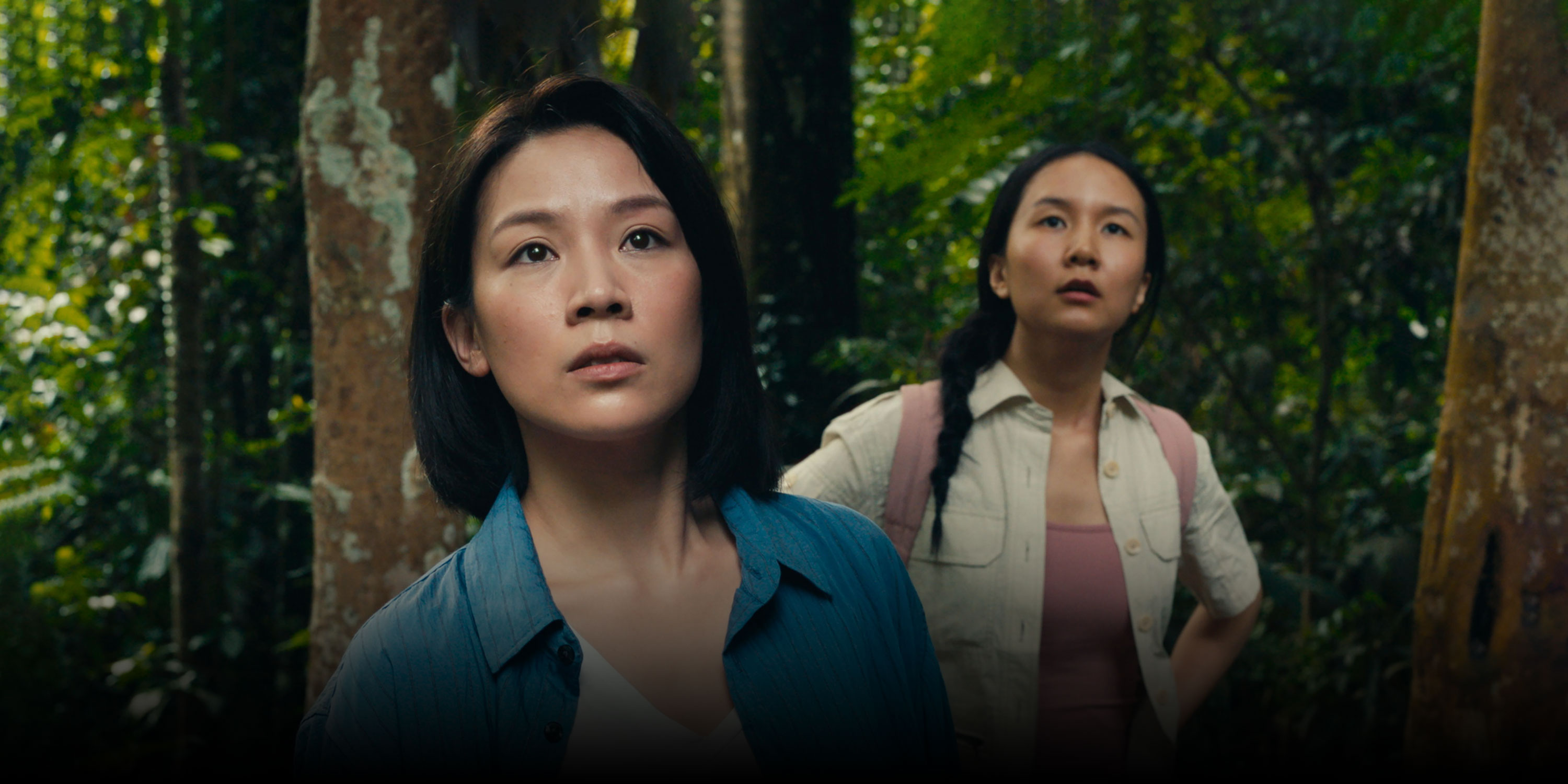
In the Rubber Forests, ‘Shanghai Daughter’ Traces a Father’s Past
SHANGHAI – At the Sept. 19 Shanghai premiere of her feature debut, “Shanghai Daughter,” Shen Zhongmin carried a rubber seed from the forests of the Xishuangbanna Dai Autonomous Prefecture, nearly 3,000 kilometers away in southwestern China’s Yunnan province, where her late father had worked.
“The seed fell from the canopy and struck me as I retraced his life there,” Shen, 41, tells Sixth Tone.
Her father was among the millions of urban Chinese youths “sent down” to work in rural areas under the Down to the Countryside Movement, a campaign that ran from the mid-1950s through the late 1970s. He spent a decade on a state-run rubber farm near China’s border with Myanmar but rarely spoke to his daughter about those years.
Shen, who works professionally as Agnis Shen, first traveled to Xishuangbanna in 2011, the year after her father died. A former culture editor at the Shanghai-based magazine The Bund and the author of “The Traveler’s Desire,” a collection of short fiction. She returned to the region repeatedly, retracing her father’s life and meeting people from his generation.
Nearly a decade after her first trip, those encounters and widespread coverage of a herd of wild Asian elephants wandering north from Xishuangbanna helped inspire the idea for a film. The herd’s journey drew attention to the rubber plantations that had transformed parts of the region’s rainforest habitat.
Blending fiction with documentary methods, “Shanghai Daughter” follows Ming, a fictional Shanghai woman played by Liang Cuishan, as she seeks out her father’s former acquaintances in Xishuangbanna.
She encounters workers’ dormitories facing demolition and a landscape where mining and modern agriculture are replacing former rubber plantations. She also meets rubber tappers, village doctors, ethnic Dai villagers, and ecological researchers, all of whom appear as themselves and recount their own experiences.
“The film asks how we deal with memory,” Shen says. “When you want to understand something from the past but cannot find reliable firsthand records, how do you search for the answers?”
“Shanghai Daughter” had its world premiere in the Panorama section of the Berlin International Film Festival in February and was later selected for the Hong Kong International Film Festival and the Malaysia International Film Festival.
Seven months later, the film’s Shanghai premiere drew at least a dozen former sent-down youths from the city, all now in their 70s. They traveled about an hour by subway to attend.
At the theater, they shared old photographs from their years in Xishuangbanna, including images taken with Shen’s father, Shen Wanxiong, and posed for a group photo with the director.
Among them was Shen Weilong, 73, a former rubber tapper who had worked alongside Shen Wanxiong and describes him as his best friend. Looking at one of the photographs, he jokes, “This one doesn’t show just how handsome he was. If you want to know what he looked like, just look at his daughter.”
As he speaks about his generation, tears well in his eyes. “Our generation is rarely talked about, and now our time is running out,” he says.
Sixth Tone spoke with Shen Zhongmin the following day as she continued a multi-city promotional tour. The interview has been edited for brevity and clarity.
Sixth Tone: Not a single scene in “Shanghai Daughter” was shot in Shanghai. Why did you choose the title, and what does it mean to you?
Shen: “Shanghai daughters” was originally a local term. Villagers near the farms used it for daughters left behind by sent-down youths. Over time, the label seemed to replace each woman’s real name.
Because of my father’s history, I am also, in a sense, a “Shanghai daughter,” and so I went there too. In Xishuangbanna, the phrase took on a double meaning for me. It suggested a kind of twin existence, like looking in a mirror. We seemed to have completely different yet intersecting destinies, one born in Shanghai and the other 3,000 kilometers away in Xishuangbanna.
To me, “daughter” carries something different from either “woman” or “boy.” One of the first Dai expressions my father taught me was “long yin,” meaning “girl.” The image of a girl carries a particular gentleness that can help heal or ease the deep wounds and heaviness behind this subject. The emotional connection extends beyond father and daughter to one girl and another, and one daughter and another.
I did not want to remain trapped within a particular historical wound or view that period only through criticism. I hoped to create something relevant to the present and oriented toward the future, an expression of repair, renewed empathy, and hope.
Sixth Tone: By telling the story from a daughter’s perspective, the film approaches the sent-down youth movement through one family. How does that perspective differ from other portrayals of the movement?
Shen: This is a deeply personal and highly artistic undertaking. It emphasizes experiencing and observing our surroundings and sensory world anew.
While writing the screenplay, I did extensive research. I gathered oral histories, consulted historical archives, and reconnected with researchers at the Chinese Academy of Sciences who study rainforest restoration. But I wanted to hold back those “concrete” materials for as long as possible and put perception first. Thoughts and opinions can easily create divisions, and once expressed, they have their limits. Perception, however, can be shared and remains more open.
Later, an academically minded journalist asked whether this might be related to ecofeminism. I thought the observation was perceptive. It points toward a perspective that moves beyond anthropocentrism and rejects a structure in which “I am the center, and everyone else is the other.”
Sixth Tone: Rubber trees, dragon fruit, and other elements of the landscape recur throughout the film. How did you use them to connect personal memory with the region’s history?
Shen: During my fieldwork in Xishuangbanna, I often walked around whenever I had time. I gradually came to see the landscape itself as a theater. All the legends and stories I had heard, with their intense dramatic and emotional tension, lay silently buried in a small hill in the village.
Generations have cultivated different crops there, from rice and corn to bananas and, more recently, dragon fruit. A small patch of primary forest protected by the Dai people remains on the hillside. Beneath the present landscape lie my father’s old dormitory and the former rubber plantation.
People disappear faster than memories, but stories spanning more than half a century survive in the land’s subtle traces. When you look at the plants and the land and listen to their voices, it feels as if they are telling you stories, though not in a language humans can hear.
I brought the rubber seed to the screening because, to me, it represents a transformation of cause and effect. More than half a century ago, people had little choice but to clear primary rainforest and plant rubber trees to meet the needs of national development. We now understand that this harmed local biodiversity.
A Chinese Academy of Sciences team is rehabilitating degraded rubber groves. Its goal is not to return them to primary rainforest, which would be scientifically unsound, but to rebalance relationships among species. The researchers are restoring poor-quality groves left by haphazard planting and tapping and introducing species that can bridge rubber plantations and native tropical rainforest. By giving the rubber trees a range of “good neighbors,” they can gradually restore the ecosystem’s layers.
To me, they are taking the “effect” of an earlier decision and planting within it a new, positive “cause,” one that may bear better fruit in the future. The relationship between seed and fruit becomes a metaphor for the transformation of cause and effect. I find that deeply inspiring.
Making the film also took me to Malaysia, where I saw some of the country’s earliest rubber trees. Without that initial transplantation, rubber would not have been planted on such a large scale in Xishuangbanna, and many of these stories would not exist.
Sixth Tone: Why did you blend fiction and documentary methods rather than make a conventional documentary centered on your own search?
Shen: I have always felt that the boundary between reality and fiction is unclear, much like the line between dreams and waking life. Historical narratives also have a dreamlike quality for me, something I have explored in my fiction.
If I had relied on documentary methods alone to examine the sent-down youth movement or my relationship with my father, the film would have felt too narrow.
I drew on my own experience to present subjects I have long cared about in a more contemporary, open form. If I had appeared as myself and made a pure documentary, the film would have become too narrow, confined by the standards of historical fact and leaving viewers less room to project themselves into it and experience it openly.
Sixth Tone: How did you approach your father’s past and his former co-workers while making the film? How did they respond after the premiere?
Shen: My father rarely spoke about the decade he spent in Xishuangbanna. People of his generation generally do not talk about those experiences.
You could sense a deep wound behind the way an older audience member spoke yesterday. At times, his questions seemed to judge other people, but they ultimately revealed his own views and emotions.
I didn’t even know my father had tapped rubber. He had never told me what work he did there. Only when I first walked into the plantation did I understand that these were rubber trees and that his generation had planted and tapped them.
At first, I avoided contacting my father’s former co-workers. I knew they would be eager to help and provide a great deal of firsthand material. But the film began with the particular relationship between my father and me. He had told me very little and died before I could learn more, so I went there to search for and reconstruct that missing part of his life.
I also did not want to disturb them for what was, after all, a small personal project. Revisiting those experiences can be extremely painful, especially for some of them.
Since yesterday’s premiere, I have spent all morning replying to their messages. Today, they are gathering for a reunion lunch to discuss the film.
One of my father’s former co-workers wrote: “Thank you to the screenwriter, creative team, and director for bringing a fitting close to our 50 years as sent-down youths.”
Editor: Apurva.
(Header image: A still from “Shanghai Daughter.” Courtesy of Shen)