Chinese Cinema Turns Its Lens Outward
“Once Upon a Time in the Middle East” opens, somewhat incongruously, in a Chinese family kitchen. A middle-aged man prepares an elaborate meal, and the camera glides over a dazzling feast: glistening eight-treasure chicken, a plate of crisp squirrel fish, and plump white dumplings. Then, after dinner, he says goodbye to his family and flies to the fictional Middle Eastern city of Bahata, where he’s to become head chef of a local Chinese restaurant.
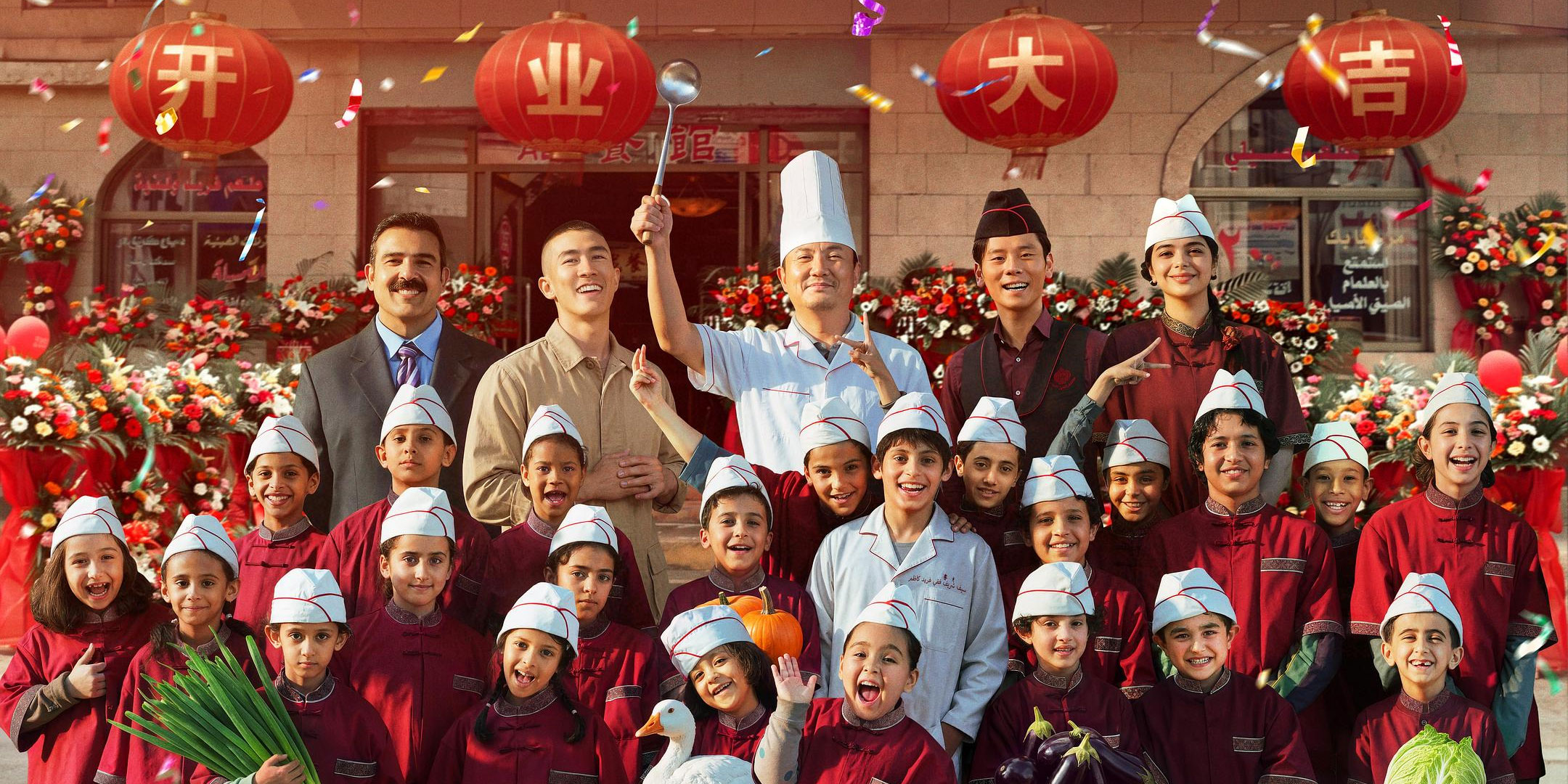
At first glance, the film has all the familiar ingredients of a Chinese feel-good blockbuster. Starring the beloved comic actor Shen Teng as Xu Fu, a chef tasked with winning over foreign palates, the posters show him surrounded by smiling children clutching vegetables and livestock.
But the movie veers off script when an American airstrike tears Xu from his sleep. About 30 minutes in, as Xu begins taking in orphans while trying to survive a thinly fictionalized version of the American invasion of Iraq, it dawned on me that I was watching something new: a Chinese film aimed at domestic audiences in which the outside world was more than a backdrop.
It’s not that Chinese cinema lacks stories set overseas. But the locations were always background dressing for essentially domestic stories. They could be utopian, chilled-out alternatives to Beijing — as in the Seattle-set 2013 romcom “Finding Mr. Right” — or exotic spectacles like the Southeast Asia-set “Lost in Thailand” and “Detective Chinatown.” Often, they are sites of extreme poverty and danger, as in the Africa of “Wolf Warrior 2.” Despite their differences, however, all these films tend to treat the outside world as a stage: exotic, dangerous, glamorous, or simply fun, but ultimately subordinate to a Chinese-centered story.
That is what makes “Once Upon a Time in the Middle East” such a departure. It is not another story about Chinese people abroad. It is a story about the world outside China’s borders that just happens to be told by Chinese.
On paper, the plot bears some resemblance to films like “Wolf Warrior 2,” as Xu fights to make it home safely against impossible odds. But the film’s director, Wen Muye, never loses sight of the bigger picture.
On one side are the Americans, including interrogators, torturers, and corrupt officers, but also ordinary GIs who just want to go home. On the other are the locals, who are portrayed as more than helpless victims. Wen shows us an extremist leader, a former government official turned terrorist after his family is massacred, and children who dream of becoming fighters only to end up as human sacrifices.
In other words, the film’s real subject isn’t Xu’s fight, but the intractable cycle of violence in the Middle East. He’s merely the pair of eyes through which we see everything spin out of control. Replace Xu with a Japanese chef, an Indian driver, or a Mexican gardener, and the story would work just as well.
So, how did we get from “Wolf Warrior 2” to “Once Upon a Time in the Middle East”?
Let’s start with the filmmaker. Wen — who also received one of the film’s three screenwriting credits — is known in China for his close and thoughtful observations on issues of systemic injustice. In 2018’s “Dying to Survive,” the system is global pharmaceuticals. In 2022’s “Nice View,” it is the electronics supply chain. And in “Once Upon a Time in the Middle East,” it is war and cycles of violence. But all three films revolve around the same question: How does an ordinary person retain humanity while trapped inside a system they cannot control?
Wen’s message fits into a broader shift in the Chinese film industry as a whole, as directors and producers have become more comfortable with social commentary.
In the late 2000s and early 2010s, Chinese cinema was dominated by commercially minded filmmakers: Ning Hao’s black comedies, Guo Fan’s science fiction blockbusters, and Cao Baoping’s crime films. Together, they drove Chinese cinema into its “genre age.”
Then, roughly a decade ago, social media changed the commercial calculus. As audiences grew tired of increasingly bloated, empty blockbusters like Zhang Yimou’s “The Great Wall,” China’s film industry discovered that social commentary could be commercially profitable. Shen Ao’s “No More Bets” took on cross-border telecom fraud. Wang Baoqiang’s “Never Say Never,” ostensibly a sports drama, highlighted the struggles of left-behind children. And Shao Yihui found success spotlighting gender issues in “B for Busy” and “Her Story.”
“Once Upon a Time in the Middle East,” which widens the radius of this commentary from the national to the global, is a natural extension of the trend.
It’s also the product of China’s growing ties with the Middle East. Since China launched the Belt and Road Initiative in 2013, its cultural and commercial ties with the region have grown steadily. Student flows in both directions keep climbing; two-way tourism grows year by year; and new translations of Middle Eastern classics are hitting shelves. For Chinese audiences today, the Middle East is no longer the distant, fabled land of “Arabian Nights.” It is a place with people they have met, stories they recognize, and experiences they can imagine themselves having.
This new landscape helped set the stage for “Once Upon a Time in the Middle East.” Take Mohamed Osama Mohamed Ragab, for example. Originally an Egyptian guest on the first season of “Informal Talks,” a Chinese talk show launched in 2015, he was brought in to help cast Middle Eastern actors for “Once Upon a Time in the Middle East.” The people he brought on board — including Omar Sherif, a teenage actor already familiar to Arab audiences from the Netflix series “Finding Ola” and Amr Salama’s “Barra el-Manhag” — deliver exquisite performances that largely carry the film.
Put these pieces together, and the arrival of “Once Upon a Time in the Middle East” — a true international story told by a Chinese team — looks less like an accident than an inevitability. It’s also just the beginning. Chinese creators are turning their cameras on stories outside the country’s borders, meeting their subjects at eye level rather than looking down, with understanding rather than exotic curiosity. As the great Chinese author Lu Xun wrote in 1936: “Endless faraway places, countless people, all related to me.”
(Header image: A still from the 2026 film “Once Upon a Time in the Middle East.” From Douban)