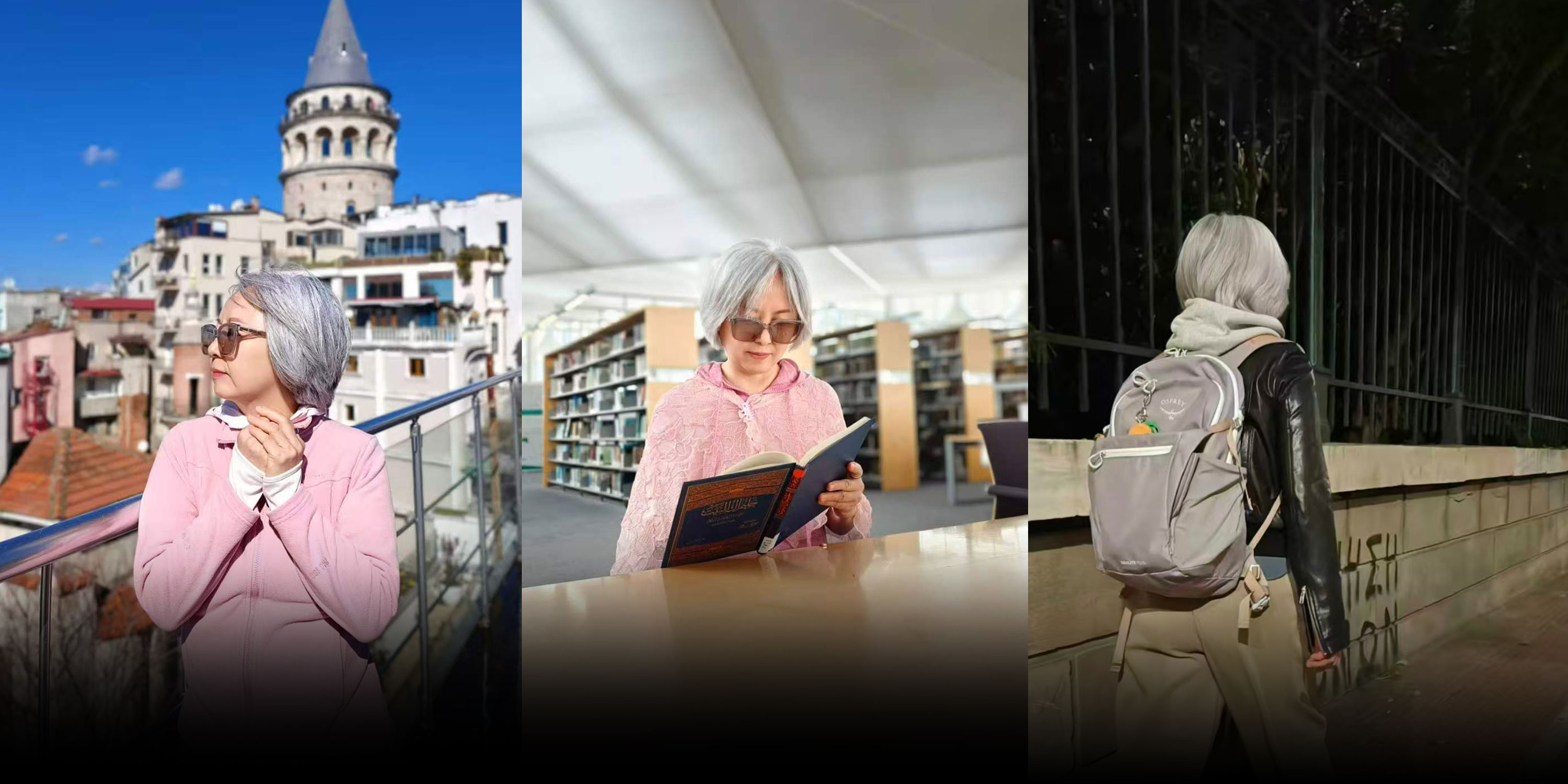
China’s Study Abroad Boom Finds a New Generation: Retirees
After decades spent working, raising families, and putting personal ambitions on hold, two Chinese women in their 50s returned to school thousands of kilometers from home.
In Athens, 58-year-old Ella Wang found a new sense of purpose at university, studying Greek archaeology, history, and literature. While in New Zealand, 54-year-old Zhao found herself overwhelmed by an English program that was far beyond her level.
Both studied alongside classmates young enough to be their children, but their experiences could hardly have been more different. Yet both are part of a growing number of Chinese retirees looking overseas for education.
Having spent their working lives during China’s reform era, many now have greater financial security, more control over their time, and familiarity with overseas education after sending their own children abroad.
China already has about 105,000 universities for older adults, but overseas programs that combine learning with international travel have a particular appeal for retirees seeking cultural experiences beyond the classroom. EF Education First, one of the world’s largest international education providers, estimates that China’s broader overseas education market for older adults will reach 1.2 trillion yuan ($167 billion) by 2030.
Yet for those entering education systems designed around younger students, the challenge is finding a classroom that fits.
Lesson learned
Zhao discovered that within days of arriving in New Zealand.
She had enrolled in what she believed was a beginner English program. EF had assessed her at A1, the lowest level, and shown her an A1 textbook before she left China. But when lessons began, every available course was beyond her level, and teachers spoke only English.
“It was completely incomprehensible,” Zhao told Sixth Tone.
After one lesson, she returned to the same room for the next class, only to find it empty. The class had moved, but she had not understood the instructions. On another occasion, a teacher called on her, and she did not understand the question.
Zhao had paid about 160,000 yuan for tuition and an eight-month homestay. After retiring from Shanghai’s flower industry, she hoped the program would teach her enough English to travel while she was still healthy. EF’s promotional videos had shown students studying, immersing themselves in local culture, and traveling around New Zealand.
She soon considered quitting. The experience, she felt, had been “overly romanticized” by overseas education providers. “I completely broke down and burst into tears,” Zhao said. “I couldn’t tell my family how miserable it was. I only said I missed them.”
Zhang, 56, had enrolled in a six-week program at the same school and found the pace equally punishing. “It was like I hadn’t even learned to stand, and they were already asking me to run,” she said.
Both had hoped to learn practical English: how to read a menu, take a bus, ask for directions, and order food. Instead, their classes focused on subjects such as history, biology, and mathematics. Another Chinese retiree in the same course quit after three days.
Zhang began to question what she was struggling for. “Do I really need to learn history, biology, and math at this age?”
That mismatch has led some Chinese education providers to design programs specifically for retirees. Yao Xiaoqiong, head of private education provider New Oriental’s Global Campus Center, told Sixth Tone that one- to three-year courses remain difficult for many older students. Instead, the company offers two- to four-week overseas programs, including art courses in the UK and culinary courses in France.
The programs require no prior language skills and include 10 hours of preparation before departure, as well as interpreters and coordinators during the trip. Yao said older clients generally seek cultural immersion and hands-on learning rather than degrees.
Zhang encountered some of that outside the classroom. When she got lost or struggled to understand bus announcements, strangers stepped in to help.
But keeping up with the course consumed her. Zhang studied until 11 p.m. and woke at 4 a.m. to prepare. In class, she relied on a translation app but still “couldn’t keep pace with everyone else.” Younger students often avoided partnering with her for group work.
By the end of the program, she was physically and mentally exhausted. She still hoped to return to New Zealand one day as a tourist. “But this time, I just don’t have the mood to travel,” she said.
Zhang said the program did not match how it was promoted, and planned to file a complaint with EF. The company did not respond to Sixth Tone’s requests for comment.
Zhao’s longer course gave her more time to adjust. Gradually, she learned to manage the classes, grew more confident, found time to hike, and made local friends through a church.
“Now I’ve made it through,” Zhao said. “I’m mentally much stronger.”
Second chance
At the University of Athens, 58-year-old Wang found her way back to an undergraduate thesis she had never considered complete.
Titled “God, Humanity, and Their Destiny,” the thesis at the time fell short of the university’s highest assessment. At her defense, a professor told her she would need “at least another 30 years of life experience” before she could fully develop its argument.
In 2023, while staying at her family’s holiday home in Athens, Wang came across an English-taught undergraduate program in Greek archaeology, history, and literature. More than 30 years had passed since her professor’s remark. “If I finish the archaeology and literature courses here,” she recalled thinking, “maybe I can write the essay better.”
Born in northwestern China’s Xinjiang Uyghur Autonomous Region, Wang had worked as a Chinese teacher, an advertising executive, and later in publishing before retiring. With one child in college and the other already working, she was free to spend part of the year in Athens.
Most of her classmates were born around 2006. “The last students I taught were born in 1983 and 1984,” she said. “Now, their children are my classmates.”
Keeping up with them meant learning more than history. Wang typed with two index fingers and struggled to navigate the university’s online systems.
During her first semester, Wang’s daughter arranged to work remotely from Athens, helping her practice English and navigate campus life. Reading textbooks on a screen made Wang “dizzy,” so she ordered printed copies and asked her husband to bring them to Greece.
The effort showed. While many students skipped lectures, Wang rarely missed one. She sat in the front row, stayed after class to ask questions even when she could not fully follow the answers, and spent weekends catching up on coursework. Before long, she was using AI to review her exams and identify mistakes.
She even won over classmates by showing them photos of her cats. “No one can resist kittens,” she said. She also discovered that gray hair was no obstacle to using her student ID for a 10% discount at KFC.
Studying the Peloponnesian War changed how Wang thought about conflict. She began to see the same struggle playing out beyond ancient Greece. “One side wants to preserve the existing order, while the other wants to change it,” she said. “That’s how many conflicts in the world work.”
She came to see traditional expectations around family and marriage as part of that same order. She wanted to break away from them, while her husband, who benefited from the arrangement, was more comfortable preserving it.
“My life used to be a multiple-choice question with only one correct answer,” Wang said. “Work, love, marriage. There was always something I was supposed to do at each stage, and I was carried along by society. People were always defining me: whose daughter I was, whose student I was, whose wife I was, whose mother I was.”
“Now my definition comes from myself,” she said. “I no longer care about those labels. I even have a new name: Ella. I’m Ella.”
Wang has thought about becoming a museum guide or writing a memoir after graduation. But she said those plans matter less than what she has already discovered. “The biggest thing I’ve gained over the past two years is realizing that learning itself is the goal, not a means to something else. I just enjoy learning.”
Sometimes, Wang still thinks of her hometown’s long winters in Xinjiang. As the eldest of four daughters, she helped her parents prepare vegetables for the cold months ahead. Surrounded by piles of produce, she longed to play with other children but could not leave.
“My body was confined by labor, but my thoughts were free. They had already traveled thousands of miles around the world,” she said.
Decades later, Wang feels she has finally caught up with those childhood dreams.
“Now I am standing in the open field of life,” Wang said. “I am lonely, but I am free. It is the solitude of freedom.”
Editor: Apurva.
(Header image: Ella Wang in Athens. Courtesy of Wang)