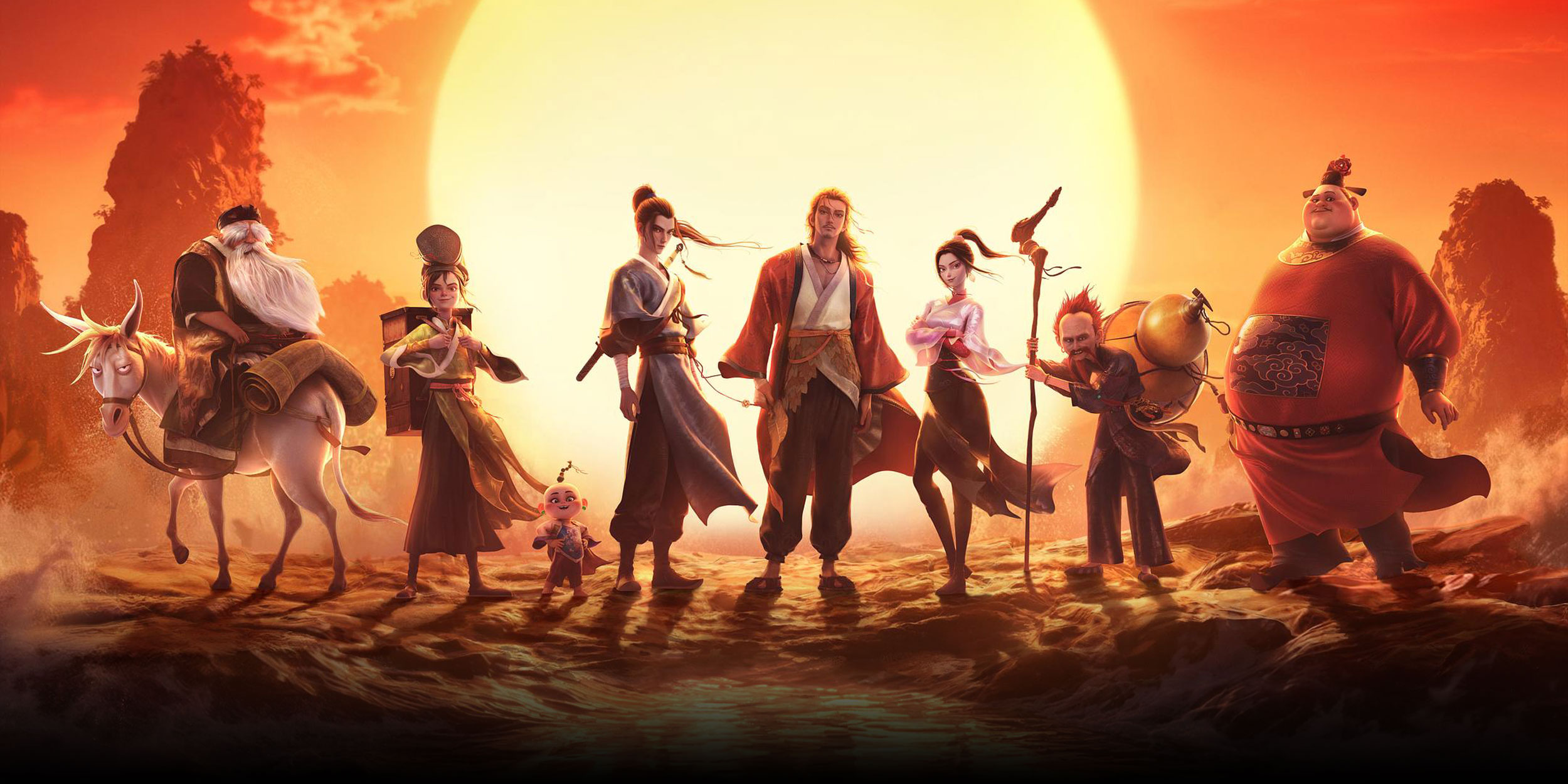
China’s Summer Hit Recasts the Eight Immortals as Con Artists
Before they were immortals, they were scammers.
That’s the irreverent premise behind “All Wishes Come True!,” a new Chinese animated comedy that has turned a band of mythological figures from Taoist legend into a summer box-office hit.
Released July 18, the film recasts the Eight Immortals — traditionally symbols of people from all walks of life — as con artists who impersonate gods and deceive worshippers before achieving immortality themselves.
In less than a week, the film has grossed more than 370 million yuan ($51 million), becoming the second highest-grossing domestic animated film of 2026 behind “Boonie Bears: The Hidden Protector.” It also holds an 8.3 rating on Chinese review site Douban, the highest among this summer’s new releases.
The film’s biggest twist unfolds in Penglai, a fairyland where gods and humans coexist under a surprisingly modern bureaucracy governed by an immortals management bureau. Deities are assigned temples, evaluated on performance targets, and ranked on giant leaderboards based on the incense offerings they receive.
Unlike traditional tales of the Eight Immortals’ journey toward enlightenment, the film gives the legendary figures a new beginning: they first appear as schemers targeting the riches of Fu, Lu, and Shou, the three deities of fortune, prosperity, and longevity.
Zhongli Quan, traditionally portrayed as a general who became a Taoist immortal, is reimagined as a con artist who leads the group in impersonating deities. Cao Guojiu, traditionally linked to the Song dynasty (960–1279) imperial court, appears as an official in the immortals management bureau.
After taking over a temple, the group finds itself responsible for granting wishes — and eventually becomes known for catching thieves. Their journey later leads to a clash with the war god Yang Jian.
Director Mu Zhengyang said he designed Penglai as a “first-tier megacity,” where gods and humans operate within a modern social system. “At first, audiences should feel that they’re entering a traditional Eastern fairyland. But once inside, it becomes much more like an amusement park,” he told domestic media.
The film’s character-driven approach also extends to its voice performances. Voice director Chen Hao, who worked on the popular “Ne Zha” films, voices Zhongli Quan, while Tieguai Li’s Chongqing dialect adds regional flavor to the character.
The film’s cultural references have also fueled online discussion. On streaming platform Bilibili, videos decoding more than 100 Easter eggs and hidden details have each attracted nearly one million views.
One widely discussed clue is the Eight Immortals’ temple number — 1350, the same number associated with Sun Wukong, better known as the Monkey King, in the “Book of Life and Death,” a mythical register of the underworld in “Journey to the West,” hinting at his possible appearance later in the story.
The same reinterpretation has also drawn criticism from some viewers, who argue that the film alters the identities and values associated with traditional mythology.
Yang Jian, for example, traditionally portrayed as a righteous war god who protects ordinary people, is reimagined as a figure willing to sacrifice heaven and humanity to save his mother. The film’s other redesigns have also drawn attention, including Cao Guojiu’s portrayal as an overweight, flamboyant official and Lan Caihe’s depiction as a toddler.
The debate also extends to the film’s portrayal of immortality. Through the line, “Only immortals can do good deeds,” it offers a new interpretation that some viewers praised, while others argued it differs from traditional Taoist ideas of attaining eternal life.
The production team, based in southwestern China’s Sichuan province, said the Eight Immortals offer creative space for reinterpretation because many audiences know their famous stories but are less familiar with their broader legends. The filmmakers said they hoped to introduce the figures to a new generation through a fresh retelling.
“We didn’t want to simply bring the Eight Immortals in front of young audiences and tell the same story again,” producer Ying Xujun told domestic media. “We had to create something new for a new generation.”
Editor: Apurva.
(Header image: A poster for “All Wishes Come True!” From Douban)