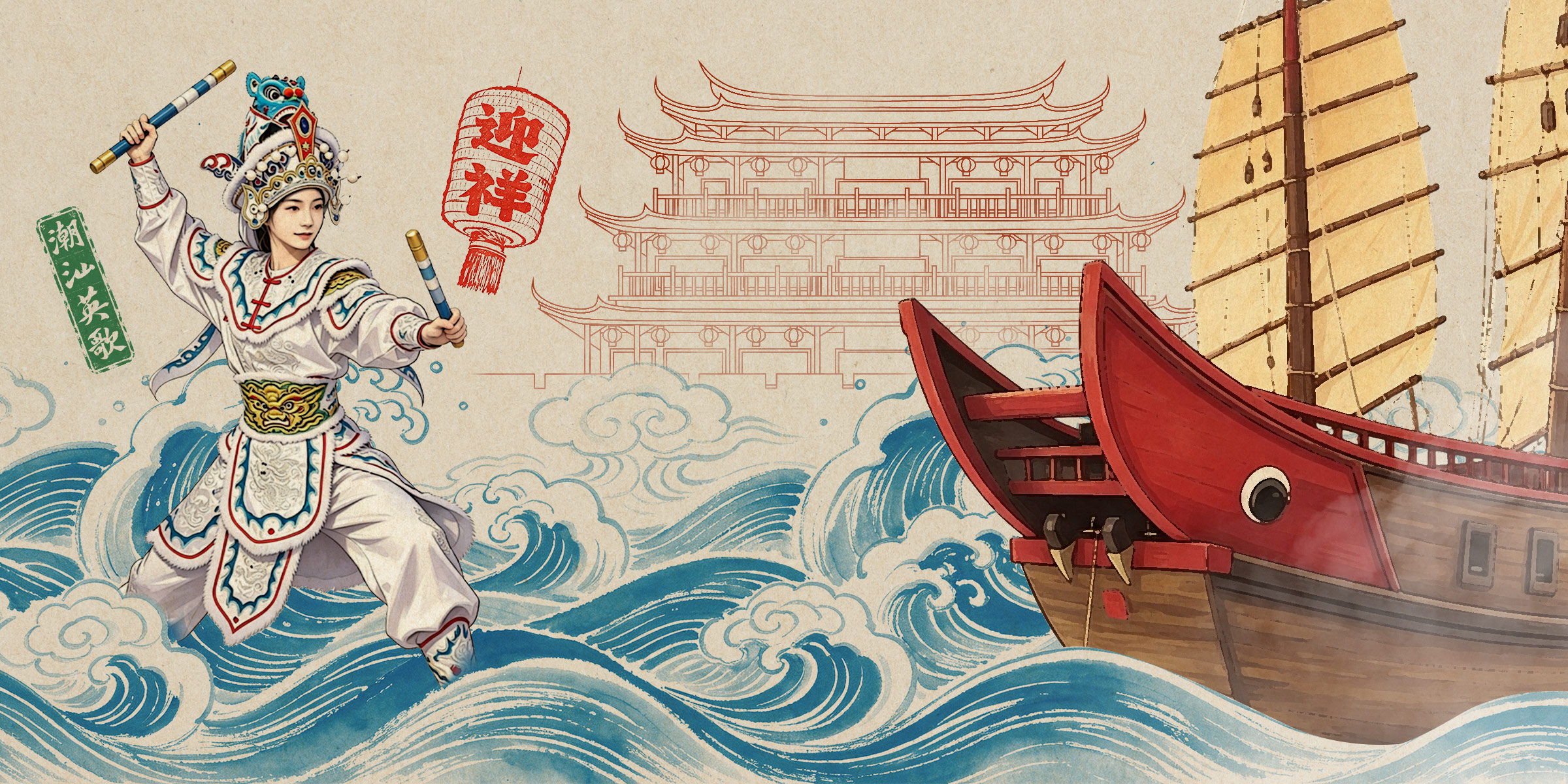
From Chaoshan, Into the Stars
This is the fourth article in a series on China's southern Chaoshan region, exploring the history, culture, and identities behind its recent resurgence in the spotlight. Read Part 1, Part 2, and Part 3.
Thousands of light-years away, on a planet illuminated by a binary star system, humans have built a city that floats on the tides. An intelligent system governs the sleep, diet, and travel of everyone living there. Yet when a group of the planet’s inhabitants — descendants of people from Chaoshan, a region in southern China’s Guangdong province — hear the drumbeats of the Yingge dance, they feel the same passionate physical response as did their distant ancestors.
This is the basic premise of my recently published young adult sci-fi series, the “Raging Yingge” trilogy. In it, I wanted to convey an idea that I’ve become increasingly convinced by in recent years: Chaoshan people may well be among the first humans willing to migrate to the stars — but they would also bring their customs with them.
Over the past few centuries, this coastal region has been the origin of one of the world’s largest Chinese diasporas, with millions of people of Chaoshan heritage now living across the globe. From Southeast Asia, Europe, and North America, they run businesses everywhere from Bangkok’s Chinatown to Paris’ 13th arrondissement. Wherever they go, they still speak the Chaoshan dialect, eat beef meatballs and noodles, and worship the same deities and ancestors.
I myself am a native of Chaoshan. I grew up in Shantou, Guangdong province, near the historical district of Xiaogongyuan, where there was a Bo Gong temple by the entrance to the alley. Bo Gong is the local earth deity, and almost every neighborhood has a temple dedicated to him. Locals passing by drop in to pay their respects or cast divination blocks to ask their fortune, just like people nowadays pull out their smartphones to ask artificial intelligence. I can still remember the smell in the temple: incense ash mingled with the fishy scent of the wet market that clung to my nostrils and refused to fade. Some people prayed there, others cried, but most just nodded as they passed. A single temple bound together the beliefs and destinies of thousands of households across the neighborhood.
Back then, all I could think about was escape. At school we were taught materialism, while at home I was irritated by the endless rounds of ancestral rites and holiday rituals. I fought with my grandmother over the television remote: She wanted to watch Chao opera, while I wanted cartoons. When I left for university in Beijing at the age of 18, I felt a wave of relief as the train pulled out of the Chaoshan plain. At last, I was leaving behind this small, old place with all its rules and conventions.
However, after turning 30, my perspective completely reversed. While at Google, I’d have meetings with French, Thai, and American colleagues, and when I asked about their ancestry, it turned out they all traced it back to Chaoshan. Later, when I went to Shenzhen, I’d hear the Chaoshan dialect as I walked along the street and see beef hotpot restaurants everywhere. It was only then that I realized that Chaoshan people had already been practicing decentralization for generations. From stepping aboard the pioneering, iconic red-head junks and sailing to Nanyang in the Qing dynasty (1644–1911), to the network of Chaoshan merchants scattered around the world today, wherever they settled, they remained recognizably themselves.
Gradually, I came to understand what holds this whole web together. It isn’t scripture, doctrine, or political power — it is a web of human relationships. The nodes are ancestral halls, the connections are kinship ties, and the protocol is an unwritten ledger of favors and obligations passed on by word of mouth. This system was lightweight enough to fit into the hold of a red-head junk bound for a new world, yet resilient enough to operate simultaneously in the rice paddies of Siam, the rubber plantations of Malaya, and the streets of Paris. What’s more, the polytheistic and animistic nature of Chaoshan faith means that each Bo Gong temple has served as a self-contained node wherever it was moved and rebuilt. In modern-day terms, this was a distributed cultural-survival framework.
Meanwhile, qiaopi — remittance letters exchanged between Chinese migrants overseas and the families they left behind — play an important role in this framework. A single qiaopi doesn’t look like much, yet it serves as the trust protocol of this distributed network. As long as one letter is sent and another is received, two people on opposite sides of the ocean can be simultaneously present in each other’s reality. Chaoshan people call this “carrying someone in your thoughts.” People are not afraid of poverty, distance, or death. What they fear is the severing of these ties.
So when I say that Chaoshan people are suited for interstellar migration, it’s not just a joke. The hardest part of settling a new planet has never been rocket thrust: It’s whether a social system can be transplanted. A bureaucratic apparatus is too heavy to bring along, and there’ll be no one to enforce a constitution. Bring a clan network instead, then the ancestral hall becomes the community center, the ledger of favors and obligations becomes a mutual-support network, and the Bo Gong temple becomes a spiritual anchor. It doesn’t rely on any external infrastructure because it’s composed of those countless ties of gratitude, grievance, and longing that bind people together.
This points to a fundamental difference between the rooted, yet mobile Chaoshan approach toward embarking on voyages and the frontier Western narrative of exploration. In the classic image of interstellar exploration presented in Anglo-American science fiction, a person stands on the surface of a strange planet, looks back at their spaceship, and then heads out into the wilderness. He is saying goodbye to his old world. But this is not how Chaoshan people go out. When the red-head junks left Zhanglin Port, no one truly looked back. It’s not because they weren’t reluctant to leave, but because everything was already on board the ship: ancestral tablets, soil from their hometown, and agreements recording who had contributed money and labor. They weren’t leaving Chaoshan at all. They simply rolled it up, slung it over their shoulders, and carried it with them, spreading it to more distant and unfamiliar seas and countries. They never truly left.
Of course, this cultural tenacity has another side, and Chaoshan contains a structural contradiction, one that has taken me many years to understand. On the one hand, there is a deeply conservative insularity: family, ancestral halls, dialect, offerings — all that must be protected, passed down to the next generation, and not altered. On the other hand, there is an intense drive outward, borne by the geography itself — going out to sea, doing business, leaving for foreign countries, and expanding business to every corner of the world with a port. The two forces operate simultaneously within the same group of people — and I’m no exception. Rather than go into business as many had assumed, I insisted on writing science fiction. Rather than having men perform the Yingge dance in line with Chaoshan traditions, I deliberately made a young girl the lead dancer in my novel. Every Spring Festival, a kind of gravitational pull deep inside my bones draws me back to Shantou. But once I get home, all those rituals and conventions make me uneasy. To call it reconciliation would be too simple — it’s more like an endless tug-of-war.
And yet, this very tug-of-war is what creates both tension and momentum. Looking inward preserves the cultural core, while reaching outward prevents it from turning into a fossil. Twisted together, these two forces have allowed Chaoshan people to endure the currents of globalization longer than most communities. The same is true in writing. The most interesting things often emerge from the space between these two forces.
I’ve coined a term of my own for writing that explores this: “Chaoshan futurism.” In it, you throw a highly local culture into a far-distant future shaped by algorithms and interstellar distances and then watch what happens when the two collide. In a city where AI controls everything, who will people perform the Yingge dance for? Who will the kung fu tea be brewed for? And will there still be deities to answer the prayers offered in a Bo Gong temple?
While writing my trilogy, I came to understand that these concrete, everyday acts are why the Chaoshan people haven’t disintegrated despite being scattered around the world for several hundred years. These seemingly insignificant acts are the smallest units of cultural survival. They don’t require anyone’s approval or an institution’s support. As long as people continue to exist — and as long as human ties and affections remain — they will continue to survive. And what’s more, they’ll likely last much longer than we can even imagine.
It’s now 2026. AI is writing poems, creating art, and making decisions for us. But there is one problem that algorithms cannot solve: They don’t know what it means to carry someone in your thoughts. No large language model can calculate how a migrant bound for Nanyang might compress all the complexity of longing, worry, and affection into a few brief lines for family members across the sea. The amount of computation contained in that moment exceeds anything humanity has ever encoded into an algorithm, because it isn’t the optimal solution — it’s the most human one.
Translator: David Ball.
(Header image: Visuals from VCG, edited by Fu Xiaofan/Sixth Tone)