The Lexicon of Revolution: Tracing the Origins and Global Journey of China’s ‘Long March’
This year marks the 90th anniversary of the victory of the Long March — a foundational epic of the Chinese Red Army’s perilous passage from Jiangxi province in the east to Shaanxi province in the northwest, which helped them survive their Kuomintang enemies. Yet, this epic might have remained confined to a localized military retreat were it not for the language used to describe it. In the annals of history, events are often defined by those who name them.
The name used to define the Long March — changzheng — contains a story that parallels the arduous journey. According to historian Li Dongfang, the term did not appear immediately; instead, it evolved alongside the struggle itself.
The earliest known official reference to the term dates back to February 1935, in a document released by the General Political Department of the Red Army. It opens with the line: “Our Workers’ and Peasants’ Red Army has shifted its combat zone from Jiangxi and made a changzheng to the border region of Sichuan and Guizhou.”
In Chinese, chang means long, while zheng can mean either a journey or, in military contexts, an expedition. And so, the term came to be used to describe a large-scale military expedition.
By May of that year, Commander-in-Chief Zhu De issued the “Proclamation of the Chinese Workers’ and Peasants’ Red Army,” featuring the sentence: “The Red Army has made a changzheng of ten thousand li, advancing with irresistible force,” using the Chinese measurement equivalent to 500 meters. Later, in August 1935, the Central Political Bureau’s resolution at the Shawo Meeting officially referred to the strategic shift as the “18,000-li Changzheng,” marking the first time central documents formally adopted the term for the Central Red Army’s movement.
One year later, in August 1936, Mao Zedong and Yang Shangkun initiated a campaign to compile firsthand accounts of this odyssey. The resulting manuscript, compiled in February 1937 under the title “Red Army Chronicles of the Changzheng,” became the primary source.
It is here that the story intersects with American journalist Edgar Snow.
Snow arrived in China in the summer of 1928, cutting his teeth at The China Weekly Review in Shanghai before venturing into the Communist base in Yan’an, Shaanxi province, in mid-1936. By then, the term changzheng had been popularized in political documents and Mao’s 1935 poem of the same name. Snow’s subsequent masterpiece, “Red Star Over China,” did more than just report the journey; it mythologized it. Drawing heavily upon materials from the “Red Army Chronicles,” Snow recounted how a besieged force rose from the brink of extinction to become a revolutionary flame.
Toward the end of the seventh paragraph in “Red Star Over China,” we see the first documented appearance of the term “Long March”:
What were the hopes and aims and dreams that had made of them the incredibly stubborn warriors — incredible compared with the history of compromise that is China! — who had endured hundreds of battles, blockade, salt-shortage, famine, disease, epidemic, and finally the historic Long March of 6,000 miles, in which they crossed twelve provinces of China, broke through thousands of Kuomintang troops, and triumphantly emerged at last into a new base in the Northwest?
In the Western consciousness, the “Long March” exists as a concept precisely because Snow, a Missouri-born reporter, chose those two specific English words to describe a desperate flight for survival. In English, “long” naturally captures the vast distance, while “march” describes both an ordinary trek and a military advance. If anything, “march” adds a subtle layer of order, determination, and momentum, arguably giving it a richer connotation than the Chinese itself. Simple and punchy, it’s a brilliant translation.
Growing up in Taiwan during the era of Cross-Strait confrontation, I saw the Long March as a distant abstraction. Our textbooks remained silent on the ordeal, treating the history of the Communist Party of China as a taboo subject, and it wasn’t until 1992 that I first set foot on the mainland. Amid the traditional sights of Beijing, I visited Peking University and stood before Snow’s tomb by Weiming Lake. The headstone, inscribed by Marshall Ye Jianying, honored him as an “American Friend of the Chinese People.” It left me unmoved at the time — I simply wasn’t aware of the significance of his work in China. But as I matured in my career as a lexicographer, I began to see Snow not just as a journalist, but as a profound linguistic bridge.
The Oxford English Dictionary (OED), the definitive authority on the English language, confirms this. In my research into Chinese-derived words, I found that the OED cites Snow’s account as the earliest attestation for the term “Long March.” Through his seminal translation of changzheng, Snow became the term’s canonical translator.
The evolution of the entry within the OED reflects the event’s rising historical significance. In 1976, “Long March” was first added to the dictionary, merely as a subentry under “long.” However, in June 2016 — coinciding with the 80th anniversary — the OED upgraded it to a standalone main entry with a comprehensive historical definition: “The retreat of Chinese Communist forces ... in 1934–35 ... over a distance of 6,000 miles.”
The OED’s choice of this timeframe reflects the prevailing view among Western media outlets, which is based on the Central Red Army’s departure from southern Jiangxi. It does not account for the arrival of other Red Army factions in 1936. Yet the entry concludes with historical commentary — rare for a dictionary: “The retreat ensured the survival of the Communists and made possible their ultimate victory over the Kuomintang in 1949.”
Through six selected quotations spanning 1937 to 2007, the OED traces the term’s evolution. It begins with Snow’s original 1937 description of the “historic Long March of 6,000 miles” and moves through Life Magazine’s 1950 acknowledgment that the march solidified Mao’s undisputed leadership. It even touches on personal tragedies, citing scholar Li Xiaobing’s 2007 note about a mother losing her son amid the ordeal.
Yet language, like revolution, is rarely static. Over time, the Long March shed its capital letters to become the common noun “ long march,” signifying any arduous journey toward a political or social goal. The name has ascended even further — from the earth to the stars. Consider how China’s “Long March” rockets — such as the Long March 10 super-heavy lift vehicle — have become fixtures in international aerospace reporting. As The Los Angeles Times recently noted, these tests mark “complete successes” in China’s mission to reach the moon.
In an era of AI hallucinations and digital noise, linguistic evolutions like this remind us that words bear the weight of history. What began as a desperate retreat was immortalized as a revolutionary epic, and now stands as a metaphor for both arduous pursuit and a journey to the cosmos. Ninety years on, the Long March has transcended its origins. It is no longer just a Chinese story: It has become an indelible part of the global lexicon.
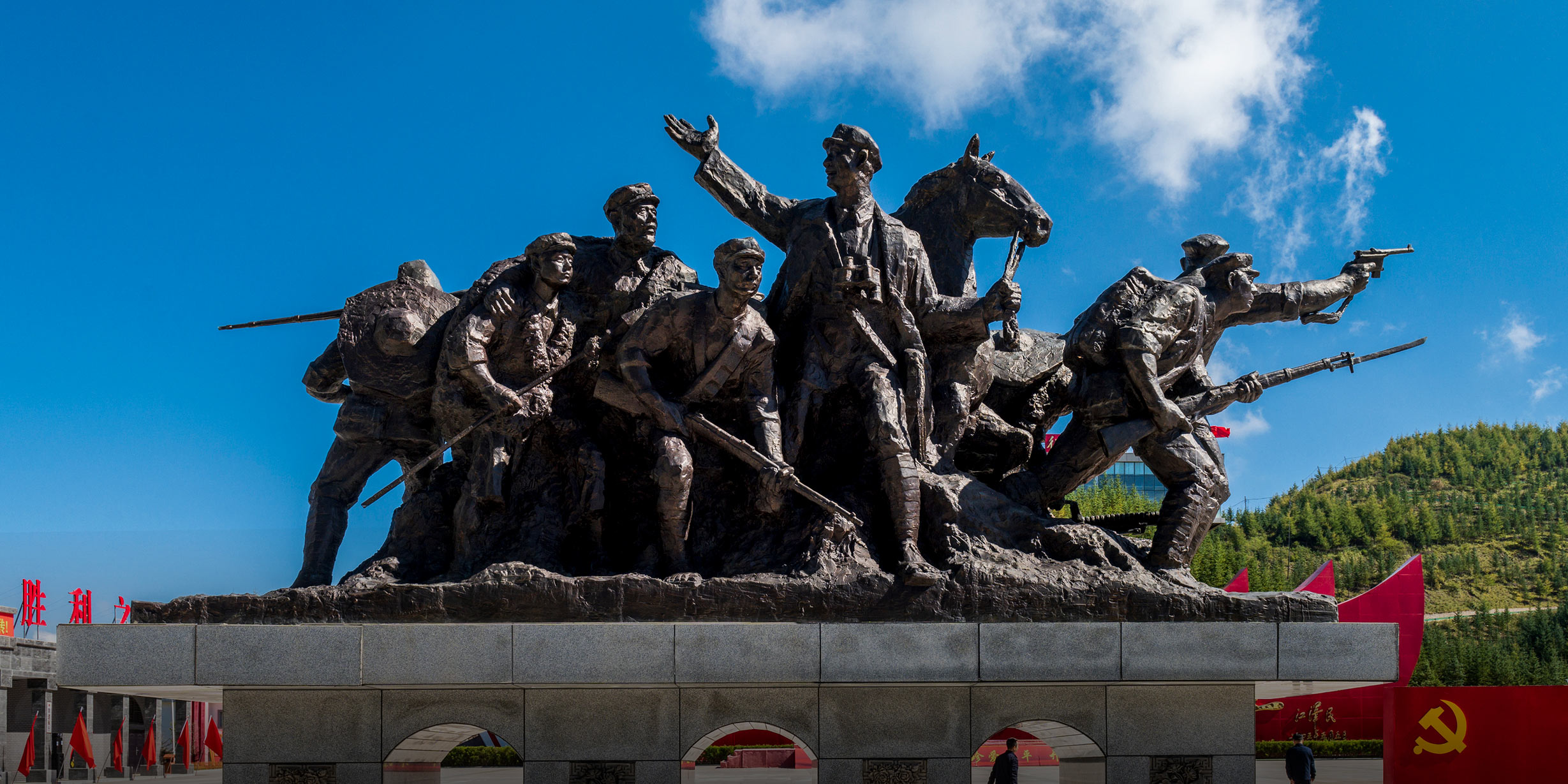
(Header image: A statue commemorating the Long March in Guyuan, Ningxia Hui Autonomous Region, 2025. Sun Leshan/VCG)