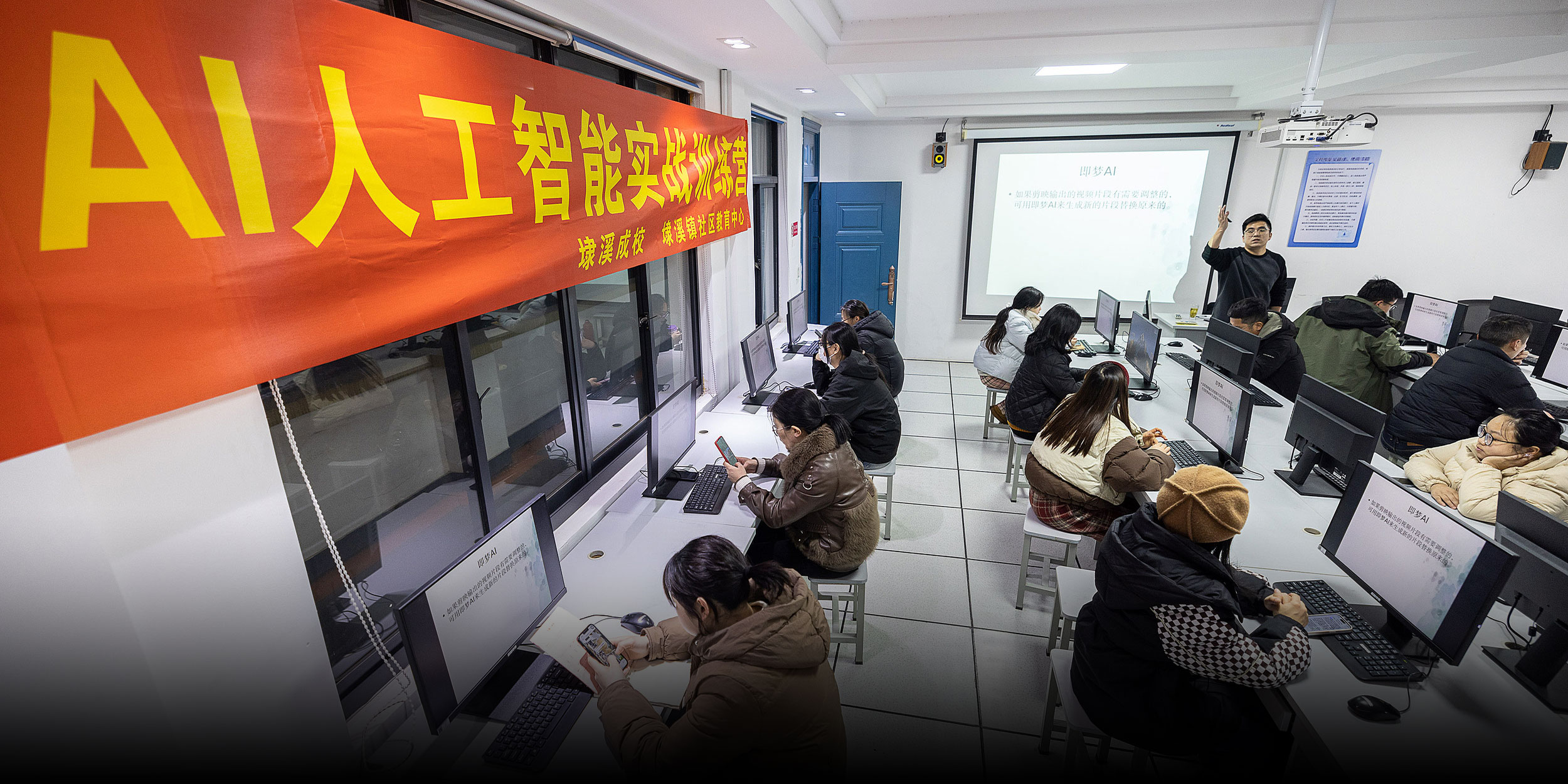
Locked Out of China’s AI Boom, Graduates Turn to Bootcamps
When Wu Jianhua graduated from college in June 2024, China’s AI industry seemed to be hiring everyone except her. Desperate for a way in, she turned to AI tutorials on social media.
“But the videos were mostly aimed at professionals and used very complex language,” the 24-year-old told Sixth Tone.
So when a friend who had completed the program and landed a job told her about a three-month AI training bootcamp in Beijing, Wu decided to give it a shot. By the end of March, she had learned Python, the programming language, and landed a job as an AI Junior Trainer, one of a growing number of entry-level roles supporting China’s AI boom.
“Unlike the videos I found online, the courses broke concepts down with examples,” Wu said.
Wu is one of a growing number of Chinese graduates turning to short-term training programs as competition for jobs intensifies. With the number of new graduates rising from 7.65 million in 2016 to 12.7 million this year, many are finding that employers increasingly value practical skills over academic credentials alone.
To close that gap, local governments have rolled out short-term training programs tied to fast-growing occupations. The courses range from AI-related work and drone piloting to health care and elder care.
Whether a few months of training can translate into a lasting career remains a subject of debate. For now, demand for such programs appears to be growing.
Bootcamp
The job Wu landed was less glamorous than the title might suggest. Rather than designing AI models, junior AI trainers spend much of their time cleaning, organizing, and analyzing data to help improve AI products.
To prepare students for that work, the bootcamp at the Beijing AI Future Vocational Education School began with Python, widely used to process and analyze large datasets. Trainees were also introduced to workplace AI tools commonly encountered on the job.
Unlike the tutorials she had found online, the bootcamp followed a structured curriculum. Wu reinforced lessons through practical exercises and could turn to instructors and teaching assistants on messaging app WeChat whenever she got stuck.
“The instructors would go over the questions people kept running into and explain the difficult parts again,” Wu said. “There were also regular quizzes, so you always knew whether you were keeping up.”
Since March, more than 1,500 people have completed training through the Beijing school, many of them unemployed and looking to improve their job prospects through new skills, according to Zhao Xuesong, a partner and board member of the institution.
One of the biggest challenges, Zhao said, is correcting misconceptions about the field. Many trainees assume AI training means learning to program or build AI systems, when much of the work involves translating business needs into data, feeding that data into models, fine-tuning and deploying the solutions, and driving continuous iteration to enhance AI usability.
“We need to explain clearly that AI training is not the same as programming or coding,” she said.
The program combines self-paced online coursework with hands-on training led by university instructors and industry professionals. Tuition ranges from 1,200 yuan to 2,400 yuan ($170 to $335), depending on the course level.
Graduates who find work as junior AI trainers through the program typically start at around 5,000 yuan a month, according to Zhao. Roughly 85% of trainees pass the certification exam on their first attempt, while those who fail can retake both the course and exam free of charge.
After completing the program in March, Wu was introduced to potential employers through the school and soon began interviewing for positions. Zhao said the institution maintains long-term partnerships with domestic tech companies including Alibaba, ByteDance, Tencent, and Baidu.
“Without the institution, I might not know which companies are hiring for this role. I would be in a relatively closed information loop,” Wu said.
She now works largely remotely and, aside from a weekly team meeting, enjoys a flexible schedule.
Plan B
When Li Jiaxin signed up for an AI training program last August, she was looking for any job that offered some semblance of stability: a steady salary, weekends off, social insurance, and housing fund benefits.
Fresh out of college, Li had spent months applying for video-editing jobs without success. As classmates found work or moved on to graduate school, she grew increasingly anxious. “I just wanted to get ashore,” she said.
Despite having no prior experience in artificial intelligence, Li landed a job as a junior AI trainer after completing the training. The role involves creating videos, learning new AI tools, and working on-site from 9 a.m. to 6 p.m.
Not everyone is convinced that such programs are a long-term solution. Short-term training courses risk narrowing education into a quick pipeline for producing job-ready workers, said Ma Jiuyuan, a career advisor at Shanghai’s Fudan University.
Without unified certification standards or reliable public data on employment outcomes and salaries, graduates may struggle to distinguish between serious training providers and expensive anxiety-driven bootcamps. Ma said she has seen students enroll in costly AI-generated content courses hoping to gain an edge, only to discover that the curriculum covered little more than basic generative AI tools.
At the same time, employers increasingly favor candidates with practical experience, Ma said. “A graduate with only textbook knowledge may be eliminated at the résumé screening stage.” For that reason, she argued, short-term training can help bridge the “last mile” between campus and the workplace.
Ma also acknowledged the policy’s role in easing structural mismatches in the labor market, particularly for vocational students, applied undergraduates, and graduates seeking to switch careers. She nevertheless called for stronger oversight, including greater transparency around employment outcomes and salaries.
Yu Zhuanzong, an associate professor at Fudan University and career planner, expects demand for such programs to continue to grow. As industries evolve faster than university curricula, graduates increasingly need short, practical courses to update their skills after leaving campus, he said.
Li can already see the demand among her peers. Many of her former classmates remain in traditional industries, and she said she would recommend the program to those looking for a different path.
“It’s at least a fallback,” she said. “And if you do well, the instructors may recommend you for better jobs.”
Her own ambitions have expanded as well. “As I go deeper into the industry, my goals have become clearer,” she said.
“Beyond a stable job and a good work environment, I want to build my professional skills so that I qualify for more roles and eventually earn a higher salary.”
Editor: Apurva.
(Header image: Inside an AI training bootcamp in Huzhou, Zhejiang province, 2025. VCG)