How Emojis Have Become a Language Within a Language in China
It’s the Year of the Horse, and as you’d expect, the horse face emoji has become a favorite on Chinese social media, especially for conveying greetings and blessings during the Spring Festival. However, not all the messages are positive. For example, when someone says “I’m stepping on *horse face emoji*,” it does not mean they are riding a horse — rather, they’re expressing frustration or anger, using the horse emoji as a substitute for a profanity that users often avoid writing out directly.
But the horse face was a common sighting on the Chinese internet, even before this year. Used in lieu of direct references to words that share a similar pronunciation with “horse” (ma) in Chinese, it can represent everything from “mother” and “mosaic” to “marked.” For example, if someone posts something useful, you can indicate your interest by commenting with a horse face.
This was not how emojis were originally designed to be used.
Invented by Japanese mobile phone companies in the late 1990s, emojis were originally designed to make text messages more expressive. Emoji itself is a portmanteau of the Japanese words for “picture” (e) and “character” (moji). As smartphones spread around the world, so did emojis, which evolved from a niche Japanese feature into a near-universal part of online communication: the entire set was eventually encoded into Unicode in the 2010s, making it compatible with Latin letters, Chinese characters, Arabic numerals, and other scripts.
The number of encoded emojis has increased from a few hundred in 2008 to 3,953 today (including gender- and skin color-inclusive variants), and newly approved emojis are always big news. The “face with tears of joy” emoji was even chosen as Oxford Dictionaries’ 2015 “word of the year.” Emojis have already been accepted as a language.
Yet in China, emojis became something more: a language within a language. Since emojis fall within the realm of typography, Chinese users searching for characters via pinyin input will also see related emojis suggested alongside them — a feature introduced years before the English equivalent. In this system, the emojis are linked not by meaning, but by sound.
If you type “it’s doomed,” yao wanle in pinyin, not only are you presented with the word for “doomed” but also the medicinal pill, “yaowan,” emoji. This input quirk quickly became part of online slang, with the pill emoji coming to mean “impending doom.” Young netizens might comment, “This freaking site is *pill emoji* sooner or later,” under vulgar videos, or convey their loss of confidence in a celebrity after a PR crisis by posting a string of pills.
Chinese users developed this phonetic use of emojis partly because of the convenience of pinyin input, but also because Chinese characters are logograms — multiple characters sharing the same pronunciation make puns and homophonic wordplay a natural part of daily life. On social platforms, that same logic has also made emojis a useful way to soften or disguise words that users — vying for maximal exposure of their posts on platforms — may not want to write directly.
Double-entendre emojis also play a key role in the Chinese internet’s “abstract” subculture. Emerging from communities on the once hugely popular Baidu Tieba messageboard and livestreaming platforms in the mid-2010s, “abstract” (chouxiang) is a youth-driven internet subculture built on absurdist humor, homophonic wordplay, and deliberately high-context references. Its users often communicate through layers of puns, emojis, and inside jokes, creating a playful, often cynical vernacular that has since spread far beyond its original communities. Public figures such as Go player Ke Jie have even helped popularize its language.
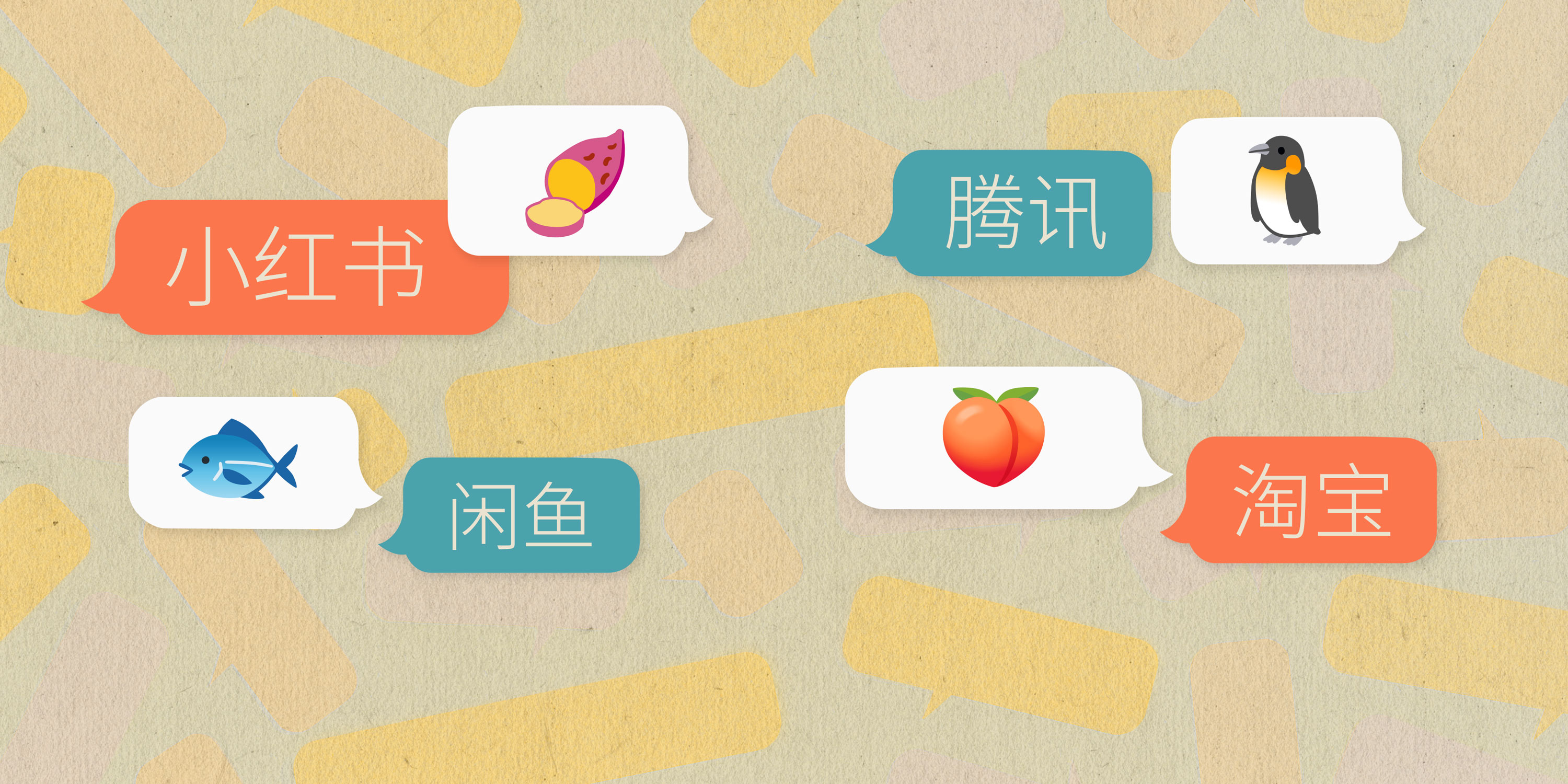
By the late 2010s, increasingly strict keyword shadow-filtering mechanisms on livestreaming and short-video platforms further promoted the use of covert emojis. For instance, platforms with their own e-commerce channels may block posts containing the name of the e-commerce giant Taobao, prompting users to substitute “Tao” with a peach emoji, since “peach” is pronounced tao in Chinese. With platforms expanding their lists of shadowbanned phrases — and even homophones of phrases — users have had to keep up. One common substitution for “kill (sha),” for example, is an emoji of a shark, or “shayu.”
As a result, the practice of using phonetic emojis to convey double meanings remains prevalent across almost all social media platforms. Even users with no connection to the “abstract” subculture use them for double meanings, sound-alike jokes, or simply because they make ordinary comments more playful.
Yet as this cyber rhetoric evolves, it also risks becoming too tribalized. Younger generations raised in this environment naturally regard such usage as normal; however, many older users struggle, taking emojis at face value and missing their connotations, hobbling communication between generations. When the younger generation takes this language out into the wider world, the meaning may be lost on those outside the culture. Not everyone shares their niche references or is internet savvy, so, via homophonic wordplay and subcultural in-jokes, emojis become insider symbols — harder to decode and harder to feel part of.
Emojis were once hailed as a universal visual language that could transcend linguistic boundaries. Yet on the Chinese internet, they have been absorbed into local systems of pronunciation, platform algorithms, slang, and subcultural identity. The result is paradoxical: the more universal emojis become, the more culturally specific their meanings grow. As they travel across countries, communities, platforms, and generations, the pictograms themselves may remain unchanged, yet an ever-growing user base continues, consciously or unconsciously, to imbue them with new layers of meaning, many of which do not often translate across groups. In trying to build a digital language shared by everyone, the internet may simply be constructing a new Tower of Babel.
(Header image: Visuals from VCG, reedited by Sixth Tone)