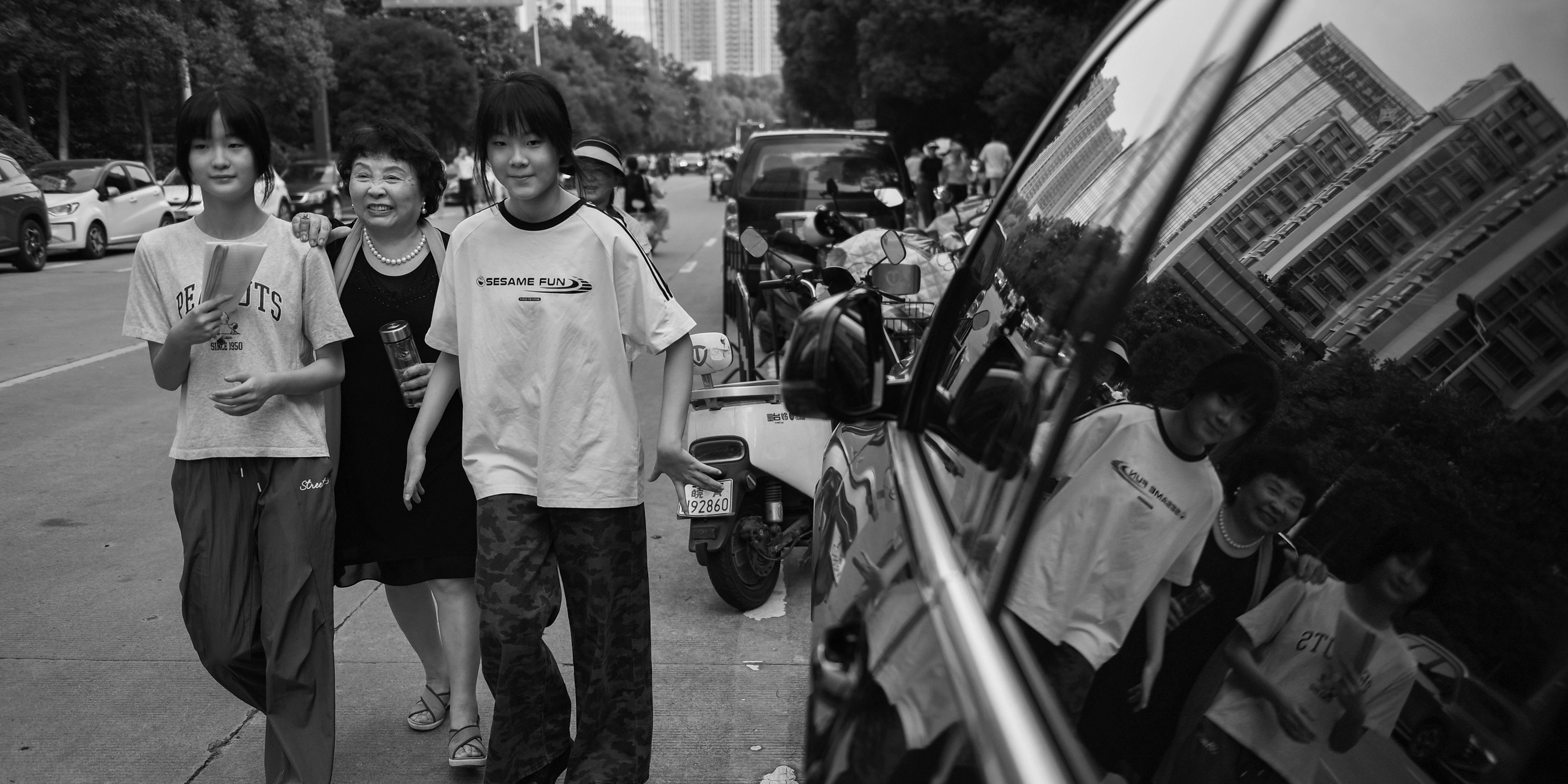
The Life Project: Documenting the Chinese Woman Who Gave Birth at 60
In 2009, Sheng Hailin, a 59-year-old retired doctor living in Hefei, capital of eastern China’s Anhui province, lost her only daughter to carbon monoxide poisoning. In an instant, she became one of China’s “shidu” parents.
In China, “shidu” — literally “loss of only” — describes parents whose sole child has died. Beyond grief, the bereaved also face the collapse of the traditional family structure that promised emotional and financial support in old age. Many are past childbearing age and unable to have another child.
When photographer Wu Fang first began documenting shidu families, estimates from the 2010 China Health Statistics Yearbook, released by the former Ministry of Health, suggested there were 841,000 nationwide, with the number growing by roughly 76,000 each year. Some media reports, citing the same yearbook, placed the figure at more than 1 million.
Unwilling to accept her inability to have another child, Sheng would make a decision that thrust her into the national spotlight: At 60, she underwent IVF and gave birth to twin daughters, Zhizhi and Huihui, in May 2010. At the time, she was the oldest woman ever to undergo assisted reproduction in China.
The story quickly became a lightning rod for debate. To some, Sheng represented maternal resilience and defiance in the face of tragedy. To others, her decision raised uncomfortable questions. Could a woman in her 60s raise two children? Who would care for them if her health failed? Was her act driven by courage, selfishness, or something in between?
Fifteen years later, those questions remain — as does Sheng.
In 2022, Sheng’s husband died after suffering a stroke, leaving her to raise the twins alone. To support the family, she came out of retirement to work as a traveling health lecturer before reinventing herself as a livestream host, garnering nearly one million followers. Over the years, she has never been far from the public eye — major media outlets like CCTV have repeatedly told her story. Her twin daughters have grown from babies into teenagers about to enter high school.
Wu has quietly documented much of that journey.
A Hefei native and former photo editor at two local newspapers, Wu had spent years working with international agencies including Reuters, Agence France-Presse, the Associated Press, and Getty Images. Living in the same city allowed him to build a long-term relationship with Sheng and her family. Since first photographing the twins shortly after their birth in 2010, he has spent 15 years documenting their lives, producing nearly 20,000 images.
In 2026, his project “Motherhood at 60” won the Long-Term Project Award at the 69th edition of the World Press Photo Contest, making Wu the only photographer from the Chinese mainland to receive an award that year.
The jury described the work as “an intimate and layered portrait of a family in China,” praising its exploration of care, resilience, motherhood, and the lasting impact of the one-child policy, as well as its transformation of a personal story into a broader reflection on social pressure, life chances, and enduring family bonds.
In an interview with Sixth Tone, Wu reflects on how he gained the family’s trust and the ethical tensions that arise when documenting intimate lives over such a long period.
The interview has been edited for length and brevity.
Sixth Tone: How did you first approach Sheng Hailin? Did living in Hefei help?
Wu: Absolutely. We live in the same city, so I could visit often, sometimes just for a casual chat. I was working at a newspaper when we got a tip that a 60‑year‑old woman was about to give birth to twins. We went to see her. She didn’t object, so we started documenting.
At first it was just a straightforward news story: a 60‑year‑old shidu mother gives birth to twins. We didn’t deliberately discuss policy issues. Staying neutral as a medium, not expressing a point of view, is itself a point of view. She was quite tolerant of the media, but she gradually learned that public attention was a double‑edged sword.
Sixth Tone: How did you build trust with Sheng Hailin? Was there a turning point?
Wu: China is a society built on personal connections. After I visited a few times, we became familiar. Sometimes she ran into difficulties — including a livestreaming controversy — and we would help her speak out or give her advice, which she took. I see us more as friends.
Before each visit, I would call and say, “I’ll come see you in a couple of days.” She understood that “see you” meant chatting and taking some pictures. She’s a strong‑willed person, but at her age, she doesn’t have many people to really talk to, so she would share her troubles, her recent feelings, and the difficulties of raising the girls. Trust built up gradually — there was no single turning point. It just grew over time.
Sixth Tone: How do the teenage twins relate to you? Do they ever refuse to be photographed?
Wu: Every time I go, they still accept me. But now that they’re teenagers, they care about their looks. They might say, “My bed isn’t tidy yet; wait a moment,” or “Let me put on some makeup.” Sheng also likes to look good, and she jokes, “Don’t make me ugly.”
Sometimes I think it would be easier if the person documenting them were a female photographer — she could get closer to their daily lives and photograph more intimate spaces. For example, when the girls used to share a bunk bed, it was easier to capture their interactions. Now they have separate rooms, which makes it much harder to shoot the two of them together. And forget about dormitories — school officials won’t let you in; you’re lucky if a teacher lets you take two pictures in a classroom. These are really constraints of gender and the photographer’s role.
Sixth Tone: What kinds of moments stayed with you emotionally while documenting the family?
Wu: Most of my photos were taken while observing their everyday life. Whenever I visited, Sheng would often treat me like someone she could confide in. She would keep talking about her past, her current life, and the difficulties she was facing. If I stayed for two hours, at least one hour would be spent just listening to her. The actual time left for shooting was quite limited, which did affect my work a little.
But I felt that listening was important, too. So every time I went, I would first listen to her and then start photographing. Whenever she talked about her daughters, her eyes would light up and her mood would visibly lift. Those moments were very moving to me.
At her age, being able to raise the children into adulthood is already extraordinary. More than anything, I feel relieved and happy for her. I often tell her that grades are not the most important thing. Just being able to raise the girls and see them grow up makes her greater than many mothers whose children get into elite universities like Peking University or Tsinghua University. I’m speaking metaphorically, of course.
Sixth Tone: What have been your biggest challenges and regrets over the 15 years of shooting?
Wu: The hardest part is “access.”
Once, Sheng Hailin was hospitalized for more than 20 days and didn’t tell me because she didn’t want me to see her when she was vulnerable.
And when her husband passed away, I heard about it from someone else — by the time I arrived, the most critical moment had already passed.
(One of) my biggest regrets is not capturing the scene of Sheng Hailin in the hospital with her daughters at her bedside. From a documentary perspective, those images would have been extremely powerful. But I couldn’t get them — she needed to preserve her dignity, and I had to respect that.
Sixth Tone: When her husband died in 2022, you were there. What did you feel? How hard did it hit the family?
Wu: When I arrived, I paid my respects first. We had known each other for years — he had always been kind to me — so his sudden death was heavy for me too. I didn’t immediately try to capture the most heart‑wrenching moments. I put my gear aside and first stayed there as a friend.
The financial impact was huge — even after retirement, her husband’s pension accounted for two‑thirds of the family’s income. That money was gone. And emotionally, without her partner, the girls would come home and no longer see their father. But Sheng is a resilient person. Losing her elder daughter was even more devastating. The death of her husband, as painful as it was, didn’t break her the same way.
Besides, with the twins still at home, she couldn’t afford to collapse — she had to comfort them and keep going. That’s why my pictures don’t show collapse. I think a restrained approach is more powerful.
Sixth Tone: Your pictures avoid highly emotional moments. How did you select the 30 images (related to Sheng’s story) for the World Press Photo Contest? What was your editing strategy?
Wu: Editing was the hardest part. I had nearly 20,000 images to choose from, and I did it all by myself. In the end, I tried to keep a restrained, consistent tone. Excessively emotional images — like the raw grief at the funeral home — would disturb the flow. I chose a picture of (Sheng) with tears in her eyes in front of the memorial altar instead. That kind of contained sorrow is more powerful than a scream.
Sixth Tone: Will you continue this project? What could be its endpoint?
Wu: Yes, I will. Fifteen years is just a milestone — the twins have just finished their high school entrance exams. Next comes high school, college, and Sheng growing older. How will the family move forward? All of that is still unknown.
After the girls go to university, what will Sheng’s life be like at home? Lonely again. And how will the daughters care for her in the future? From a human perspective, those are things worth documenting. Perhaps one day the twins will marry and have children, and a new life will be born — that could be the end of the story: a new beginning echoing the one with which the project started. So it may not be 15 years, but 20, 25, or even longer. As long as the family is willing, I’ll keep going.
Contributions: The Paper
(Header image: Sheng accompanies the twins to the high school entrance exam venue, Hefei, June 13, 2025. All photos courtesy of Wu Fang)