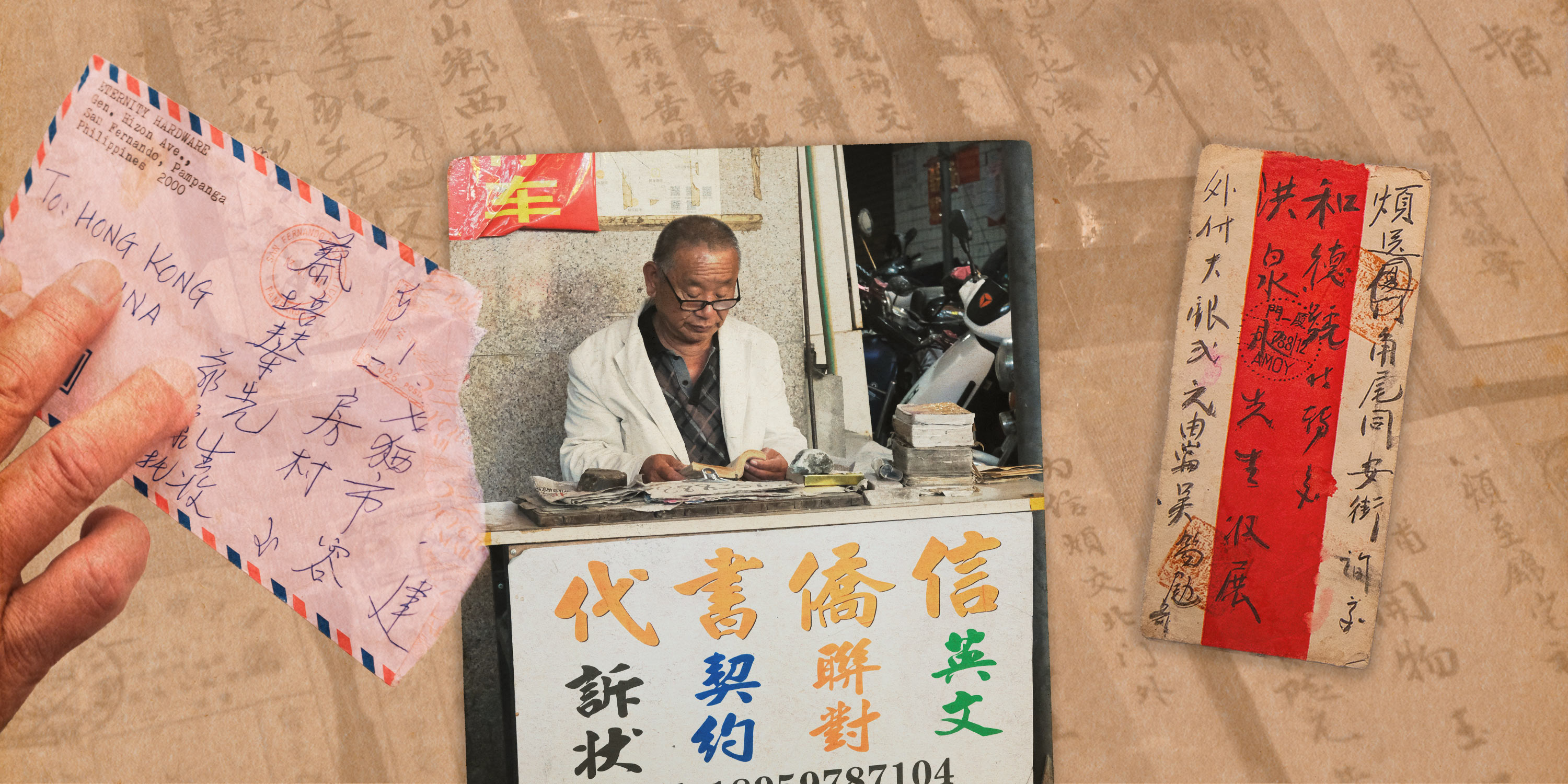
Before WeChat, There Were Qiaopi Writers
FUJIAN, East China — The last family letter Jiang Mingdian wrote crossed the Pacific Ocean.
Last June, an elderly woman arrived at his stall in Shishi, a coastal city in eastern China’s Fujian province, hoping to write to her two granddaughters in the U.S. after her son died overseas in his 40s.
Unable to type or use a smartphone herself, the woman sat beside Jiang and dictated the letter sentence by sentence while he wrote each line down by hand. When she finished, the letter was printed and sent digitally.
At 77, Jiang may be the last remaining writer of qiaopi — remittance letters exchanged between Chinese migrants overseas and the families they left behind. Often sent together with money from abroad, the letters once served as a vital lifeline between relatives separated by migration.
For nearly six decades, Jiang has helped people put difficult things into words: asking overseas relatives for money, delivering news of a death, settling family grievances, or writing to loved ones they had not seen in years.
During the peak years of emigration to Southeast Asia, entire villages depended on letter writers like Jiang to communicate with relatives abroad. In Shishi, where many residents were once illiterate or semi-literate, more than 20 letter-writing stalls competed for customers.
Today, Jiang writes only a handful of overseas family letters each year. Most mornings, he arrives at his stall at 9 a.m. and packs up around sunset. The stall sits beside a decades-old Hong Kong-style café near the entrance to an underground parking garage on Shishi’s main road.
Sitting beneath a retractable beach umbrella, he arranges the same objects he has carried for decades: a fountain pen, torn dictionaries, stone paperweights collected from the shore, and a rusted tin box holding the calligraphy brushes left behind by his father.
These days, most clients come to Jiang for legal paperwork, ancestral hall disputes, or messages for relatives living overseas. And all still trust him to find the right words.
Mountains and seas
“I miss you very much, but I hate you.”
Decades later, Jiang can still recite the line from memory. He wrote it for Cai Tianzhu, a man separated from his mother in Singapore as a child — one of countless families divided by migration.
Cai was sent back to his ancestral hometown in Fujian to preserve his father’s bloodline while his mother remained overseas. The family home belonged to his father’s first wife’s side of the clan; Cai’s mother was the second wife.
Both of his “mothers” later formed new families, leaving Cai suspended between two homes. For decades, he returned to Jiang’s desk to write letters to Singapore.
“I asked him what he wanted to say, but most people who came to me for letter writing could never really put their feelings into words,” Jiang recalls. “Cai was no different. For decades, he repeated the same emotions: longing, missing her, wanting to reunite. I wrote those words for him countless times.”
“My dear mother, I miss you very much. It has been more than 35 years.” And: “I miss you very much, but I hate you. Why did you send me back to China?”
Cai eventually reunited with his mother more than 40 years later. They spent only a week together before she died unexpectedly in a traffic accident the following year.
“Cai’s life feels like a family nameplate left standing there forever,” Jiang says.
Jiang met Cai during his second year as a letter writer, when he was still struggling to earn customers’ trust. At the time, his mother urged him to cycle from village to village offering door-to-door service.
Carrying pens and bottles of ink, Jiang traveled across southern Fujian using address lists compiled by his father, who had also worked as a letter writer. Outside each home, he asked the same question: “Uncle, Auntie, do you have any letters to write today?”
Most days, the answer was yes. Jiang says he used up two bottles of ink every 10 days.
“Tell him the back wall of the ancestral hall has been repaired and no longer leaks when it rains,” one client asked him to write. Another said, “Mother is doing well, so don’t worry.”
When replies arrived, Jiang read them aloud in Hokkien, a southern Fujian dialect, to families waiting at home.
“When Hokkien-speaking migrants went overseas, they wrote English with a Hokkien accent,” Jiang explains. “Even names changed. The surname Cai, for example, became ‘Cua.’ If the name was written in Mandarin, the letter might never reach the right person.”
Migrants from this region who left for Southeast Asia were known as fan ke, or “wanderers.” Their wives back home were called fan ke shen, and were among Jiang’s most frequent customers.
Overseas letters followed their own conventions. Requests for money were rarely written directly. Instead, Jiang might phrase the message more delicately: “I’ve been ill and bedridden lately.” Soon afterward, a remittance might arrive.
“Sometimes I wrote in someone’s kitchen, sometimes in the living room, and once even in a woman’s bedroom,” Jiang says. “But my mother told me never to enter unless the curtain was drawn first. Otherwise, people would gossip.”
Many overseas Chinese families appeared prosperous from the outside. Men returned from Southeast Asia wearing gold jewelry, sending money home and building large multistory houses in the village. But the women waiting behind often lived very different lives.
When writing letters for them, Jiang often used the phrase “mountains and seas between them” to describe distances too great to overcome.
“Many endured endless heartbreak, their hair turning from black to white without ever seeing their husbands return,” he says. “Some men died overseas. Others started new families there.”
Jiang remembers one woman in Houxi Village who continued writing letters to her husband in the Philippines long after learning he had died. Living alone in a large courtyard house, she kept sending letters to the same overseas address, asking why he had left her behind and when he would finally bring her to join him.
In one letter, she asked Jiang to write: “While you idle among beauties and green hills, I grow old in the blink of an eye, letting spring flowers and autumn moons pass in vain.”
As China’s “reform and opening-up” policies transformed the country in the 1980s, many fan ke shen finally traveled overseas hoping to reunite with husbands they had not seen in years. Some arrived to find entirely new families waiting for them there. Others chose instead to begin new lives in Hong Kong.
Around that time, Jiang received an acceptance letter from a university in Canada, along with a ship ticket offering him the chance to continue his studies overseas. He turned it down.
“I couldn’t afford the $10,000 tuition fee, and I couldn’t leave my wife behind the way the older generations had done,” he says. “I wouldn’t do that. Even now, I don’t regret staying.”
Learning distance
But he spent much of the next several decades studying the outside world anyway.
Jiang grew up in a family of educators. His father, Jiang Yitao, had once served as a middle school principal in Taiwan before becoming a letter writer in Shishi, while his mother spoke fluent English and made him practice the language aloud early every morning.
“People passing by would ask, ‘Why is this idiot standing at the door saying things nobody understands?’” Jiang recalls. “Later, when they needed letters written, they realized I was the same person practicing foreign languages at the door every morning.”
Through radio broadcasts, cassette tapes, newspapers, and dictionaries, he taught himself enough English, Spanish, Vietnamese, Tagalog, German, French, and Portuguese to handle overseas correspondence.
Although Jiang never studied beyond middle school, he says he still spent at least an hour each night studying languages, reading newspapers, and learning about the law.
“I immediately put whatever I learned to use and eventually made money from it,” Jiang says. An English letter, he says, could cost 10 times as much as a Chinese one.
In 1967, shortly after turning 18, Jiang took a seat behind the writing desk himself, turning locals’ spoken messages into letters for relatives scattered abroad. Dozens of customers lined up each day, he says, and the work paid far better than many ordinary jobs at the time.
“I could hardly finish writing for all of them,” he recalls with a laugh. “Business was very good.”
It was so competitive that even stall placement mattered. Jiang says his father once shared a letter-writing stall with two other writers arranged in a triangle so they could take turns sitting closest to the street — the spot where new customers usually stopped first.
Jiang still remembers the first day he picked up his pen professionally at the Shishi Remittance House, writing replies for villagers who had received money from overseas relatives and wanted to confirm it had arrived safely.
With his first earnings, Jiang bought a pack of pork for his family. At the time, he says, his father was struggling to support the household and could barely afford enough rice.
Yet Jiang never fully adapted to the digital world that replaced the letters he once wrote. He only switched to a smartphone three years ago. “I’m not very good at these new things,” Jiang says. “I don’t reply to text messages very often.”
Last year, someone helped him open an account on the Chinese social media platform Xiaohongshu, known internationally as RedNote. Several posts about his work quickly went viral before the account fell inactive.
Even now, most clients contact Jiang by phone or simply walk directly to his stall. Some are elderly residents who still struggle with typing and smartphones.
Jiang also earns additional income by giving guided tours at the local Qiaopi Museum, explaining the history of overseas Chinese letters to visiting student groups. But most evenings, after the tours end, he still returns to his stall.
Dead letters
Today, the skills Jiang spent decades teaching himself are what keep his stall alive.
Overseas family letters may have largely disappeared, but people still come to Jiang seeking help with ancestral hall conflicts or overseas property disputes. Most overseas correspondence now arrives digitally, often involving family assets or fundraising appeals linked to ancestral halls.
One recent client asked Jiang to draft an application seeking posthumous martyr status for a relative who died fighting the Japanese in the Philippines during WWII. Others are younger people drawn by nostalgia, asking Jiang to write letters for friends or relatives by hand.
Jiang still does not use WeChat and relies almost entirely on phone calls. In a place like Shishi, he says, people prefer discussing sensitive matters face to face.
A fading red sign hanging from Jiang’s timeworn desk still reads: “Writing Letters for Overseas Chinese.” The reference book he reaches for most often today, however, is a large-print edition of China’s Civil Code.
Jiang still writes in the traditional vertical format, from right to left. As his eyesight worsens, he says he has gradually stopped subscribing to most newspapers. The only one he still reads regularly is Cankaoxiaoxi, a state-run paper largely dedicated to translating foreign reporting for Chinese readers.
Every morning before arriving at the stall, Jiang jogs in the hills, walks 1,000 meters backward for exercise, and then strides briskly into town. He takes only two days off each year: Chinese New Year and Qingming, or Tomb-sweeping Day, one of the most important holidays in the Hokkien calendar.
“As long as people still need me,” Jiang says, “I will continue.”
This year, on the eve of Qingming, Jiang spent the day leading tours for visiting students at the local Qiaopi Museum before returning to his stall, where a client had already been waiting for hours. The man needed help resolving a dispute over the ownership of a rebuilt overseas Chinese family home.
They sat at the wooden table reviewing property records late into the evening. At one point, the client left to retrieve more paperwork, but Jiang stayed without stopping for dinner. By 8 p.m., he was still there waiting.
The next morning, after tending his family’s graves for Qingming, Jiang returned to the same wooden table.
Editor: Apurva.
(Header image: Visuals from Chen Yiru and VCG, reedited by Sixth Tone)