From Ancient Fields to Olympic Slopes: The Story of China’s Leopard Cats
In 2017, while hiking in the mountains of northern Beijing’s Yanqing District, I came across animal scat along the trail. After nearly two decades studying cats, I recognized it immediately. The question was: what variety produced it? A house cat, a feral cat, or a leopard cat?
Leopard cats are known to inhabit the mountainous areas around Beijing, but this scat lay less than a kilometer from a villa complex. If it came from a leopard cat, it would mean this elusive predator was surprisingly active near human homes.
I wrapped the scat in tissue, took it back to my lab at Peking University, and ran a molecular test. The result was clear: it was from a leopard cat.
The discovery marked the beginning of a new phase in my research.
Soon, my team set up six infrared camera traps along the 15-kilometer route where I had been hiking. A month later, the cameras had captured two leopard cats. I was thrilled. Even in a megacity like Beijing, meaningful wildlife fieldwork was still possible.
Over the next few years, we expanded our monitoring network. In the winter of 2020, while retrieving footage, I noticed construction underway across the valley: alpine skiing slopes for the 2022 Beijing Winter Olympics.
I thought of that famous image of a puma walking beneath the Hollywood sign in Los Angeles. Could we capture a leopard cat beside this Winter Olympics venue? On impulse, I placed a camera facing the site.
Months later, we retrieved an unexpected image. In the snowy foreground, a leopard cat walked calmly across the frame. Behind it, the future Olympic ski slopes rose.
I later sent the photograph to Science, together with a 300-word essay titled “The Hidden Olympic Spectator.” It was published on July 23, 2021, the opening day of the Tokyo 2020 Olympics, hosted without spectators due to the COVID-19 pandemic. The image circulated widely and became one of the most recognizable moments of my career.
In the article, I wrote:
Humans are capable of extraordinary feats, beautifully showcased by Olympic events. Such achievements bring me hope that we can leverage our strengths to ensure continued coexistence between wilderness and human settlements. As we watch the skiers race down the slopes, I know that the striding leopard cat will be watching us.
My connection to the Olympics did not end there. When the Beijing Winter Olympics opened a year later, I served as a technical official on the alpine skiing referee team.
Spectators were still not allowed on site, but we witnessed something extraordinary: a leopard cat strolling through an award ceremony rehearsal. Few would have expected one of the Games’ spectators to be a wild animal. In that single moment, Beijing’s wildlife came quietly into view.
But this was only the latest chapter in a much older relationship between humans and leopard cats.
Leopard cats and ancient China
In 2020, my team began collaborating with researchers, including Han Yu, then a doctoral student at Oxford University, to investigate the origins of domestic cats in China. Our findings were published in Cell Genomics early this year.
For the study, we analyzed 22 ancient cat bones excavated from human settlements across China, spanning more than 5,000 years. Using ancient DNA technology, we obtained complete mitochondrial genomes from all samples and whole genomes from seven.
What we discovered reshaped the history of cats in China.
For decades, scholars debated whether domestic cats in China originated in the Neolithic period or the Han dynasty (206 BC–AD 220). Earlier remains from sites such as Quanhucun and Chang’an in the northwestern Shaanxi province had been interpreted as evidence of domesticated cats.
Genetically, however, these bones told a different story.
They were leopard cats.
Our study showed that from the late Neolithic Yangshao culture, which existed in the middle reaches of the Yellow River from around 5000 BC to 3000 BC, through the Eastern Han dynasty, the small felids living alongside humans were not domestic cats but leopard cats. For over 3,500 years, leopard cats formed commensal relationships with agricultural communities.
True domestic cats, derived from African wildcats in the Near East, did not appear in China until the Sui (581–618) and Tang (618–907) dynasties, likely introduced by merchants via the Silk Road.
Historical records align with the genetic findings. Early Chinese texts refer to an animal called the “li,” described as a spotted, leopard-like animal prized for catching mice. A Han-dynasty text even notes that a “100-coin li” was worth a substantial sum, suggesting these animals were valued pest controllers.
Archaeological artwork supports this picture as well. A painted lacquer plate from the Mawangdui Han tomb, located in modern-day Hunan province, depicts a long-tailed spotted cat, consistent with leopard cats rather than striped domestic cats.
In essence, ancient Chinese farmers lived alongside a native wild species that adapted to human settlements, much as African wildcats did in the Near East.
Why did domestication of leopard cats fail?
Yet leopard cats did not become domesticated.
After coexisting with people for millennia, they retreated into the wild.
Why?
One factor may have been historical upheaval. The end of the Han dynasty brought centuries of warfare, population collapse, and agricultural decline. Leopard cats’ commensal lifestyle depended on stable farming systems and abundant rodents. When agriculture faltered, so did this ecological niche.
Later, when the agricultural sector recovered during the Sui and Tang dynasties, a new competitor had arrived: the domestic cat. Introduced from western Eurasia, domestic cats were equally effective mousers but more docile and adaptable, and came in a wider range of coat colors.
Changes in poultry farming may have also played a role. As chickens shifted from free-ranging systems to enclosed coops, leopard cats — natural predators of both rodents and birds — became liabilities. In enclosed spaces, their predatory instincts could lead to catastrophic losses for farmers. Such conflicts likely eroded tolerance.
Unlike the African wildcat, leopard cats never underwent domestication in China.
They returned to the wilderness.
Leopard cats in Beijing today
Yet leopard cats are still here.
Today, in the forested hills beyond Beijing’s ring roads, they continue to survive alongside one of the world’s largest cities.
Our current research focuses on understanding their ecology in this human-dominated landscape. With permits from the Beijing Municipal Forestry and Parks Bureau, our team conducts live trapping in accordance with strict ethical protocols. We safely anesthetize captured cats, collect samples, fit them with satellite tracking collars, and release them immediately at the capture site.
When a leopard cat enters a trap, often in the middle of the night, the alarm system is triggered and a signal instantly flashes on our phones. To minimize an animal’s stress, we head out immediately, sometimes arriving at 3 a.m. By dawn, the work is complete, and the leopard cat has been released back into the forest.
As I drive back toward the city at sunrise, merging into Beijing’s morning traffic, I often find myself slipping into a deeper historical timeline.
Leopard cats lived here long before Beijing existed, long before the city lights stretched across the horizon. For thousands of years, humans and leopard cats shared this landscape; at times in close proximity, at times at a distance. That relationship has shifted, fractured, and found new forms of balance.
Now we face the same question again:
In an age of rapid urban expansion, can humans and wildlife find a new equilibrium?
Each time a leopard cat steps quietly past one of our cameras, the answer feels within reach.
Portrait artist: Wang Zhenhao.
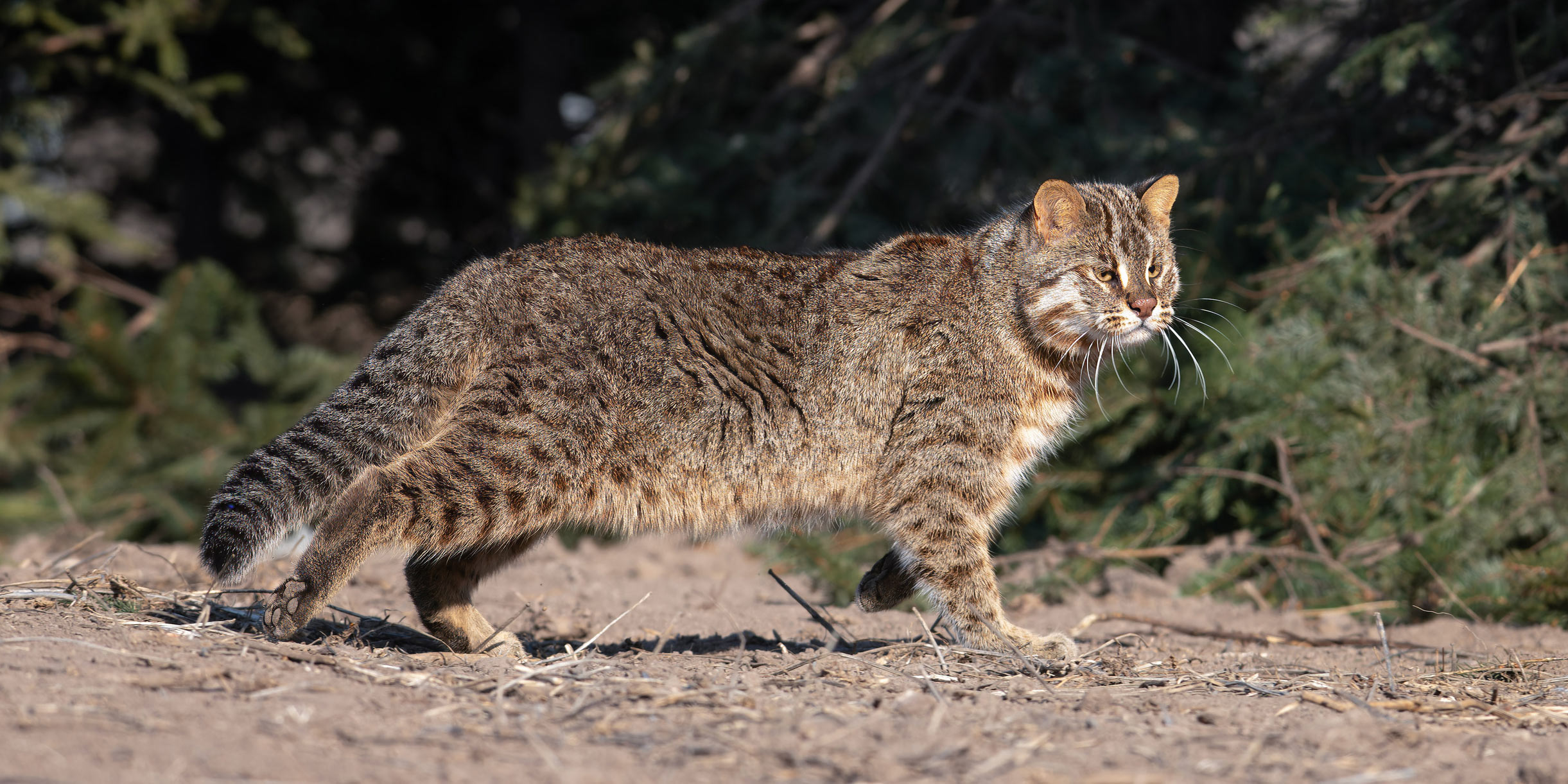
(Header image: A leopard cat at a forest farm in Tieli, Heilongjiang province, 2024. Chi Shiyong/VCG)