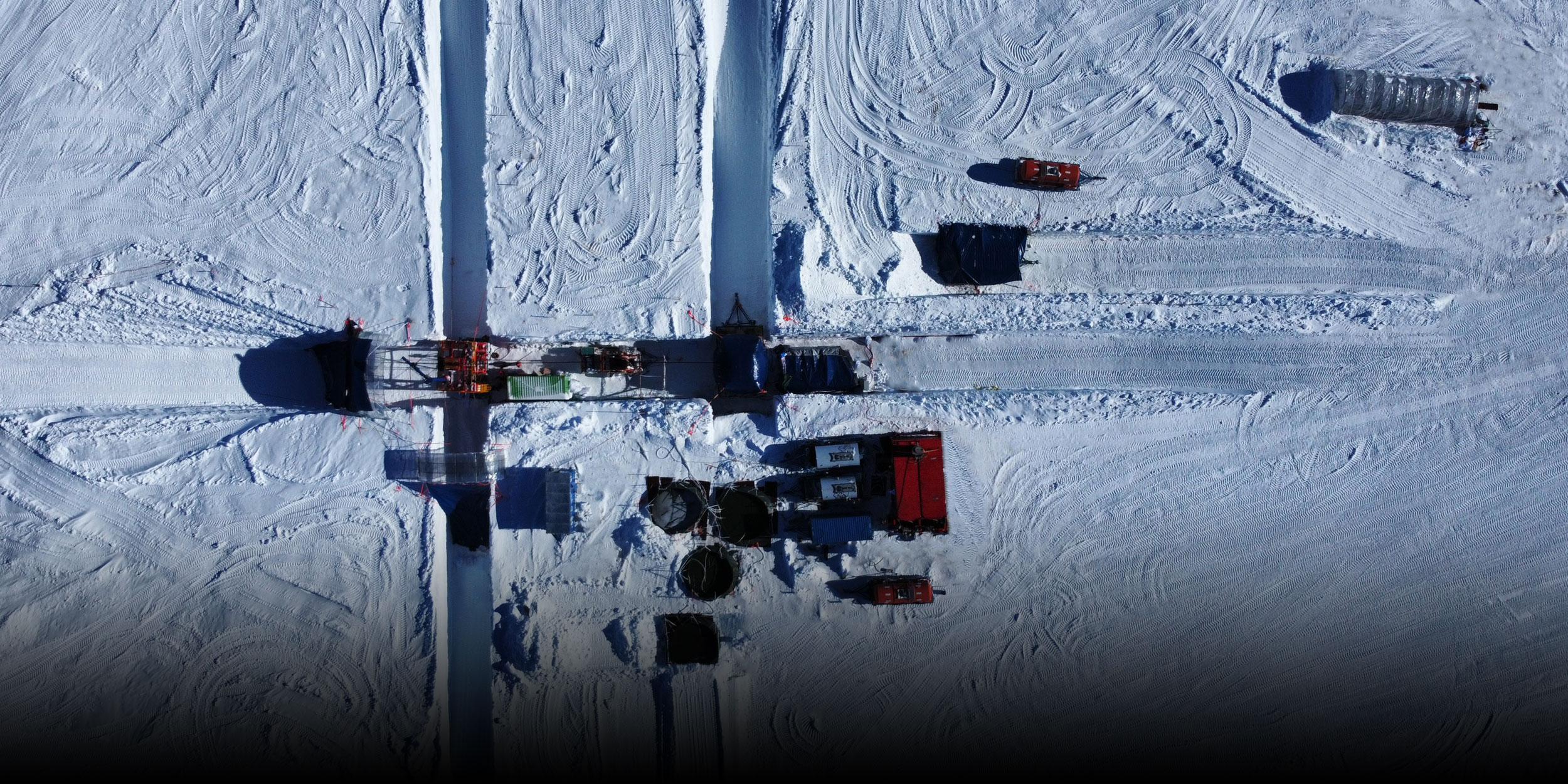
Ice, Ice, Maybe: China Drills to Record Depth in Antarctica
China has completed its first hot-water drilling test in East Antarctica, reaching a record depth of 3,413 meters and surpassing the previous international record for the excavation method.
The mission, carried out on Feb. 5 as part of the 42nd Chinese Antarctic Expedition, was jointly led by the Polar Research Institute of China, Jilin University, and the China University of Geosciences, in collaboration with multiple institutions. Sun Youhong, an academician of the Chinese Academy of Engineering, also helped plan and provide mission guidance.
Polar hot water drilling is used to study Earth’s paleoenvironmental changes, predict future climate trends, and explore the limits of life. Compared with traditional mechanical ice drilling, it can penetrate deeper and more efficiently while causing minimal disturbance to the ice, making it easier to access subglacial lakes and the bases of ice shelves. Previously, the record depth reached by hot water drilling was 2,540 meters.
The goal of the test was to demonstrate the application of a deep ice‑sheet hot-water drilling system in Antarctica. By penetrating the ice sheet above the region’s Qilin Subglacial Lake — named for the mythical Chinese creature — the operation established a channel for future observation of the lake, as well as water and sediment collection.
“Before drilling began, we didn’t dare set a goal of reaching beyond 3,000 meters. But our team was determined. If there was even a 1% chance (that we would succeed), we would give 100% effort,” Guo Jingxue, the leader of the expedition’s subglacial lake research team, told domestic media.
Experts involved in the experiment described how Antarctica’s subglacial lakes feature extreme environmental conditions, including high hydrostatic pressure, subzero temperatures, minimal light, and nutrient scarcity, and hold rich information about ice sheet history and climate change. These factors make their study ideal for understanding sediment formation and biological evolution.
The test lays the foundation for China to scale up its polar drilling and sampling efforts and advances deep subglacial environmental and climate research. Key technological breakthroughs included findings on low‑temperature resistance for hot water drilling and external contamination control.
The expedition, which departed from Shanghai in November, was organized by the Ministry of Natural Resources and comprises two research vessels carrying over 500 members from more than 80 Chinese institutions. Researchers from more than 10 countries and regions, including Thailand, Chile, and Portugal, were also present.
Beyond the drilling test, the expedition is also advancing the construction and system optimization of China’s Qinling Station — an Antarctic research station — conducting tests on equipment such as wheeled vehicles and fully hydraulic high‑power tractors. The expedition is expected to return to China in May.
China dispatched its first Antarctic expedition team from Shanghai in November 1984 to conduct comprehensive scientific research in Antarctica and the South Pacific. The following year, China completed construction of its Great Wall Station on King George Island in West Antarctica, making it the 18th country to establish a scientific research station on the continent.
Editor: Marianne Gunnarsson.
(Header image: China’s first hot-water drilling test on the Antarctic ice sheet, 2026. Xinhua)