The Enthusiasm and Anxiety Behind China’s OpenClaw Craze
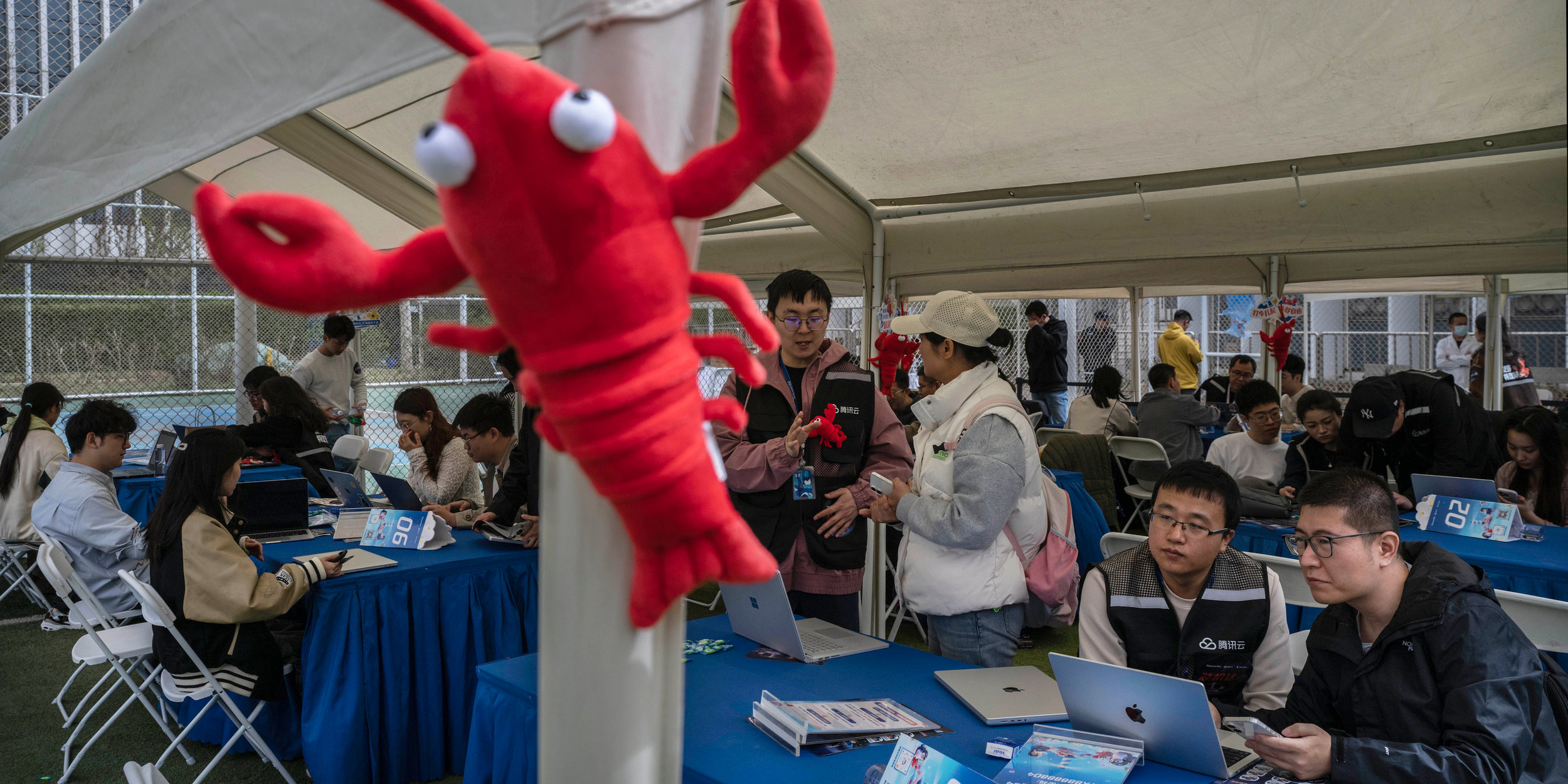
Last month, an image shot across Chinese social media that neatly captured the country’s uneasy relationship with technology. It was a vertical split-screen collage. On top was a grainy black-and-white photo from decades ago: a group of people in a public park, aluminum pots balanced on their heads, eyes closed in meditation, convinced they could “receive cosmic energy.” Below it was a bright color snapshot taken only days earlier: people in the southern Chinese tech hub of Shenzhen wearing novelty hats shaped like the mascot of AI agent software OpenClaw — widely nicknamed “crayfish” — staring at a giant screen that read, “In 2026, humanity is divided not by gender, but by creators and bystanders.” The caption was merciless: “The hat has changed, but the people haven’t.”
The image captured how AI has become commonplace enough in China to be the subject of viral memes, but also how it has divided society between those who use it because they believe the technology is a useful creative tool and those who use it because they are anxious about being left behind.
The mockery came fast. To many viewers, the “crayfish craze” — the frantic rush to deploy local AI agents, semi-autonomous programs users install and maintain on their own devices — looked like a new form of collective mania, a digital echo of the qigong fever of the 1990s, when large numbers of people embraced quasi-mystical self-cultivation practices. Now, crayfish hats instead of aluminum pots would deliver miraculous self-improvement. Every generation, it seems, finds a new object onto which it projects the promise of salvation, and ends up looking faintly ridiculous.
But behind the memes and the ridicule, something more complicated was taking shape. If AI in China often appears practical, emotionally charged, and deeply woven into everyday life, it is because two dynamics are operating at once: one driven by pressure, competition, and fear of falling behind, and the other by convenience, play, and the desire to make AI useful in daily life.
For many people, turning to AI feels less like a voluntary experiment than a response to mounting pressure in study, work, and everyday competition. The seemingly absurd spectacle of the “crayfish craze” is simply the most visible expression of employment anxiety, skill pressure, and fear of exclusion. Beneath the mockery aimed at people in crayfish hats lies a more uncomfortable truth: for many, this anxious rush is a rational response to a changing world.
For Chen Hao, a humanities undergraduate working in his university’s career office, the AI boom is no game. He has watched career paths once seen as natural options for humanities graduates become less secure, as employers place increasing weight on technical adaptability and AI literacy. “This isn’t just FOMO,” Chen said. “People feel that if they can’t at least keep up with AI, they may be excluded before they even begin.”
His unease is widely shared, though rarely in a pure form. A 2025 survey offers a useful snapshot: 50.2% of respondents said they felt “very excited” about AI, while 46.3% said they felt both excited and worried. Only 3.5% said they felt simply worried. The broader mood, then, is not one of straightforward fear, but of anticipation threaded through with unease. One expression of that mixed response is defensive use. Even among people eager to experiment, enthusiasm is often tempered by concerns about security, reliability, and misuse.
For users shaped by these pressures, AI appears as a rival, a judge, or a stopwatch. Their interactions with it are tense and transactional: install, configure, panic, uninstall. They are trying to protect a job, a status, or a fragile sense of relevance. Their use of AI is defined by defense.
But anxiety-driven adoption is only part of the picture. A quieter mode of engagement has also been taking shape in living rooms and community centers. Here, AI is no longer just a technical hurdle or a status object. It is becoming a practical mediator in everyday life: something people use to solve small problems, maintain family ties, and lower the friction of digital living.
In Lanzhou, capital of the northwestern Gansu province, a 63-year-old grandmother chats with the AI assistant Doubao every day. Her conversation history reads like a digital diary of ordinary life: questions about a malfunctioning phone, worries about a grandson’s picky eating, and repeated, courteous thank-yous. As her son put it, she does not like bothering him with small matters, so she quietly asks the AI instead.
A particularly visible shift emerged during this year’s Spring Festival, when major platform companies launched large-scale digital-literacy drives. During the holiday, 1.56 million users aged 60 and above reportedly ordered food delivery through AI voice interaction for the first time. For many seniors, the smartphone stopped feeling like an opaque obstacle and began to function as a more responsive intermediary. Whether it is a 70-year-old in Xuzhou, in the eastern Jiangsu province, using AI to restore old family photos or senior universities in Shanghai expanding AI classes to meet overwhelming demand, the technology is increasingly being recast as playful, usable, and socially accessible.
For users moved by this second dynamic, AI can be a collaborator, a listener, or simply a practical bridge between people who might otherwise hesitate to ask each other for help. Their use is oriented less toward coping than toward making.
These two dynamics are not separate. They often coexist within the same person: anxious about work and competition, yet also curious enough to use AI for care, convenience, or everyday creativity. That is part of what makes China such a revealing place to watch AI become ordinary. The mix itself is not uniquely Chinese, but in China, it is unfolding with unusual speed and visibility, as pressure is quickly translated into jokes, routines, family use, and platform-based habits.
The real divide in this emerging landscape is no longer simply between those with AI and those without. Adoption is uneven, and many people still remain skeptical or make fun of the latest AI fads. Even so, the more meaningful divide increasingly lies between defensive use and creative use.
Seen from the perspective of defensive use, one thing remains familiar across different historical moments: the fear of obsolescence and the urge to project hope onto a new object. From the qigong fever of the 1990s to today’s AI boom, the form changes, but the anxiety is recognizably similar. Seen from the perspective of creative use, however, something genuinely new is happening. AI will not simply be discarded like the aluminum pots of an earlier era, because it offers something materially real: capability, convenience, and new ways of moving through the routines of everyday life.
The question facing Chinese society is no longer simply whether this tool can be mastered, but whether the conditions surrounding its use can make daily life less stressful, more inclusive, and more open to creativity. Can the “crayfish craze” — now less a mania than an everyday culture of living with AI — move beyond proving competence and avoiding exclusion, and toward care, judgment, and everyday creativity? The answer will emerge not from grand declarations, but from the quiet decisions made in homes, classrooms, offices, and online communities — decisions about whether AI is approached mainly through panic and self-protection, or with enough confidence to make it a tool of care, convenience, and imagination.
(Header image: People learn how to set up and use the AI agent OpenClaw during an event at Tencent’s offices in Beijing, April 3, 2026. Kevin Frayer/Getty Images via VCG)