China’s Next Megaprojects Are Built for Big Science
This story is part of Sixth Tone’s 10-year anniversary series, Ten Years in Transition.
SHANGHAI – Thirty meters underground on the outskirts of Shanghai, engineers are painstakingly fitting together the components of a tunnel more than three kilometers long into place.
Inside, a superconducting accelerator will generate intense X-ray pulses that allow scientists to record how atoms move and rearrange during chemical reactions.
Keeping such beams stable demands extraordinary precision. Engineers must align the accelerator tunnel within millimeters across its entire length, accounting for the Earth’s curvature and minimizing vibrations from nearby maglev trains.
The facility is known as the Shanghai High Repetition Rate XFEL and Extreme Light Facility, or SHINE, China’s first hard X-ray free-electron laser. “Building an ordinary tunnel, you can advance hundreds of segments a day,” said Li Xinsheng, a senior engineer on the project. “Here we manage about eight.”
Like many engineers in China’s construction industry, Li began his career building roads, real estate, factories, and utilities. Today he is among a growing number applying those same skills to large scientific projects.
Known as megascience facilities, they include giant neutrino detectors, fusion reactors sometimes called “artificial suns,” and massive radio telescopes.
China still spends far more on traditional infrastructure, but investment in research facilities and scientific equipment has grown much faster over the past decade, even as infrastructure spending has slowed.
Between 2015 and 2024, spending on scientific fixed assets, including labs, equipment, and machines, more than tripled, while traditional infrastructure investment grew by less than 80%.
In the past, Chinese scientists often focused on theory in frontier fields because the country lacked the resources to build such instruments, said Liu Zhi, vice president of ShanghaiTech University and director of the Center for Transformative Science (CTS), which runs SHINE with the Chinese Academy of Sciences.
“As China’s economic capacity has grown, the country has increasingly invested in the tools needed to explore those questions directly,” he said. “Such facilities can also help attract researchers and build scientific hubs.”
Today, more than 90 megascience facilities have been built or are planned across China, forming a growing network of scientific infrastructure that supports the country’s push into frontier research.
The pivot
For years, large infrastructure projects were among the fastest ways to drive economic growth in China. Highways, railways, and real estate development became key tools for local governments seeking to boost output and investment.
That model accelerated after the 2008 global financial crisis, when a 4-trillion-yuan ($580 billion) stimulus program triggered a nationwide wave of construction. But by 2016, authorities had begun addressing overcapacity in traditional infrastructure. That year, investment growth slowed to 17.4%, down from more than 42% in 2009.
Two years later, authorities launched a nationwide cleanup of public-private partnership projects, tightened controls on local government borrowing, and began steering investment toward what officials called “new infrastructure.”
The new focus fell on digital networks, computing power, and scientific research facilities.
China launched its “East Data, West Computing” program in 2022 to expand national data centers, while the number of 5G base stations surpassed 4.8 million by 2025 — nearly seven times the 2020 total. At the same time, growth in traditional infrastructure investment turned negative, falling 2.2% year on year, a rare contraction after decades of expansion.
Roads and bridges remain essential, officials say, but returns on new projects have diminished. Recent spending has therefore focused more on filling gaps, including improving infrastructure in less-developed regions and strengthening disaster resilience.
China’s spending on R&D rose from 89.6 billion yuan in 2000 to 3.6 trillion yuan in 2024. Adjusted for purchasing power parity, that rise was the fastest among major economies.
Innovation became a central development goal in the early 2010s. Annual R&D spending surpassed 1 trillion yuan in 2012, and the government soon began planning a new generation of large scientific facilities scheduled for construction between 2016 and 2030.
Authorities also set long-term targets: becoming an innovation-driven economy by 2020, moving into the front ranks of global innovation by 2030, and building a world-leading science and technology powerhouse by midcentury.
For engineers like Pan Chao, the shift is already visible on the job. After years of building drainage systems and steam pipelines across China, the engineer in his 30s now works on the SHINE facility in Shanghai.
“The national direction is shifting toward higher-tech projects,” he told Sixth Tone. “And we’re one drop in that wave.”
New wave
China’s push into megascience began modestly. The country’s first major research instrument, the Beijing Electron-Positron Collider, was completed in 1988 after years of funding struggles.
For much of its early life, the facility operated on an annual budget of just 27 million yuan, a level scientists later said led to aging equipment and mounting technical problems.
Today, investment in megascience facilities totals about 16 billion yuan every five years, and individual projects can cost 10 billion yuan or more.
From 2016 to 2023, five regions — the cities of Shanghai, Beijing, Hefei, and Xi’an, as well as the Guangdong-Hong Kong-Macao Greater Bay Area — were designated national science centers, drawing clusters of large research facilities and laboratories.
Some centers have developed distinct specializations. Hefei, capital of the eastern Anhui province, has emerged as a center for fusion research. Shanghai has become a hub for photon science, anchored by multiple synchrotron and free-electron laser facilities.
“The significance of megascience facilities is not just that experiments can be carried out,” said Li Xinsheng, the SHINE engineer. “They also drive related industries.”
The effects are already visible in pharmaceuticals. Researchers have used the Shanghai Synchrotron Radiation Facility (SSRF) to assist more than 40 companies with drug discovery by analyzing molecular structures.
One resulting drug, zanubrutinib, a treatment for certain types of blood cancer, received approval from the U.S. Food and Drug Administration in 2019 and later became the first Chinese-developed drug to exceed $1 billion in annual sales.
Megascience facilities are also shaping development beyond China’s major research hubs.
In southwestern Guizhou province, for instance, the giant FAST radio telescope has led local authorities to invest about 5 billion yuan in an astronomy-themed tourism complex, including a science park and education facilities built around the observatory.
Most major science facilities were fully funded by the central government. Today, costs are increasingly shared with local authorities, though the split varies. In Shanghai, for example, the municipal government covered roughly 80% of SHINE’s roughly 10 billion yuan budget.
The model has since been replicated by other regions seeking to attract megascience projects, contributing to concerns among some scientists that construction is beginning to outpace demand.
Yet, building them is only the first challenge. Operating large research centers can require annual budgets equal to 10% to 20% of their construction cost in China, and in some countries the figure reaches 50%.
“Investment should be strengthened as the economy develops,” Chen Hesheng, an academician of the Chinese Academy of Sciences and a researcher at its Institute of High Energy Physics, told domestic media. “But what matters more is producing results rather than simply expanding the number of projects.”
Liu Zhi, director of the Center for Transformative Science, agrees. “China’s rapid expansion of megascience facilities is somewhat overheated,” he said, adding that such projects require clearer top-down planning. “Investment in big science is very long term; if the direction is not correct, the consequences are long lasting.”
Chen also cautioned that large scientific instruments require specialized construction teams and long-term research communities. “This is not like building an opera house, a museum, or a public square,” he said. “It requires an experienced team of several hundred people spanning science, technology, engineering management, and technical support.”
Inside SHINE
At SHINE, those demands fall on engineers like Pan Chao and Li Xinsheng.
When Sixth Tone visited the unfinished interior, the structure resembled an ordinary tunnel at first glance. Heavy curtains hang at the entrance, and a negative-pressure dust chamber filters the air to keep dust out.
Li acts as the bridge between scientists and construction crews. When researchers specify strict requirements — such as temperature stability — his team translates them into engineering solutions, often traveling across China to find manufacturers capable of meeting those standards.
“Scientists have more complex problems to solve,” Li said. “Their time shouldn’t be spent on this.”
Many of the challenges, he added, only become clear once construction begins.
SHINE’s straight three-kilometer design, for example, required engineers to account for the Earth’s curvature to keep the tunnel precisely aligned. Its location on Shanghai’s outskirts also required engineers to mitigate vibrations from nearby maglev trains.
Much of the work involves repeated testing. Every weld and installation must be checked and rechecked, and even small deviations can force crews to redo weeks of work.
“To be honest, it’s a bit tedious,” Pan said. “Like solving the same math problem a hundred times and still having to do it again.”
Once completed, SHINE will allow scientists to observe atomic-scale processes on extremely short timescales. Hard X-rays reveal the structure of matter, while the facility produces 1 million free-electron laser pulses per second. Each pulse lasts just a few femtoseconds (10⁻¹⁵ seconds), fast enough to freeze the motion of atoms during chemical reactions.
“For the first time, we can measure processes at the atomic scale using ultrafast methods,” said Liu.
He compared SHINE with the SSRF. “The SSRF is like a focused incandescent bulb in a lighthouse,” Liu explained. “SHINE is like a giant laser pointer. The earlier machine was already about a billion times brighter than ordinary light sources, and SHINE’s beam will be another billion times brighter still. Its pulse rate is another key difference.”
That leap in capability has required construction teams to develop new expertise of their own. Shanghai Construction Group made “new infrastructure” a dedicated business line in 2019, and new contracts in the sector reached 27.8 billion yuan by 2024.
Robotics is increasingly used on site. Machines installed hundreds of shielding blocks weighing up to four tons each, and transport robots cut the time needed to move accelerator modules into the tunnel by about 70%.
“We may not reach international standards overnight,” Li said. “But the experience we accumulate will support future projects. When enough experience builds up, it can lead to breakthroughs.”
Contribution: Yang Yang; visuals: Ding Yining; editor: Apurva.
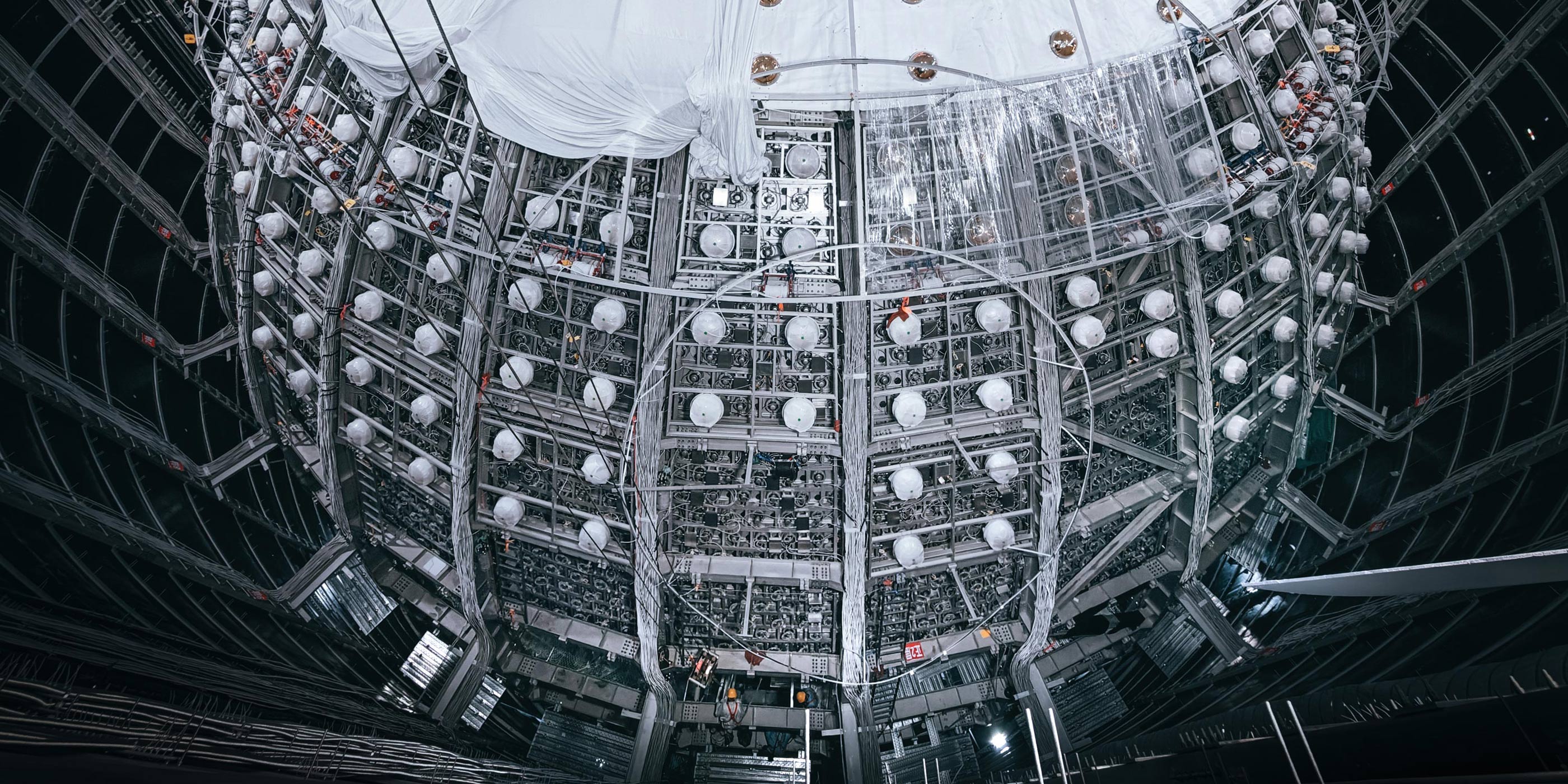
(Header image: Construction of the Jiangmen Underground Neutrino Observatory (JUNO) detector, a giant sphere filled with 20,000 tons of specialized liquid, in Guangdong province, 2024. Wu Yuqin/VCG)