The Cost of Staying Visible on China’s Internet
This story is part of Sixth Tone’s 10-year anniversary series, Ten Years in Transition.
“Grandpa, time to go to work.”
Wu Jieying, 27, pulls her grandfather off the sofa in the middle of a TV show, ignoring his grumbling. Her mother, just back from walking the dog, is told to quickly change.
Within minutes, the living room is rearranged. Two fill lights click on. A phone is fixed in place. The three of them take their positions. Wu has already mapped out the lines and talked through the phrasing with them, debating which expressions in Shanghai dialect will sound most natural on camera.
Her grandfather frowns as she begins explaining the Winter Olympics. “People our age don’t understand this,” he says. “I’ve barely even seen snow.” After a few moments, he tries to get up and leave.
Wu stops him, lifts her phone, and pulls up an AI app. Reading from the screen, she walks him through the rules, answering questions as her mother chimes in too.
“Everyday conversations are often filmed in a single take. But scripted lines introducing brands take longer — two to three takes with my mother, five to seven with my grandfather,” Wu says. “Sometimes, they start chatting in the middle of a conversation.”
By the time they finish, a casual family exchange has been recorded as an advertisement for Qwen, an AI platform developed by Alibaba — one microscopic transaction in China’s trillion-yuan attention economy, where livestreaming alone now drives nearly one-third of all online shopping.
A decade ago, that economy was a loose mix of personal blogs, early influencers, and experimental video. By the early 2020s, short video and livestreaming had moved to the center of online life, as platforms such as Douyin, Kuaishou, and Xiaohongshu began directing traffic through algorithms and linking content directly to sales.
With 1.6 billion creator accounts now competing for attention, the field has also grown more crowded. Growth in livestream e-commerce, once explosive, has slowed from 41% in 2023 to a projected 16% last year.
For the people working inside it, the shift meant constant adaptation: new platforms, new formats, new pressures, and new ways of being seen. Some built careers in the boom. Others found themselves remaking their lives just to stay visible.
Family business
Wu found a foothold in a fast-growing corner of Chinese social media: family content that feels spontaneous in a feed crowded with staged personas.
Her videos draw on the rhythms of a three-generation Shanghai household — teasing, arguments, dialect, and everyday habits — in what platforms group under the “family” or “mother-daughter” niche.
In 2020, after returning from London, Wu began posting short videos on the side while working as a clothing designer. Two years later, she quit to do it full time. Her breakout video featured her parents poking fun at the hidden expectations behind the idea of a “high-quality man.”
As she kept filming, the videos settled into a recognizable formula: her mother scolding her in Shanghainese, quick-fire exchanges, and sudden turns from irritation to affection.
In one clip, Wu tries to sneak home in the morning after staying out all night, only to be caught immediately. She offers a weak excuse, saying she had just gone out to pick up a delivery.
Her mother shoots back: “Dressed like that to pick up a package?”
The video drew more than 100,000 likes on Xiaohongshu, also known as RedNote, which began as a platform focused on cross-border shopping and lifestyle posts before expanding into short video and e-commerce.
As Wu’s following grew, so did the business around it. At one point, commercial collaborations were bringing in two to three deals a month. Her mother and grandfather became recurring figures in the videos, and what had started as an experiment settled into a steady workflow. Her mother later opened an account of her own to document daily life.
Soon, her mother and grandfather began to be recognized on the street. To this day, her grandfather believes Wu is “making movies.” After appearing in one campaign, he wrote on his calendar, where he keeps a diary of life at home: “I never imagined that one day so many people would like me.”
But the arrangement only works as long as family life remains available to film. Wu estimates that 90% of her time now revolves around work — tracking trends, writing scripts, filming, and editing, largely on her own.
Although she entered this corner of content creation relatively early, she says the field has grown more crowded, with more and more creators producing similar material. “Sometimes their videos may even be better than mine,” she says. “I worry that my growth isn’t fast enough. I have to follow trending topics closely and keep my phone within reach, ready to record moments that might turn into content.”
Her mother was initially uneasy about being filmed, but later opened an account of her own and began sharing her experience of menopause, a topic rarely discussed on social media.
Her grandfather is less accommodating. When filming cuts into his television time, he declares, “No work today.” Wu says, laughing, that she bought gold to “bribe” her family into cooperating.
Audience reaction can be intimate. Viewers compare Wu’s appearance with her mother’s, while others accuse her of encouraging competition between women within the household.
Wu also worries that audiences may eventually tire of what she makes. She has considered taking on more controversial topics from the perspectives of three generations, but has held back, describing the current environment as less tolerant and more sensitive than before.
“Maybe the market isn’t doing well, and people need an outlet for negative emotions,” she says. “There’s more misunderstanding.”
Catching waves
By the time Wu entered the field in 2020, Zhang Xinxin, 38, had already spent years adapting to earlier versions of China’s content economy.
When she was first invited in 2015 to turn her WeChat writing into a business, Zhang, from the eastern Shandong province, was skeptical. But her posts quickly found an audience, bringing in advertising deals and, soon after, enough momentum for her and two partners to launch one of China’s earliest multichannel network (MCN) companies around her online persona, “Sister Ximen.”
Over time, the company grew to hundreds of employees and worked with more than 300 accounts. Zhang became a familiar figure at fashion weeks and brand events, and in 2019, Zhang was named one of Forbes China’s Top 50 KOLs. She now has more than 22 million followers across platforms.
Even then, the job was hard to explain.
“For roughly the first eight years, no one really knew what I did for a living,” Zhang recalls. “People kept asking how we made money, or why we seemed to be ‘just playing’ every day.” Some employees told their parents they worked in advertising, unsure how else to describe the job.
“That period coincided with the strongest economy and the most aggressive brand spending,” she says. At her busiest, she was traveling abroad almost every month for fashion weeks and campaigns, sometimes visiting three countries in a single week.
By 2020, she was preparing to pivot again. As brands shifted toward selling products in real time and platforms funneled traffic and incentives toward livestream rooms, Zhang began moving into livestreaming on Taobao, China’s leading e-commerce platform. Her debut session drew nearly 1 million views and generated more than 5 million yuan in sales.
Ding Yiran, a lecturer at the Center for Computational Communication Research at Beijing Normal University, says livestreaming also began reshaping the platforms themselves.
“Platforms that once focused on social interaction and entertainment are now, almost inevitably, moving toward e-commerce logic,” she says. “Increasingly, their primary goal is to serve the economy and profitability.”
Today, Xiaohongshu is where most of Zhang’s brand work happens. “Since around 2022, 90% of deals have been on Xiaohongshu,” she says.
She remembers when Xiaohongshu first emerged, and her partners urged many bloggers to join early. Many simply copied over their Weibo posts, saw little response, and gave up before the platform took off.
“We caught many of the industry’s major waves — from WeChat official accounts to Weibo, and from Weibo to Xiaohongshu,” she says. “I’ve seen many people leave the industry simply because they didn’t want to transform.”
Selling attention
Yet, keeping up with the industry increasingly meant doing work she did not enjoy.
“Commercialization has become extremely competitive,” she says. “In the past two years, Xiaohongshu has been promoting the ‘livestream buyer’ model and directing more traffic toward it, and gradually everyone has been drawn into doing it.”
Zhang has largely stayed away from it. She says the pressure of livestreaming often made her vomit and left her short of breath after long sessions. At one point, the work meant filming promotional videos for more than a dozen outfits in a day, then returning the next day for a 10-hour livestream.
Though Xiaohongshu suits her better, she admits the transition was difficult. “The platform’s algorithm had completely changed. On Weibo, people followed you and would watch whatever you posted. They watched because of you,” she says. “Now it’s purely an algorithm-driven competition. You have to please brands and audiences while also expressing yourself. You’re constantly trying to find a balance.”
To adapt, her team produced short videos on Douyin, China’s version of TikTok, of her answering relationship questions from middle-aged men, packaging the exchanges into short, easily quotable clips.
In one popular clip, she responds to a question about whether she worries other women might pursue her husband after marriage. “I never check my husband’s phone,” she says. “If you’re at a point where you need to go through someone’s phone to be sure about the relationship, then you really don’t know each other.”
Though traffic spiked almost immediately, she eventually stopped. The format, she says, felt “meaningless” and was not something she could sustain over the long term.
Even now, with around six brand collaborations a month — with clients ranging from fashion brands Chanel and Estée Lauder to payment platform Alipay and luxury electric vehicle brand Maextro, jointly developed by Huawei and JAC — Zhang says she still struggles to make content that does not feel repetitive and to meet both viewers’ expectations and business demands.
“I feel like these past 10 years have been like experiencing a mini ‘reform and opening-up’ — everything changes every day,” says Zhang.
For some creators, being seen now also means paying for traffic. A livestream operator for a clothing brand, who began as a customer service representative on Taobao before moving into livestreaming on Douyin, says buying traffic has become hard to avoid.
“Because we were among the first group to do livestreaming, we were relatively lucky,” he says. “Back then, generating 1 million yuan ($145,200) in sales might require only a few thousand yuan in traffic spending. Now, spending 10,000 yuan on traffic for a single livestream is fairly normal.”
For some creators, that is where MCNs come in, offering brand access, strategy, and operational support.
Wu, however, has chosen to remain independent. While MCNs can provide resources and strategic support, they have also drawn criticism for tight control and restrictive contracts.
“MCNs ultimately need to make money with commercialization as their primary value,” she says. “That doesn’t fully align with my original intention.”
No signal
Even Zhang, after helping to build a successful MCN company, stepped back from that model.
The mounting pressure of the business eventually pushed her to leave the company she had co-founded. As its lead KOL, she says she often felt less like an employer and more like a product, managed by others and expected to keep generating value.
Most of her time was consumed by work. “For a long time, I kept asking myself: Am I allowed to feel this way? Am I allowed to feel uncomfortable? Am I allowed to feel tired?”
“This tension between self-expression and commercialization has never been resolved,” she says. “I think it always exists; it’s an inescapable dilemma. As long as you do this work, the conflict remains.”
In recent years, platforms have made it somewhat easier for creators to work outside agencies. They now maintain internal systems for evaluating creators’ commercial value, using metrics such as follower counts, recent engagement, and advertising rates. Those systems allow independent influencers — often called “wild bloggers” — to build careers without agency backing.
Wu is one of them. She says she values freedom over her time and creative direction. Most of her commercial opportunities now come through the platform’s official system or intermediaries, both of which take a cut.
But staying independent has also meant giving up certain opportunities. At one point, she pursued a chance to appear on a reality show, only to learn it required signing with an MCN for at least three years.
Jiang Qingyun, a professor of marketing at Shanghai’s Fudan University, says the growing maturity of platforms and technology has lowered the barriers to doing so. “As platforms become more powerful, individuals can rely on them to operate independently,” he says. “More creators are driven by interest and creative freedom rather than purely by commercialization.”
Ding Yiran sees the same shift more cautiously. Independent creators, she says, are still running inside the same “algorithmic racetrack.”
“Unlike creators supported by MCN agencies, they don’t have access to legal or psychological support,” she says. “They have to face issues such as copyright disputes, anxiety over traffic, and even verbal abuse on their own. Those pressures are often the price they pay for choosing ‘independence.’”
She argues that the system has not produced greater diversity so much as more repetition. “Formulas that have already proven successful on a broader scale end up guiding smaller and newer creators, who then replicate or align their content with those patterns,” she says. “Under this set of rules, people are actually less free.”
At the end of 2024, Zhang left the MCN company she co-founded and formed what she describes as a “nomadic-style” team, with no full-time employees, fixed working hours, or permanent office. She now works with former colleagues on a project-by-project basis.
The new arrangement draws on the resources she accumulated over the years, but in a different way. “I no longer have strong ambitions for my career,” she says. “I want to make choices based on my own intentions and build a relaxed, joyful working environment without KPIs or too much pressure.”
Even so, stepping back has not meant fading out. Her influence has continued to grow, and this year she ranked among Xiaohongshu’s top 20 bloggers for product recommendations.
Wu has begun thinking about a life that is not fully consumed by the pace of content work. She is considering starting her own clothing design business while remaining open to new opportunities.
What she has come to value most are rare moments of disconnection. During a trip to a rainforest in the southwestern Yunnan province, where there was no mobile signal, many of her friends felt uneasy. “I felt amazing,” she says. “With no signal, no one could reach me.”
Zhang is also trying to slow down. “I want a change of pace,” she says. “I’m thinking about how to slow down and give myself more time to live and readjust. That may be my main task for the coming year.”
Though she has imagined quitting countless times, Zhang says her strongest motivation is simply to remain at the table. “Only then do I have the chance to make the things I want to happen actually happen.”
Editor: Apurva.
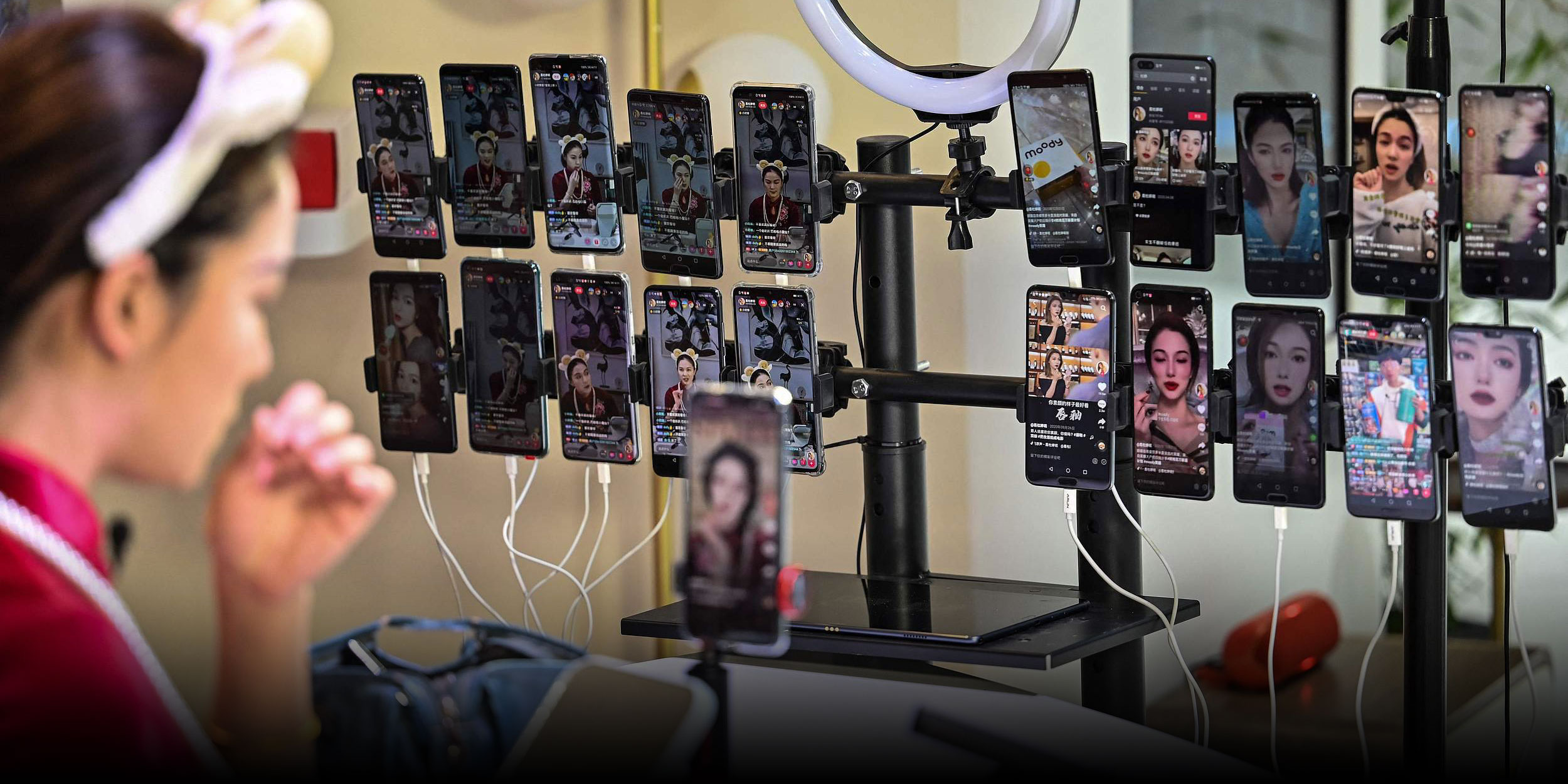
(Header image: A woman applies makeup in a livestream studio at a Huawei booth during the Mobile World Congress in Shanghai, Feb. 23, 2021. Hector RETAMAL/VCG)