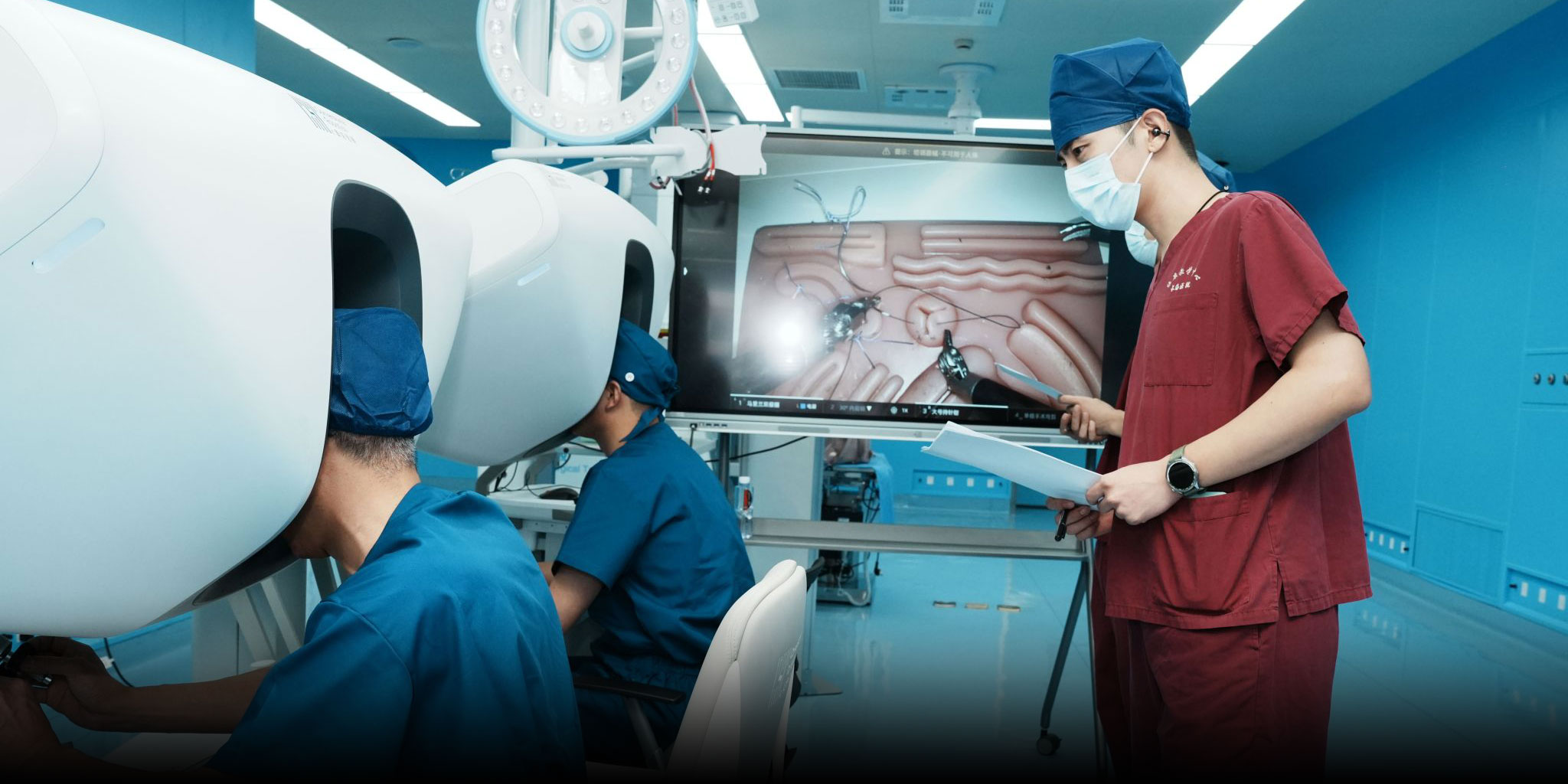
Shanghai Concludes Its First AI-Assisted Surgical Training Program
Shanghai’s first official training program for AI-assisted surgery has concluded, with its inaugural group of 18 doctors set to soon receive official certification from the city.
Launched in August, the program was directed by the Shanghai Municipal Health Commission and hosted by Shanghai Changhai Hospital, Shanghai-based news outlet The Paper reported Monday.
The program integrates theory, simulation, live animal operations using AI surgical tools, and clinical applications. Trainees learn how to both operate robotic systems and embed AI in clinical practice, such as patient management.
The hospital has mentored three cohorts to date. The second, which began in November, expanded the program from one specialty — urology — to four, adding obstetrics and gynecology, hepato-pancreato-biliary surgery, and colorectal surgery. The third cohort was welcomed this month.
Trainees can choose between two training pathways. The first is an assessment route for physicians with prior robotic surgery experience but no official certification. After passing a skills assessment including a professional Q&A and a live animal surgery evaluation overseen by the municipal health commission, they receive official certification — granting them permission to perform AI-assisted surgeries going forward.
The second is a systematic training route for physicians with no or insufficient experience to directly sit for the assessment. These candidates complete a six-month foundational program, receiving the same certification upon successful completion.
According to You Xiaohua, director of the Clinical Teaching Training Center at Shanghai Changhai Hospital, the certification has drawn interest from both young doctors and senior specialists, primarily in urology, obstetrics and gynecology, and gastrointestinal surgery — fields that frequently harness robotic surgery.
You told domestic media that the certification functions “like a work permit — it means the Shanghai health commission has recognized (a doctor’s) robotic surgery skills.”
The city is looking to expand its AI-assisted surgical training bases. Last December, the Shanghai Jiao Tong University-affiliated Renji Hospital was approved as the Shanghai AI-Assisted Therapeutic Technology Clinical Application Training Base.
Similar training programs have also been established at major hospitals across the country. In 2025, six Beijing hospitals were designated as AI-assisted surgical training bases, each with a different specialty focus. On March 16, a six-month AI-assisted training program for urology specialists also began at the Second Affiliated Hospital of Nanjing Medical University in the eastern Jiangsu province.
Editor: Marianne Gunnarsson.
(Header image: Medical staff learn to use new techniques during Shanghai’s first AI-assisted surgical training program at Changhai Hospital, 2025. From the Shanghai Changhai Hospital website)