Why Men Who Don’t Do Chores Will Have Sons Who Bully
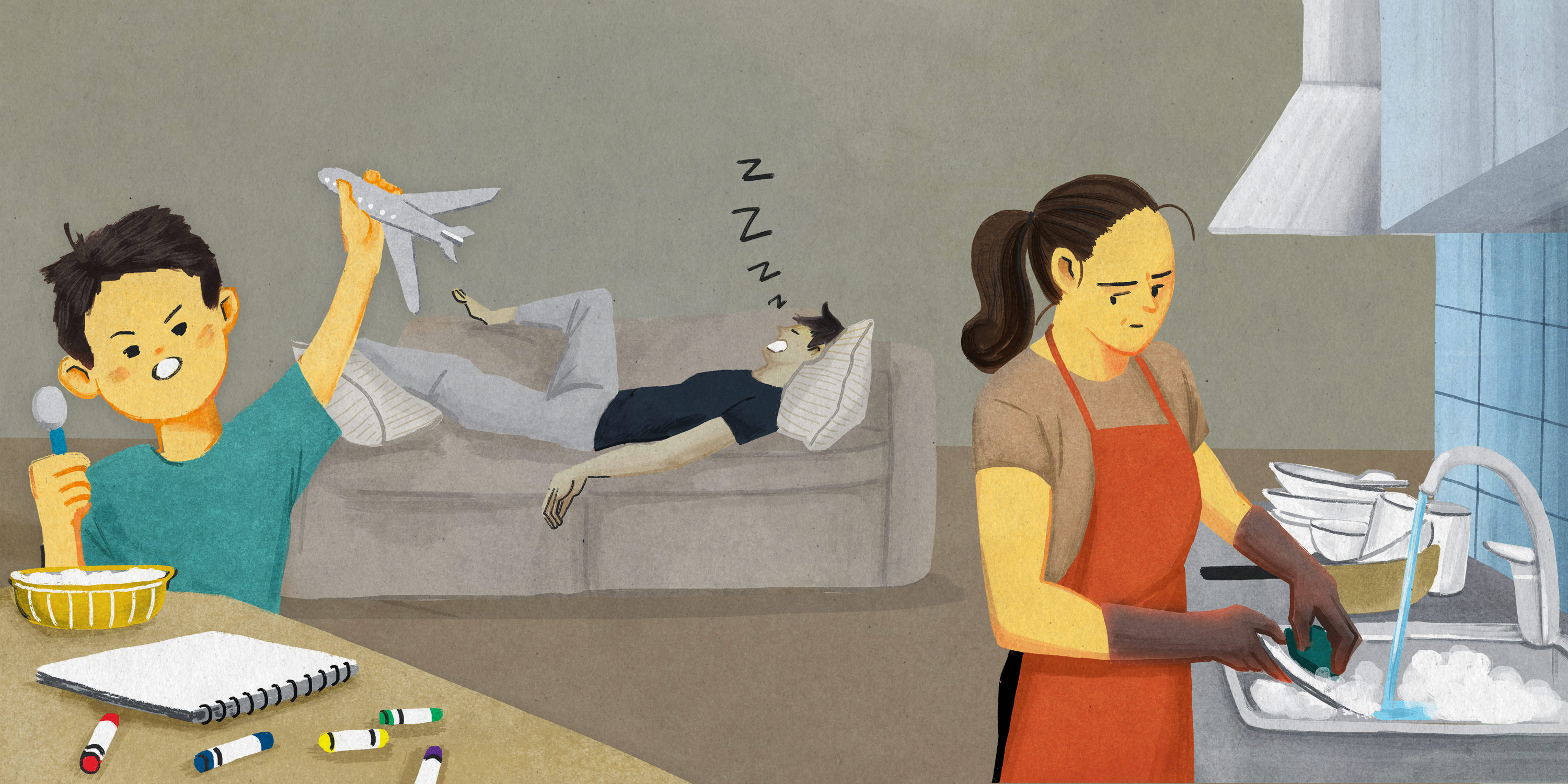
During a dinner gathering at a friend’s apartment in Shanghai last year, I watched their younger brother, a middle schooler, refuse to clear his dinner plate. “Cleaning is women’s work,” he said matter-of-factly. When his mother objected, he pointed to his father: “Dad never does it either.”
The comment stuck with me. This wasn’t just adolescent rudeness — the boy had learned something about gender and worth from his household. It made me wonder: What else might children be learning from who does the dishes? And how might those lessons play out at school? Do parents’ norms about how men and women should behave mean their children will look down on classmates who violate those norms?
That question led me and my colleagues at Shanghai Jiao Tong University to examine OECD survey data from more than 50,000 adolescents aged 10 to 16 across 15 countries. Included in these surveys were questions about their parents and about how they behave toward other children. We wanted to test a connection: Does the way families divide household labor relate to whether teenagers bully their peers?
Our data suggests it does. But the story turned out to be more complex than we had expected. We identified four distinct patterns of household labor division. About one-third of families followed an “egalitarian pattern” where parents shared cooking, cleaning, child care, and breadwinning fairly equally. Another 45% fit a “transitional pattern,” where parents increasingly shared child care and income-earning, but mothers still handled most cooking and cleaning. Some 17% followed a “gender-specialized pattern,” with mothers doing nearly all domestic work while fathers focused on earning income. And 5% showed a “disengaged pattern” where neither parent consistently handled key household responsibilities.
When we examined bullying behavior, adolescents from egalitarian households reported the lowest levels. The disengaged pattern showed the strongest association, while the transitional and gender-specialized patterns showed smaller but still significant differences.
The mechanism, however, differed by pattern. For adolescents in gender-specialized and transitional families, bullying behavior was rooted in rigid gender beliefs. Children who observed strictly divided household roles developed stronger convictions about what boys and girls should or shouldn’t do — and those who held rigid gender beliefs were more likely to bully peers who violated gender norms.
Consider how this works: A child watches mom handle all the cooking and cleaning while dad focuses on earning money. Over time, this becomes evidence that men and women are suited for different roles. At school, that child might target a boy who seems “too feminine” or a girl who acts “too aggressively.” The bullying enforces the gender order that the child has learned is natural.
For adolescents in disengaged households, the mechanism was different. Here, the pathway operated through a “fixed mindset” — the belief that people’s abilities cannot change. When household responsibilities were inconsistently managed, children were more likely to see human potential as rigid. Children with fixed mindsets showed higher rates of bullying, perhaps because they believed peers who were different couldn’t change and deserved punishment rather than support.
The prevalence of family patterns varied dramatically across participating sites. In Jinan, capital of China’s eastern Shandong province, 43% of families followed egalitarian arrangements, placing it in the middle range globally. Helsinki, the capital of Finland, showed the highest rate at 59%, while Gunma, a prefecture near Tokyo, had the lowest at just 17%. Sites in Latin American countries like Peru (41%), Colombia (41%), and Brazil (38%) were similar to China. European sites showed mixed patterns, with Spain at 45% and Bulgaria at 22%.
Despite these substantial cultural differences in how families organize household labor, the associations between family patterns and bullying perpetration remained remarkably consistent across all sites. This suggests the psychological processes linking family arrangements to adolescent behavior may operate similarly across diverse societies.
But the real surprise came with gender differences. While household patterns affected all adolescents, boys showed substantially stronger links between these psychological orientations and actual bullying behavior. A boy holding rigid gender beliefs was much more likely to translate those beliefs into aggressive action than a girl with identical beliefs. The same pattern appeared for those with fixed mindsets.
Traditional masculinity norms may provide boys with more permission to assert dominance through aggression. Boys face pressure to prove their masculinity during adolescence. If a boy grows up in a household with rigid gender divisions, bullying might become one way to demonstrate that he understands the “proper” social order. Girls may internalize similar beliefs but express them through relational aggression or self-limitation rather than overt bullying.
Our findings don’t mean parents’ chore division directly causes bullying — too many factors influence adolescent behavior. But what happens at home does shape the psychological frameworks children use to make sense of the world, frameworks that influence how they treat others.
Current anti-bullying programs focus almost exclusively on schools: teaching empathy, training students to intervene when they witness bullying, creating disciplinary policies for aggressive behavior, and fostering inclusive school cultures through anti-discrimination initiatives. These efforts matter. But our research suggests they may be incomplete. If family dynamics shape children’s fundamental beliefs about gender and fairness, school-based interventions alone might struggle.
This suggests that bullying prevention programs might benefit from incorporating components that address both household dynamics and the gender stereotypes children develop from observing family labor patterns. Rather than focusing solely on individual student behavior, such programs could help families reflect on what their everyday arrangements communicate to children about fairness and gender roles.
The timing matters. China, like many countries, officially promotes gender equality — Chinese women have among the world’s highest labor force participation rates. Yet household practices often lag behind: time-use studies consistently show women performing two to three times more unpaid domestic work than men. Understanding how these everyday arrangements shape children’s beliefs about fairness can help both parents and educators create environments that foster respect rather than reinforce hierarchies.
The protests of the teenage boy who refused to clear his plate were successful: his mom ended up doing it for him. He once again learned that certain work diminishes certain people, that gender determines what you should do, and that this order should be defended. These aren’t lessons most parents intend to teach, but children learn from observation.
The question is whether we can make these hidden lessons visible. Every parent wants children who treat others with respect. But achieving that goal might require examining the everyday arrangements we take for granted and asking what we want children to learn when they watch us divide the dishes.
This article is based on research recently published in the journal Sex Roles.
Portrait artist: Wang Zhenhao.
(Header image: Visuals from nPine/VCG, reedited by Sixth Tone)