The Year of the Horse Has Arrived. But When Did Horses Arrive in China?
This is the first article in a three-part series on the history of horses in China, which we’re running to usher in the Year of the Horse.
With another Spring Festival behind us, the Year of the Horse has begun.
In China, the horse is one of the most beloved zodiac animals. Its iconic galloping posture and spirited demeanor can give people a sense that, in the Year of the Horse, they will achieve career breakthroughs and accumulate wealth. It may even give a slight boost to China’s declining birth rate. Twelve years ago, during the previous Year of the Horse, regions throughout China saw double-digit increases in births as parents sought to give their child an auspicious start in life.
But when and how did the relationship between the Chinese people and horses begin?
As far back as the Paleolithic age, several tens of thousands of years ago, humans were already hunting wild horses in what is now China, a practice that continued into the Neolithic age. For example, a stone carving dating back some 4,000 years that was unearthed at the Shimao Ruins, in northwestern China’s Shaanxi province, depicts a person with a bow and arrow shooting a horse — presumed to be the now-extinct Equus ovodovi species. However, these sporadic hunting activities did not lead to the domestication of horses, which began elsewhere.
In order to trace the origin of domesticated horses in China, it is first necessary to understand the global horse domestication process. For many years, the Botai site in Kazakhstan, which holds the remains of a society from the 4th millennium BC, was regarded as the earliest place of horse domestication. However, the latest ancient DNA studies suggest that domestication there did not continue, and that these horses may have reverted to the wild. Newer research shows the ancestors of modern domesticated horses first appeared more than 5,000 years ago in the Western Eurasian Steppe (particularly the Lower Volga-Don region), the grasslands between the Black and Caspian seas, and spread across Eurasia around 3,500 and 3,000 years ago, replacing local horse populations.
Domesticated horses also emerged in China as part of this trend. The clearest evidence comes from the late Shang dynasty (1300–1046 BC) in the Yellow River Basin. Remains of domesticated horses have been discovered at more than a dozen archaeological sites from this period, including Yinxu in the central Henan province, Qiaobei in the northern Shanxi province, Qianzhangda in the eastern Shandong province, and Shimao, Laoniupo, and Zhaigou in Shaanxi province. These horses — almost all of which were adult males — were buried intact for both sacrificial purposes and to accompany the deceased. Domesticated horses in southern China appeared somewhat later.
Unlike other domesticated animals, horses were mainly used not for consumption but for tasks such as pulling chariots and carrying riders, giving them important military, transportation, and ceremonial functions. During the Western Zhou dynasty (1046–771 BC), a state’s strength was often measured by the number of chariots it possessed, such as a “thousand-chariot state” or a “ten-thousand-chariot state.” Inscriptions on bronzes also show that Zhou kings would bestow horses upon officials.
At the Yinxu site, horses were unearthed alongside chariots and arranged in driving positions. However, none of these horses showed signs of having engaged in high-intensity labor, suggesting that these carriages were mainly used by the nobility for traveling and hunting, and were of a ritual nature. Evidence uncovered at village sites shows a different picture: unlike the practices of urban elites, domesticated horses at the Qingqiu site in Shandong province were mostly used to pull heavy loads and transport goods.
Compared to the clear evidence for pulling carriages, evidence of horseback riding is more ambiguous and largely indirect. Bronze horses unearthed from Yanjiagou Village in Ganquan, Shaanxi province, dating to the late Shang dynasty, seem to have “padding” on their backs, possibly indicating the horse was used for riding. However, some scientists disagree with this interpretation. At the Yinxu and Laoniupo sites, tombs containing a person, horse, and dog were found, which contained whips and arrowheads, but no chariots. Some scholars believe that this might be a scene related to riding, rather than pulling a cart.
However, even if horseback riding was practiced during the late Shang dynasty, it may not have been widespread, with large-scale riding and the appearance of cavalry probably occurring later. The earliest archaeological evidence of animals being ridden in China was discovered in the Shirenzigou and Xigou sites in the Xinjiang Uyghur Autonomous Region, dating from the Warring States period (475–221 BC) to the early Western Han dynasty (206 BC–AD 25), where horse vertebrae were found showing severe lesions consistent with horseback riding. Additionally, figurines depicting horse and rider discovered in Qin tombs from the Warring States period further confirm this change in riding method.
Apart from their utilitarian roles, horses during the Shang and Zhou dynasties were also deliberately slaughtered by the nobility for use in rituals and funerals. Most horses found at sites from this period were buried intact. Reconstructions of their height based on skeletal remains suggest that there were clear differences in the horses available to different strata of society. Those horses buried alongside high-ranking nobles and used in related funerals and rituals were not only numerous — with hundreds sometimes being sacrificed at once — but they also tended to be taller and stronger. Meanwhile, lower-ranking nobles had much fewer horses, and they were of significantly inferior quality. Clearly, as a valuable resource, horses formed an important part of the political order of the Shang and Zhou dynasties.
It should be noted, however, that when domesticated horses were first introduced to the Central Plains — the middle and lower reaches of the Yellow River, which formed the core of both the Shang and Zhou dynasties — the region may not have been immediately capable of becoming self-sufficient in horse breeding. From an environmental perspective, horses are adapted to cold, dry climates, while the Central Plains are relatively warm and humid, and the soil there lacks selenium, a trace mineral crucial to muscle development in horses. In terms of production, a conflict existed in the Central Plains between crop cultivation and horse breeding since the latter requires extensive pastures. As such, the region does not seem particularly well-suited for raising horses.
Archaeological research has also revealed that almost all the horses unearthed at the Yinxu site from the late Shang dynasty were adult individuals, which suggests they were not bred locally. Strontium isotope studies, which analyze strontium in biological tissues to trace geographic origins and migration, have also confirmed that many originated elsewhere. However, it has not yet been possible to determine whether this “elsewhere” refers to outposts under Shang control or to more distant regions. Some scholars have posited that during the Shang-Zhou period, the Central Plains region largely relied on horse supplies from northern grasslands and was not self-sufficient. Others have suggested that during the late Shang period, horses were obtained from the Loess Plateau, north of the Central Plains, through exchanges of high-quality bronze artifacts.
Such a reliance on external suppliers for a resource of this importance was clearly not feasible in the long run. Entering the Western Zhou dynasty, the situation began to change. Historical records show that the Western Zhou established a comprehensive system for the management of horses, known as mazheng (“horse administration”), overseen by specialized officials. The management activities varied across the seasons depending on the breeding and growth cycles of different horses. One particularly important aspect of the horse administration was the practice of foals being separated from their mothers, selected and equipped, registered in the monarch’s registry, and then trained to pull chariots. These service horses did not graze on grassland and were instead fed grain stalks and leaves, as described in the “Classic of Poetry,” one of China’s oldest books: “The horses for the chariots are in the stable, fed with forage, grain stalks, and leaves.”
Archaeological research has corroborated this management strategy. Isotope testing of horse bones and teeth has shown that, during the Western Zhou dynasty, horses in the Central Plains region consumed a diet high in millet by-products from a young age, reflecting a feeding method distinct from that in pastoral grassland regions. Agricultural populations had already been using the by-products of millet cultivation — such as straw and husks — to feed livestock since the Neolithic period, so this method was naturally applied to other newly introduced animals to make up for the lack of pastureland in farming societies. Of course, the Central Plains dynasties continued to obtain horses from pastoral groups through warfare or exchange, but that was likely not the predominant method.
In this way, the Central Plains dynasties gradually established a standardized system of horse breeding and training that was distinct from nomadic regions, successfully raising large numbers of horses and cleverly resolving the conflicting demands between pastoral and agricultural systems. These horses were then used in a wide variety of occasions — including rituals, sacrifices, funerary practices, and warfare — becoming an indispensable part of the history of Chinese civilization.
Translator: David Ball; portrait artist: Wang Zhenhao.
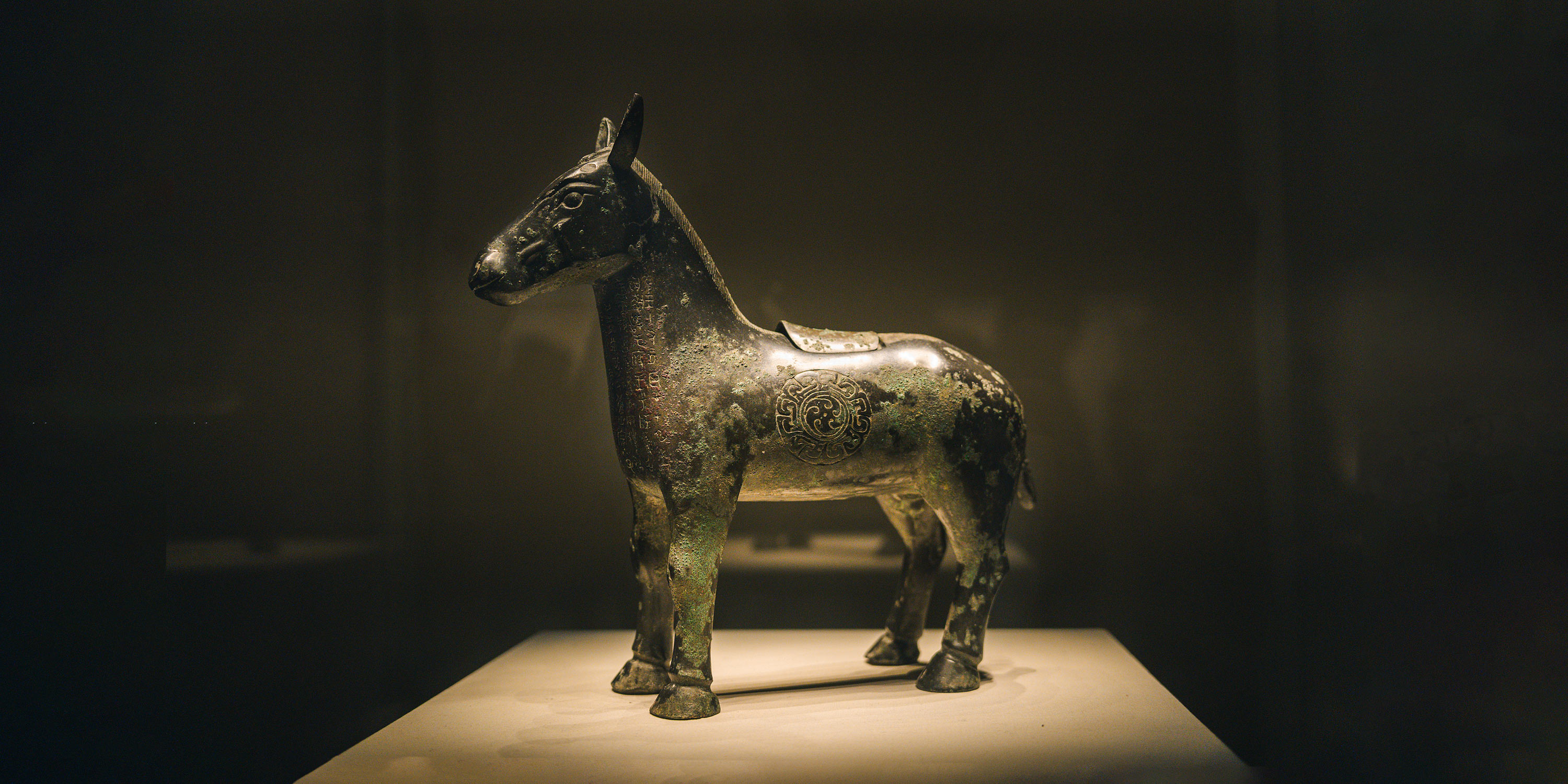
(Header image: “Liju Zun,” the bronze sacrificial wine vessel of a standing horse, dating back to the Western Zhou Dynasty (1046–771 BC), on display at the National Museum of China, Beijing, 2025. 500px/VCG)